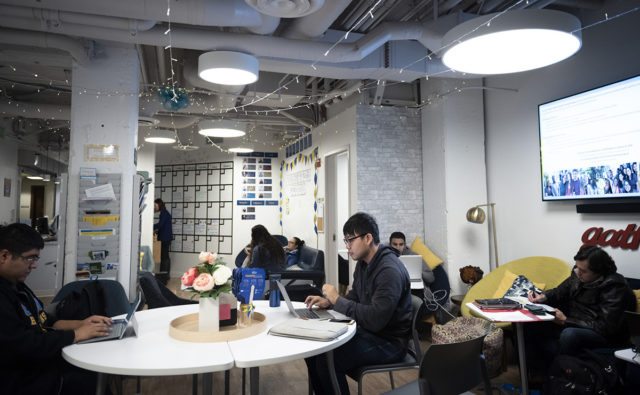
The UC implemented a new general education sequence for prospective community college transfer students this fall.
The California General Education Transfer Curriculum seeks to streamline the four-year university transfer process for students in the California Community Colleges system, according to the Intersegmental Committee of the Academic Senates’ website. While the previous transfer general education sequence – known as IGETC – included different requirements for the California State University system and the UC system, Cal-GETC’s requirements are identical for both of the state’s public university systems.
David Volz, a professor in the environmental sciences department at UC Riverside, said he has worked on the transition to Cal-GETC as chair of the Board of Admissions and Relations with Schools – which oversees undergraduate admissions-related topics for the UC Academic Senate. Volz added that Cal-GETC provides more flexibility to community college students who are considering transferring to both CSUs and UCs because they do not have to worry about taking certain general education courses that are only necessary for one of the systems.
“A lot of students aren’t going to know yet whether they want to go to CSU or UC,” Volz said. “I was a transfer student a long time ago. … There’s transportation issues, there’s financial issues to consider. There’s different campuses, whether it’s on the CSU or the UC side, that may have specific programs that are better aligned with your career goals.”
Cal-GETC is composed of 11 general education courses spanning subjects like English, mathematics, biological sciences, humanities and more. Transfer students are not required to complete a general education sequence like IGETC or Cal-GETC, but many do because it typically eliminates their general education requirements at the UC or CSU they attend later.
One of the main changes from IGETC to Cal-GETC is an oral communication course requirement, which previously only existed for the CSU system, according to ICAS. The arts and humanities course requirement was also changed, with students now needing two courses instead of three.
The vast majority of California Community College students who plan to transfer to a four-year university never achieve their goal, according to a state audit. The audit said that of those who began community college between 2017 and 2019 with the intent to transfer, only one in five followed through within four years. One of the barriers to transfer can be varying course requirements, according to the audit.
Transfer students made up about 37% of the entering UCLA 2024-25 class, the highest of any campus across the UC.
“The main driver there was the desire to make things easier for students to transfer to the Cal State and UC,” said Catherine Sugar, a professor-in-residence of biostatistics, who serves on ICAS. “We’re unusual in the number of transfer students that we have. We certainly find that’s very important.”
Kevin Fang, a third-year business economics student who transferred from Pasadena City College, said he spoke to his community college counselors often to ensure he could transfer on time. He completed IGETC with a focus on transferring to a UC but also took a communication course that he ended up not needing, he said.
“I was constantly meeting with the counselors, and we basically just planned my two years out at the university right from the get-go, like which classes I wanted to take with the goals I had in mind, what major I wanted to transfer to which colleges,” Fang said. “It was really confusing. I tried to figure it out myself at first, but the counselors really helped.”
Christopher Sullivan, an electrical engineering and computer science student at Los Angeles Pierce College, said he plans to transfer to a UC or private university. But limited counseling support, few in-person course options and confusion about which classes to take have tacked on an additional year and a half to his time in community college, he added.
Sullivan said navigating transfer requirements and general education sequences has been “an absolute nightmare.”
“There are the older people, like me. I’m 45,” Sullivan said. “I don’t have as much time. I just can’t take forever.”
Hyerim Yoon, the Undergraduate Students Association Council’s transfer student representative, said she is working to bridge the gap between current and prospective transfer students. Yoon said her office co-hosted a virtual panel with UCLA and UC Berkeley transfer students so that they could share their experiences with an audience of about 100 prospective community college transfer students in October.
Yoon also serves as a peer advisor with UCLA’s Center for Community College Partnerships, supporting prospective transfer students with their applications and essays. She added that she is aware of the switch to Cal-GETC but hasn’t noticed a major difference in the types of support that prospective transfer students need.
“We’re just doing a lot of work to uplift, especially our lower-funded community colleges and our students that are transferring from marginalized backgrounds,” Yoon said.

Comments are closed.