This post was updated Nov. 16 at 9:59 p.m.
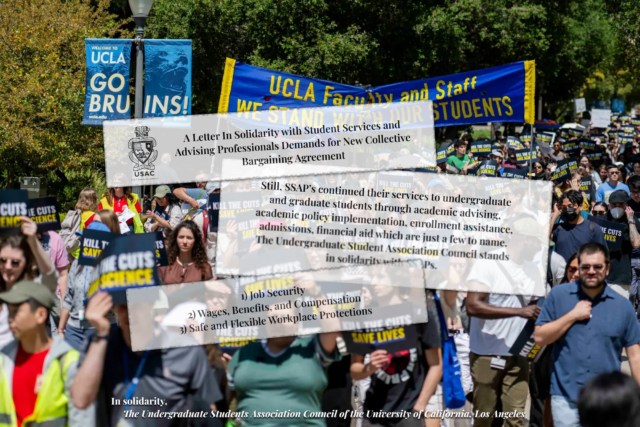
The Undergraduate Students Association Council expressed support for the student services and advising professionals unit of United Auto Workers Local 4811 in its contract negotiations with the UC.
UAW Local 4811 represents 48,000 employees across the UC, including 4,875 student services and advising professionals. SSAPs provide academic, financial and career guidance to students, according to the union’s website.
Employees included in the negotiations include academic achievement counselors, financial aid officers and student life development specialists, according to the UAW Local 4811 website. The union is bargaining for improved compensation, job security, workplace flexibility and legal and financial support for international workers, according to the website.
[Related: UAW Local 4811 members continue negotiations amid teaching hours being cut]
USAC unanimously approved a letter in support of SSAPs at its Sept. 2 meeting expressing solidarity with the union’s unit in its bargaining. UAW Local 4811’s SSAP team sent a different letter to Adriana Galván – the dean of undergraduate education – outlining the unit’s demands, which include job security, fair wages and improved workplace conditions, earlier that same day.
USAC alleged in the letter that the UCLA Division of Undergraduate Education’s treatment of SSAPs does not align with its stated mission and called on it to advocate on behalf of its workers during the union’s negotiations.
“UCLA Division of Undergraduate Education prides itself on enrichment in higher education and supporting undergraduate students in graduating in a timely manner while being a ‘campus-wide advocate’ for undergraduate education,” the letter said. “If this is the mission and principle UCLA Division of Undergraduate Education intends to carry out, SSAPs could count on you to stand alongside them on the frontlines of advocacy pertaining to the UC budget.”
The council requested in the letter that Galván forward it to UC President James Milliken and “share with him your understanding of the value of staff.”
UCLA Media Relations did not respond in time to a request for comment on the Division of Undergraduate Education’s stance on SSAP’s demands or on whether or not Galván delivered USAC’s letter to Milliken.
UAW Local 4811 has demonstrated several times since President Donald Trump’s second term, opposing federal research funding cuts and threats to international workers. The Trump administration froze over $584 million of UCLA’s federal research funding in July, alleging “antisemitism and bias,” and revoked the visas of at least 19 international students and recent alumni in April.
[Related: Trump administration revokes visas of multiple UCLA, UC students]
The United States Department of Justice announced in late April that it would reinstate these students’ visas that month while it developed a consistent framework for status termination.
[Related: UAW Local 4811 rallies to demand UC protect international workers]
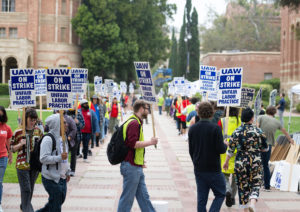
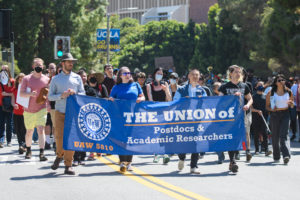
The union plans to demonstrate Nov. 20 in support of its ongoing negotiations. Nov. 20 is also the last day of the UC Board of Regents’ November meeting, which is being held at the Meyer and Renee Luskin Conference Center.
April Bolt, an academic advisor for UCLA’s Academic Advancement Program – which serves students from historically underrepresented backgrounds – said that despite the ongoing negotiations, many student service workers like herself worry they will not have their contracts renewed due to budget cuts.
AAP paused some of its programs and laid off staff in July due to budget cuts to the Division of Undergraduate Education.
[Related: Academic Advancement Program to pause some programs, reduce staff amid budget cuts]
Bolt said that counselors, alongside their academic-focused responsibilities, often offer emotional support to students, adding that better working conditions allow them to perform their jobs more effectively.
“There’s the emotional component that goes into it, in creating the rapport and the safe space for students, and again, that impacts how we provide our advising and support,” Bolt said. “Because our work requires such a considerable amount of investment for us, it’s important that our working conditions in our environment are sustainable and provide that level of support for us to do our work.”
USAC General Representative Jayha Buhs Jackson said she supports the letter and SSAPs’ efforts in general because she believes their work is integral to helping marginalized groups at UCLA. She added that she believes students from underrepresented backgrounds would be the most impacted if the contracts of academic support staff are not renewed.
“If something like the Academic Advancement Program were to be consolidated and they were to continue laying off the AAP workers as well, … this university would be unrecognizable,” said Buhs Jackson, who is also a member of AAP.
Buhs Jackson, a second-year African American studies and public affairs student, added that she believes SSAPs’ work is often the difference between whether or not a student graduates.
The most recent bargaining session occurred Nov. 8, in which SSAPs reached an agreement with the UC to ensure healthcare premium reductions, according to the union’s bargaining update tracker.
Tommy Contreras, the internal vice president of USAC, said UCLA must prioritize student services.
Contreras, a fourth-year political science and public affairs student, added that it is important for the student body to be educated on the issues impacting union members to advocate for them – which, in turn, benefits students themselves.
“If UCLA truly prides itself on being a campuswide advocate for Undergraduate Education, then we also must be a campuswide advocate for the people who make that education possible,” Contreras said.


Comments are closed.