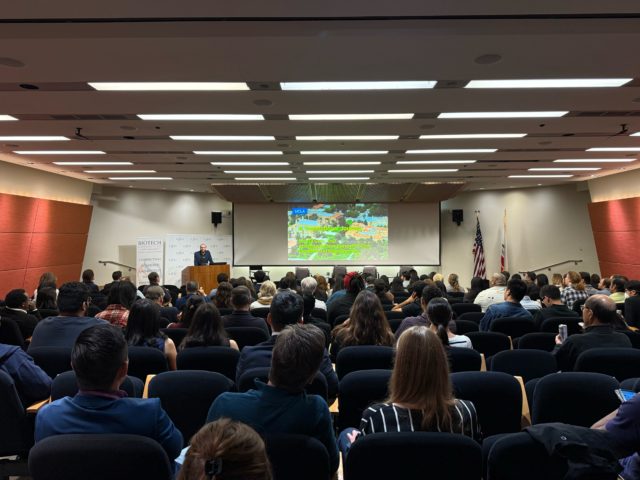
Students, industry leaders and government officials gathered at UCLA’s California NanoSystems Institute to learn about the future of biotechnology on Nov. 8.
Biotech Connection Los Angeles – a volunteer-based organization run by students and industry professionals – themed its 11th annual biotechnology summit around the year 2030, bringing together academics, industry leaders and government officials to discuss the next five years of the biotechnology industry, according to its press release. Past themes have included environmental responsibility in biotechnology and Los Angeles’ impacts on the global biotechnology industry.
Lindsay Lathrop, the events lead at BCLA and a pharmacology doctoral student at UCLA, said the event aimed to inform students about the role they can play in the biotechnology field.
“We try to (prepare) the panelists to give advice to students rather than just about the industry as a whole,” Lathrop said. “It’s supposed to be very tangible.”
She added that the Biotech 2030 theme of the event arose from pressing issues in the biotechnology field such as the rise of artificial intelligence, shifting policy and budgetary constraints. Recent federal and state funding cuts have impacted operations at research labs and resulted in UCLA requesting $130 million in a zero-interest loan from the state government, according to the LA Times.
“You need to prepare and learn how this is going to impact you immediately,“ Lathrop said. “Not 10 years from now, not even five years from now.”
Natcha Suriyavirun, an outreach associate at BCLA and a biomedical sciences doctoral student at Cedars-Sinai Medical Center, said BCLA gauged topics participants wanted to learn about prior to the event.
Suriyavirun added that the summit also seeks to inform students of existing biotechnology resources – including funding organizations and open lab spaces – available in LA.
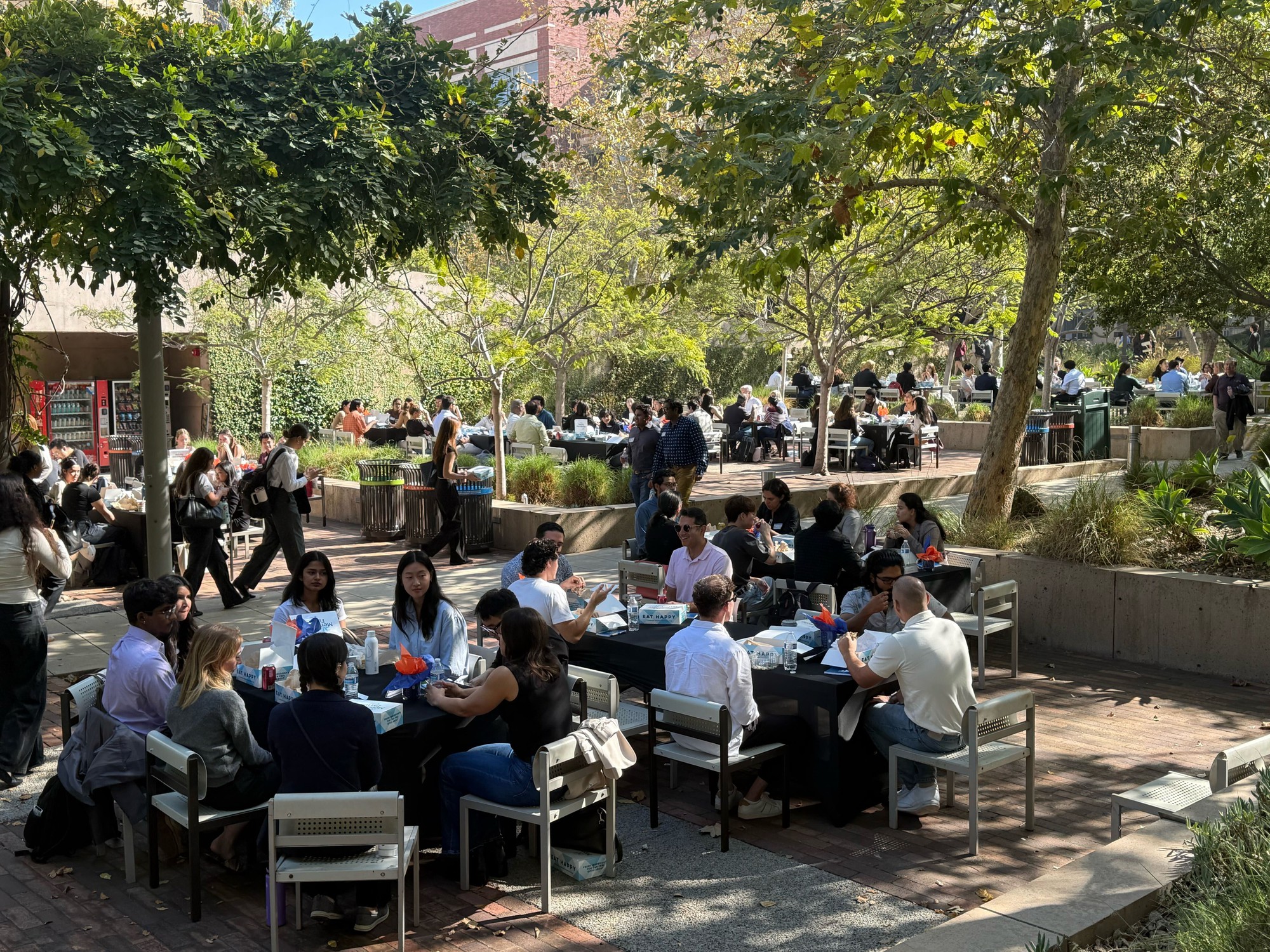
“When people think of biotech, they probably think of San Francisco or even – closest to here – in San Diego,” Suriyavirun said. “We’re kind of segmented in different neighborhoods.”
The summit began with a keynote address given by Dino Di Carlo, the chair of the bioengineering department, who spoke about his experience researching early sepsis detection and cell-to-cell interactions. In the speech, Di Carlo said that “financial conflicts of interest” in research are needed to bring new technologies to the market.
“If we don’t have this conflict of interest, this (sepsis) test probably would not have gotten to patients,” Di Carlo said in his speech, “We needed to have everyone who was developing it to help commercialize it, and have those financial conflicts of interest.”
Throughout the day, panels focused on various segments of the biotechnology industry such as the LA ecosystem, research and funding.
Daniel Benjamin, a professor at the UCLA Anderson School of Management and the Human Genetics Department at the David Geffen School of Medicine, moderated a panel on breakthroughs in precision medicine, where panelists discussed AI-based advancements and ethics in personalized healthcare – with an emphasis on biases in research groups and AI data.
“(AI is) leading to new diagnostics, much better data analysis (and) improvements in the basic science of understanding. For example, protein folding and interactions,” Benjamin said.
Stephanie Hsieh, the CEO of BioscienceLA, said initiatives such as BioscienceLA are necessary to build up LA’s biotechnology ecosystem and raise awareness about existing resources in the region.
Panelists Dan Gober, the executive director of Biocom LA, Leila Lee, the assistant director at the LA County Department of Economic Opportunity, Howard Xu, the director of LA Biospace, and Hsieh highlighted a recent $24 million grant from the California Jobs First Initiative that went toward LA’s life science sector. The California Jobs First Initiative distributes Regional Investment Initiative grants to projects that address economic disparities and support clean-energy initiatives, according to the California Labor and Workforce Development Agency’s website.
“The $24 million we got from Sacramento recently as a collective shows that we’re finally working together,” Hsieh said. “Our talent base here, with 10 million people, is what attracts a lot of the big employers to come here.”
Khang Doan, a third-year bioengineering student, said he attended the event to meet more undergraduate students who hope to pursue a career in bioengineering and to hear advice from established startup founders.
Alexander Varady, a member of the ASPIRE Biotech Training Program at Pierce College, said he learned about the importance of generating data for AI models for the future. Data is needed to train models, and high-quality data reduces bias toward certain groups while increasing model accuracy, he added.
“I’m going to develop some coding skills and AI skills,” Varady said.
Lathrop also said she was excited to meet the speakers. BCLA holds monthly events in LA, and has already begun scheduling next year’s events, she added – including startup spotlights and mixers, according to the BCLA website.
“It was a whirlwind on my end,” Lathrop said. “It’s very exciting seeing it all come together.”


Comments are closed.