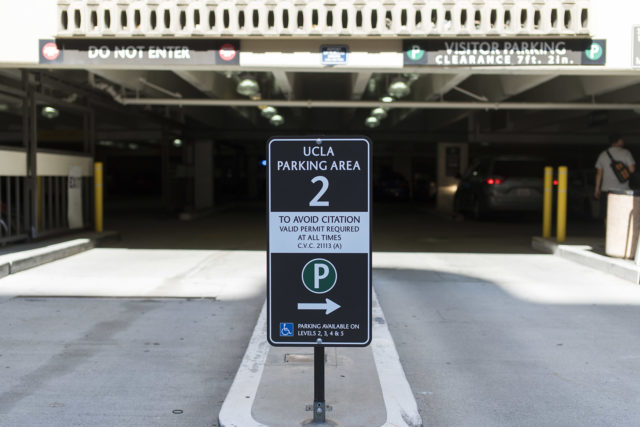
UCLA student daily parking permits will be “significantly limited” – and on some days may not be offered at all – starting Jan. 1, 2026.
Student daily parking permits, which currently cost $7.28 per day, have been offered since April 2022 as a use for excess post-pandemic parking capacity, a UCLA Transportation spokesperson said in an emailed statement. Beginning in 2026, the availability of these short-term permits will no longer be guaranteed and will instead be determined on a day-to-day basis, the spokesperson added.
Parking spots currently available for student daily permits will be reallocated for long-term permits, such as quarterly permits, the spokesperson said in the statement. Quarterly permits cost $324 for commuter student parking.
There are about 22,000 parking spaces serving almost 90,000 people on campus daily, the spokesperson said, adding that parking structures 2, 3, 4, 7 and 32 could be impacted by the change.
“Campus parking demand has returned to pre-pandemic levels, with hybrid work and increased on-campus activity filling weekday spaces and placing significant pressure on our parking infrastructure,” the spokesperson said in the statement.
Sarai Ordonez, a fourth-year linguistics and psychology student, said she uses student daily parking permits to save money on her commute from the South Bay of Los Angeles County. She added that she typically only comes to campus twice a week, making short-term permits more cost-effective than a quarterly permit.
“I still do my best to go to club meetings, hang out with my friends on the Hill, just doing small little things, and taking away the pass is like you want us to be more excluded,” Ordonez said. “You make it more of a barrier to find parking or avoid – it’s literally $80 a parking ticket.”
Michael Griffin, the external assistant commissioner of the Undergraduate Students Association Council’s Facilities Commission, said transportation affordability is a major issue for students. He added that he is disappointed with the permit availability change and that the Facilities Commission is in contact with UCLA Transportation about it.
“These daily parking permits are a heavily utilized resource by commuter students, especially because not only is the quarterly parking permit extremely competitive and difficult to get because there’s limited parking permits, but also it’s more affordable for a lot of students who only commute to campus a couple days a week,” said Griffin, a fourth-year biology student.
Griffin was a campaign director for the Bruin U-Pass renewal referendum that passed this past spring. The Bruin U-Pass provides UCLA students with TAP cards for unlimited public transit across LA County at a quarterly fee of $6.80.
[Related: Bruins renew Bruin U-Pass, vote in new council in 2025 USAC election]
While public transit is an important option for students, it isn’t always feasible for commuters who travel long distances, Griffin added.
The USAC Facilities Commission works with Sofia Gevorgian, the commuter student liaison, to amplify these students’ voices, she said. Gevorgian, a fourth-year political science and Middle Eastern studies student, said she finds UCLA Transportation’s move to limit student daily parking permits to be frustrating.
“By reducing the number of available permits, they are directly, basically, infringing on students’ ability to reduce costs that are necessary for their education,” she said.
Alan Ruiz, a second-year statistics and data science student, said he commutes about an hour each way from the San Fernando Valley to UCLA. This quarter, Ruiz has primarily commuted by bus, but he plans to start driving to campus in the future, he added.
Ruiz said he is concerned about buying a student quarterly parking permit because it would be logistically difficult to get his money’s worth.
“I would benefit from the day-to-day parking passes because I wouldn’t have to drive to school every single day,” Ruiz said. “So to at least have that option available would really help to put less stress on my family with our schedules and also make it more accessible for me to get to school on a daily basis with the different circumstances and daily schedules that I have.”

Comments are closed.