This post was updated Nov. 21 at 4:35 p.m.
Opera UCLA’s latest production plays to haunt the narrative.
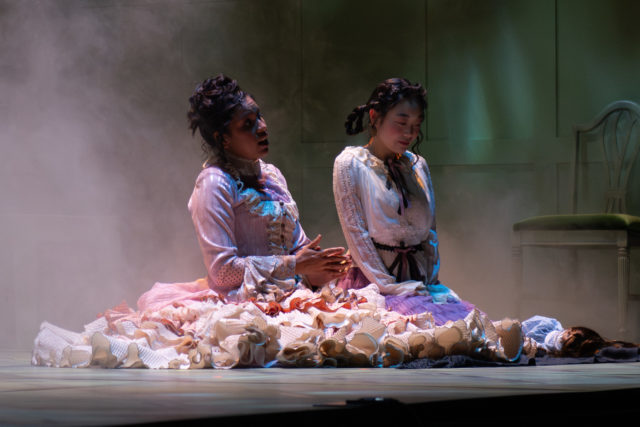
Over 70 years since its Venice premiere, Benjamin Britten’s chamber opera “The Turn of the Screw” will take new life in UCLA’s Freud Playhouse for three performances Nov. 20, 21 and 23. Based on Henry James’ 1898 novella of the same name, the story follows a governess sent to a remote estate to care for two children whom she gradually fears are possessed by ghosts. Doctoral student Leela Subramaniam, who plays the governess, said the classic opera is particularly pertinent today because it tells a story of anxiety and doubt that modern audiences can relate to.
“We’re living in a really weird time – of a lot of uncertainty and a lot of unrest and a lot of disjuncture and anxiety, like deep anxiety,” Subramaniam said. “This piece is about that anxiety and how you sit with it, and how you could also let it go – and it can die, and it can transform.”
Music director Rakefet Hak, a senior continuing lecturer at the UCLA Herb Alpert School of Music, said she worked closely with director James Darrah to develop the opera program’s schedule and found “The Turn of the Screw” to be the ideal fall show. She said they selected the piece not only because it required a smaller orchestra and cast, but also because she had hoped to work on it for many years. She has always been drawn to the eerie storytelling in Britten’s score, she said, as the elements of horror and obsession are deeply embedded in a way she hasn’t seen in other works.
[Related: UCLA TFT’s ‘Rodrigo’ transcends time with Baroque artistry, evocative modern theme]
To emphasize the depth of Britten’s composition throughout the performance, Hak said her musical leadership involves educating the singers on the opera’s complete history, looking beyond simply the notes. Rather than teaching the performers to reinvent the music, she added that she prioritizes their understanding of it because they cannot work with additional layers, such as props or costumes, before mastering that knowledge.
While the production’s orchestra is fully composed of professionals – many of whom are alumni – the cast is all students, Hak said. She added that her ultimate goal for their educational experience is for them to find success and become empowered, independent musicians through the show.
“We are giving them tools so that they don’t have this dependency to always be told what to do,” Hak said. “It’s part of growing up as a human being, and it’s part of growing up as a musician and an artist – because you then form your own identity.”

Reflecting on her own growth within her role, Subramaniam said working with the opera’s score has presented challenges for her to overcome, as it is very precise and requires almost every notation to be addressed by a performer. Because the libretto leaves much of the story ambiguous to build tension, she learned how to approach her role of the governess with curiosity instead of fixed answers, she added.
As a collaboration between the School of Music and the UCLA School of Theater, Film and Television, “The Turn of the Screw” fosters student development by allowing professionals, opera students and Master of Fine Arts designers to work closely together, said alumnus and assistant director Yekaterina Lynch. As costume designer, graduate student Jimena Soto Mejía said she is in constant conversation with Darrah and members of the visual team, including lighting designers, in order to collectively innovate an opera that has been staged for decades.
One way in which this production will be modernized while nodding to its history is through the creation of an AI-assisted sound experience, Lynch said. The voice of Miles – one of the children under the governess’ care – will be programmed to occasionally sound as though it is emerging through 1950s recording equipment, she said. Paired with the small scale of the chamber orchestra, Lynch added, the opera has an intimacy comparable to listening to a radio show.
[Related: Movie-concert ‘Right in the Eye’ harmonizes music, Georges Méliès’ films]
The incorporation of AI helps showcase the broader footprint of UCLA’s vocal program and Darrah’s vision as director, Lynch said. While a part of opera studies involves learning to project one’s voice, she said, the art form is also about appreciating the unique colors that each singer possesses, which the AI model will support.
“James’ vision … is to make sure that we showcase the individual timbres and beauty of every single voice in the opera department,” Lynch said. “There’s always this (question of) how much we can tell from a character just by their voice, and how we can use AI and other technology to … see what options are available.”

As the opera’s premiere draws closer, Hak said she hopes audiences will feel as drawn to the piece as the cast and crew have felt throughout the rehearsal process. The team has worked hard to deliver a clear and coherent story, and she wants to do Britten’s creation justice, she added. Because of the extensive details in the production, Hak said she believes it will offer a layered experience for any viewer, whether they are a musicologist or a writer.
[Related: Gallery: Opera UCLA’s ‘The Turn of the Screw’ explores themes of puppetry, control]
Considering the power of opera as an art form, Lynch said “The Turn of the Screw” is worth audience attention because it brings together artists of all mediums, from written word to sculpture. Subramaniam added that it is a great show for first-time opera-goers because it is shorter in length and only involves a few characters. Although opera is an older mode of expression, Lynch said she urges people who believe they wouldn’t enjoy it to take a chance on what it has to offer.
“If you love art of any type – absolutely any type of art that calls to you – you love opera,” Lynch said. “It deals with really big emotions that are very present in society, and it also allows a lot of people to be in the room to make those decisions about how we talk about it. … There’s something waiting in opera for you yet.”

Comments are closed.