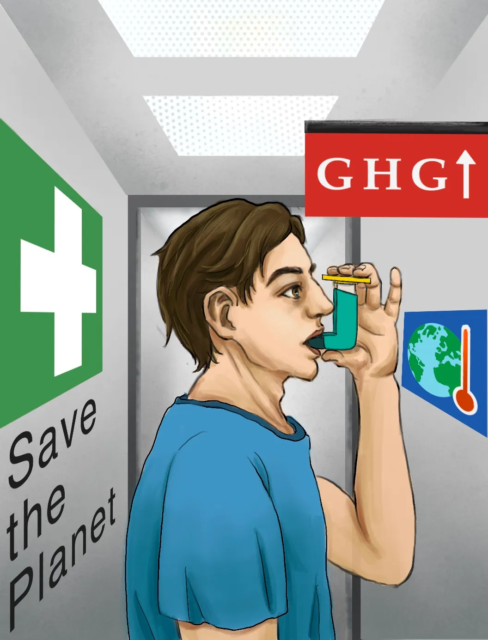
Researchers from UCLA and other health institutions found that some inhalers produce significant greenhouse gas emissions, highlighting the need for health care providers to consider their carbon footprint when making patient care decisions.
Inhalers are handheld devices that allow people with asthma or chronic obstructive pulmonary disease to breathe medicine directly into their lungs, according to the Cleveland Clinic. Inhalers generated roughly 25 million metric tons of carbon emissions between 2014 and 2024, with metered-dose inhalers – which are pressurized – accounting for 98% of that total, according to the UCLA study.
Dr. William Feldman, a pulmonologist and health policy researcher at the UCLA David Geffen School of Medicine, said the study provides what he believes is the most precise and comprehensive estimate to date of inhaler-related greenhouse gas emissions. Feldman, who is the first author of the study, added that the researchers analyzed national prescription data from 2014 to 2024 and compared emissions across specific drug formulations and inhaler strengths.
“The significance of this study is that inhalers are responsible for substantial emissions but that there are ways of minimizing those emissions with products we currently have available and with products that are coming,” Feldman said. “We highlight a problem that can be addressed in meaningful ways in the coming years.”
Metered-dose inhalers rely on hydrofluoroalkane propellants, potent greenhouse gases that help deliver medication into patients’ lungs, Feldman said. They have roughly 20 times the carbon footprint of other inhaler types, he added.
Dr. Brian Chesebro, another author of the study, said he was surprised that Symbicort – a meter-dosed inhaler – was responsible for most of the emissions.
“Every other country on Earth delivers that same medication in a dry powder form,” Chesebro said. “In fact, the studies that underlie the clinical guidelines and recommendations advocating for the inclusion of that specific drug combination in the treatment of asthma were done with the dry powder formulation of medication. So, we’re the only country that’s using meter-dosed inhaler delivery, and that wasn’t the delivery that was actually studied.”
Chesebro, who is the medical director for Environmental Stewardship of Providence – a Catholic, nonprofit health care system – said he hopes policymakers will recognize that the United States market has an outsized environmental impact compared to the rest of the world.
However, Feldman added that the study is not a call to limit patients’ access to inhalers or force the medical industry to move away from metered-dose inhalers. Treatment decisions should continue to prioritize each patient’s medical needs and affordability, he said.
Feldman’s researchers applied a method developed by Dr. Jyothi Tirumalasetty – a clinical assistant professor at the Stanford School of Medicine – of estimating emissions per inhaler. The measure multiplies the inhaler’s formulation weight by the proportion of propellant in its formulation and by the propellant’s 100-year global warming potential – a metric that measures how much energy one ton of greenhouse gas will absorb over 100 years.
Tirumalasetty also authored an editorial that discussed the implications of Feldman’s study, which said while moving away from meter-dosed inhalers is an important step for the health care system to address its contributions to climate change, it has to be done in a clinically appropriate manner.
The Veterans Health Administration replaced budesonide-formoterol metered-dose inhalers with lower-emission fluticasone-salmeterol dry powder inhalers in 2021, according to the editorial. While the switch reduced carbon emissions, it was associated with increased hospitalizations among veterans, according to the editorial.
“We could learn from that and implement these switches in a different way and make sure we educate and involve our patients, especially when they’re older,” Tirumalasetty said. “They’re veterans. They may have comorbid conditions that need to be addressed. Maybe they have brain injury or dementia or other issues where switching may not be the best thing without some counseling first.”
A promising development, Feldman said, is that new meter-dosed inhalers with lower-emission propellants – made by pharmaceutical companies such as AstraZeneca and GSK – are expected to enter the U.S. market in 2026 or 2027. Feldman added he hopes to see the increased use of dry powder and soft mist inhalers along with these newer, lower-emission meter-dosed inhalers.
Chesebro said the health care system itself can create barriers to accessing environmentally friendly alternatives. For instance, if insurance companies fail to account for lower-emission alternatives in their drug tier lists, patients and providers face limited choices when selecting inhalers, he added.
“It’s the responsibility of all of us as individuals and as leaders within our industries to address, assess and address our environmental impact in order to collectively drive down all of society’s environmental impact,” Chesebro said. “If health care alone does it, it won’t work.”




Comments are closed.