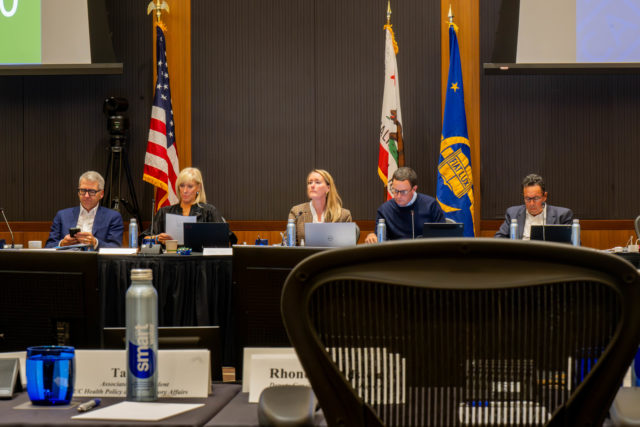
A UC task force dedicated to reorganizing the University’s operations amid budgetary constraints said it plans to create a list of restructuring recommendations at the UC Board of Regents meeting Wednesday.
The co-chairs of the Joint Academic Senate-Administration Task Force on UC Adaptation to Disruptions – which was launched in October – presented an overview of the group’s structure and initial work at the academic and student affairs committee meeting. The committee also heard from UCLA professors about research pertaining to rebuilding and recovery after the January 2025 Los Angeles fires.
[Related: The Bruin’s full coverage of the LA County fires]
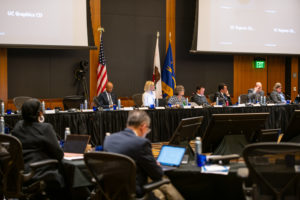
The UC Board of Regents held its bimonthly meeting Tuesday to Thursday at the Meyer and Renee Luskin Conference Center.
UCAD Plus is composed of all executive vice chancellors and provosts from each UC campus, certain UC Academic Senate leaders and other administrators, said Ahmet Palazoglu, a co-chair of UCAD Plus, at the meeting.
The task force aims to provide recommendations for “academic and operations” restructuring in five areas – research, academic personnel, program sustainability, course availability and graduate education – according to the discussion item. Each sector has a “workgroup” that develops its recommendations, according to the discussion item.
The state government recently approved UCLA’s emergency request to the state for $130 million due to budget shortfalls, said Nathan Brostrom, the UC’s executive vice president and chief financial officer, at a board meeting Wednesday.
Katherine Newman, the provost and executive vice chancellor of academic affairs of the UC and co-chair of UCAD Plus, said the task force will consult other leaders across the system and the UC Academic Senate to review recommendations once they are developed. She added that she expects it will take the entire academic year for the committee to “develop a framework” that would allow any recommended actions to be implemented. The task force will share the recommendations with UC President James Milliken and campus chancellors, followed by a systemwide review next fall.
“The vision of UCAD Plus is to align our collective expertise – faculty and administration alike – to sustain and elevate UC’s academic mission while ensuring that every campus retains its unique strengths and autonomy,” Newman said.
Newman added that the task force hopes to communicate with UC faculty about the impact of UCAD Plus’s work. Hal Stern, member of UCAD and the provost and executive vice chancellor of UC Irvine, said the task force will help the UC adapt to complex situations while still giving individual campuses autonomy.
Regent Ann Wang recommended the task force consider artificial intelligence in its planning, citing a need for the University to stay “innovative and relevant and valuable in the age of AI.”
UCLA Chancellor Julio Frenk suggested the task force consider a multi-faceted instructional approach that combines in-person classroom instruction, remote instruction and “immersive instruction.”
Newman said the task force will launch language programs across all nine UC campuses serving undergraduates in January, adding that UCAD Plus has the support of the campuses’ humanities deans. Newman did not provide further details on the program’s implementation during the meeting.
A UC Office of the President spokesperson said in a Thursday emailed statement that the UC Global Language Network seeks to increase the number of UC students taking foreign language courses. The program plans to develop ways for students to gain foreign language or general education credit by taking UC Online classes, the spokesperson added in the statement.
“GLN will complement and expand the many languages offered in-person in the UC system and create an even richer set of options for language instruction,” the spokesperson said in the statement.
Teesha Sreeram, a fourth-year sociology student, urged the co-chairs to include student voices on the task force when making restructuring decisions.
“I’m hoping that this committee – while it’s working on the innovation and the resilience within the UC – can also look at the gaps that our students are facing and how that affects our academic programming and the supports that we need as we continue on,” Sreeram said.
Newman said the task force tentatively plans to discuss its work with the regents again in March 2026.
The regents also heard UCLA researchers give updates about their participation in rebuilding and recovery efforts following the January 2025 LA fires.
Megan Mullin, the faculty director of the UCLA Luskin Center for Innovation; Julia Stein, the deputy director for the Emmett Institute on Climate Change and the Environment at UCLA School of Law; and Michael Jerrett, a professor of environmental health sciences at the UCLA Fielding School of Public Health, shared their research in rebuilding effectively and safely. Jerrett added that he hopes to study the long-term health impacts of the fires.
[Related: Bruin to Bruin: Megan Mullin on Turning Environmental Passion into Policy]
The regents also celebrated the UC faculty members who have been awarded with Nobel Prizes.
[Related: UC sets world record for most Nobel laureates from a university system]
Andrea Ghez, a UCLA professor of physics and astronomy, said she and her team discovered a supermassive black hole, which earned her a Nobel Prize in physics in 2020.
“At the University of California, we have the tools to look deep into the universe, and we were able to bring something that’s incredible into focus,” Ghez said. “That’s what we do at the University of California every day: We ask questions, we explore things that are still shrouded in darkness and we bring new knowledge and understanding into focus.”

Comments are closed.