This post was updated Nov. 30 at 7:05 p.m.
A university police department should protect its students, not harm them.
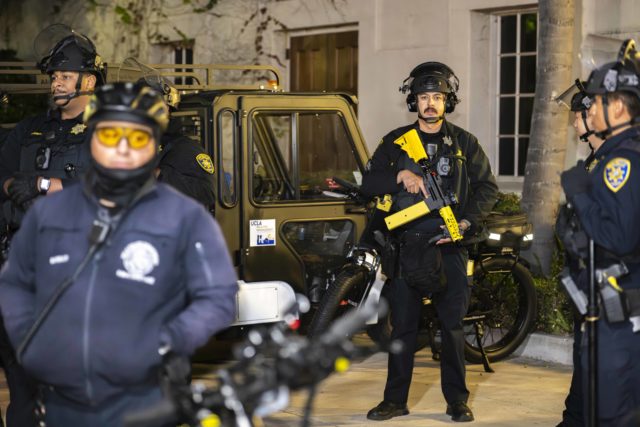
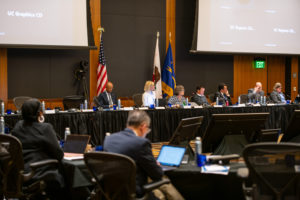
But in late September, the UC Board of Regents approved a UCPD request for less-than-lethal munition launchers and sponge rounds. These weapons are supposed to be used to de-escalate conflict while minimizing serious injury or death. They are used especially in situations with large groups of people and sometimes when individuals are looking to commit violent crimes.
This request represents a drastic overstep by UCPD and a continuation by the regents and the UCLA administration in facilitating the university’s suppression of speech.
UCLA has been a hub of peaceful protest since its inception.
In 1934, more than 3,000 students marched in protest of the suspension of five students for alleged communist sympathies.
In the 1960s, students demonstrated to protest the Vietnam War.
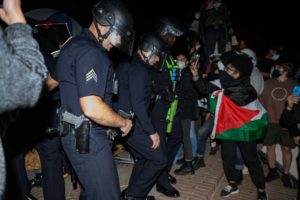
In 2024, students set up encampments to protest UC investments in companies that manufacture weapons for the Israeli military. The encampment sparked counterprotests, leading to violent clashes. The event ended with LAPD and California Highway Patrol officers using less-than-lethal force to sweep the entire encampment – a move that drew lawsuits and scrutiny from experts.
“By the very presence of that kind of weaponry, it has a chilling effect on student protest,” said Jorja Leap, an adjunct professor in the Luskin School of Public Affairs. “I don’t think it’s consistent with its (UCLA’s) mission, and I don’t think it’s consistent with its (UCLA’s) culture.”
The political landscape on campus is polarized enough.
UCLA finalized its Time, Place and Manner policies before classes began in fall 2025, replacing interim policies from September 2024. The new guidelines banned public expression activities from midnight to 6 a.m., limited sound when marching, banned temporary structures on campus property and limited spaces where people can demonstrate without prior approval.
Some of these guidelines also mirrored demands from a draft settlement sent to the university by the Trump administration to restore UCLA’s frozen research funding.
President Donald Trump and his administration have made it clear that they will not tolerate perspectives outside their own. The president has punished journalists who criticize him. He has sued media groups that oppose him. And if that isn’t bad enough, he has begun suing and investigating political enemies.
Our political climate is one that actively combats the development of new ideas. The move by UCPD to obtain less-than-lethal munitions only adds to this.
“It definitely sets a dangerous precedent for free speech expression on college campuses, which is part of what makes a university a university – a place where you can share your ideas,” said Areg Horoupian, a fourth-year political science student. “If those mediums are being actively suppressed, then I think it sets a very bad precedent.”
Students should not feel threatened when protesting important topics, especially not on their own campus. Having police armed with riot gear and launchers that can seriously injure or even kill actively discourages students from utilizing their right to protest.
“This equipment is meant to provide officers with the ability to de-escalate or overcome a self-destructive, dangerous person who comes onto campus without having to use higher levels of force. Less lethal equipment has been used on UC campuses for decades,” a UCLA Office of Campus and Community Safety spokesperson said in an emailed statement. “These tools are designed to be used in life-threatening circumstances, in order to protect the lives of students, staff, faculty and officers when bringing an incident to a conclusion with the least amount of force.”
However, one study led by the Associated Press found that more than 1,000 people died from less-lethal force between 2012 and 2021. Another study found that a person is injured about half the time police departments use less-lethal force.
The decision creates an image that protests will always become violent. It shows a lack of faith in students to engage in an act that founded our nation. It demonstrates an inability of the UCLA administration to construct satisfactory rules that allow students to protest.
Instead of engaging in discussion, UCLA decided to arm university police and frighten students into conformity.
Supporters of the less-than-lethal munitions argue that protests in the past have required this use of force and, considering how polarized our nation is, officers should be prepared if violence were to break out again.
“Less-lethal equipment is used by police departments as a de-escalation tactic in high-stakes situations to reduce the need for higher levels of force,” Scott Scheffler, UCPD’s captain of the administrative bureau, said in a written statement. “Less-lethal equipment makes campus and the police officers who protect it safer … If a person comes onto campus using a weapon or posing a threat, these tools can be used to stop them with less risk of severe injury or death, and as an alternative to using lethal firearms.”
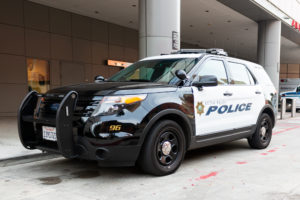
It is true that less-lethal equipment is a better alternative to lethal firearms. However, UCPD neglects the fact that its department deals with fewer violent crimes per year than larger police organizations, such as LAPD, do in one month.
If UCLA, or even Westwood, were a hotbed for violent crime, the munitions would be warranted. But this is not the case.
The UCPD statement also disregards a main component of universities – that they remain open to protests and free speech.
UCLA outlines this in its mission statement: “We value open access to information, free and lively debate conducted with mutual respect for individuals and freedom from intolerance.”
Colleges are supposed to encourage the marketplace of ideas. They are supposed to promote discussions – and heated ones, too. Students must have experience questioning, debating and protesting because they are necessary to the function of our democracy.
If students aren’t comfortable doing these things in college – what should be hubs of knowledge and free thought – then when and where will they be?


Comments are closed.