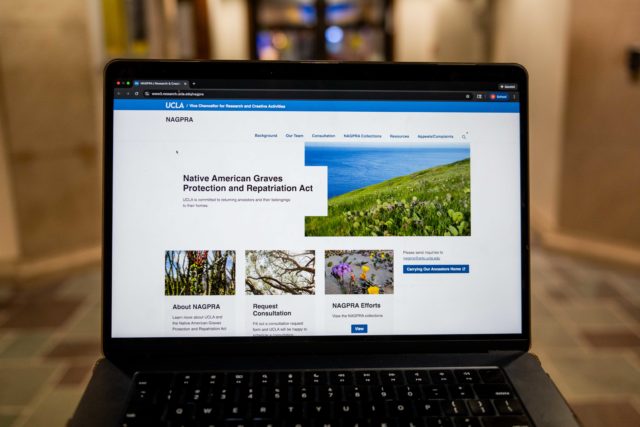
About 30 students honored Indigenous history at a teach-in about the Native American Graves Protection and Repatriation Act on Nov. 12.
The event, which was hosted at the Student Activities Center, aimed to educate the campus community about the NAGPRA – a federal law passed in 1990, which outlines requirements for federally-funded agencies and museums to return Native American human remains and funerary objects to their respective peoples.
The offices of Sherry Zhou, the Undergraduate Students Association Council’s external vice president, and Jayha Buhs Jackson, a USAC general representative, hosted the event alongside the American Indian Student Association.
Attendees learned how to submit student testimonials to the UC Board of Regents about the UC’s allegedly incomplete repatriation of all remains and belongings. Buhs Jackson encouraged attendees to speak during public comment at the UC Regents’ meeting – held Tuesday to Thursday at UCLA – as part of the accountability process.
Arianna Osuna, a third-year political science student and the vice president of AISA, said the teach-in was part of a broader campaign across the UC system led by Students Enacting Environmental Defense – a UC Student Association initiative focused on environmental justice and advocacy. As the SEED campaign vice chair for the UC Student Association, Osuna said she is coordinating teach-ins to raise awareness about NAGPRA across all nine UC campuses this month.
“I’m having the teach-ins to have students be educated,” she said. “We cannot have student advocacy for NAGPRA if they’re not educated on the topic in general.”
Osuna added that while UCLA is among the UC campuses with the highest rate of NAGPRA compliance – with roughly 99% of its inventoried ancestral remains repatriated – significant gaps remain in students’ understanding of the law.
“No students really know what NAGPRA is – even some Native students don’t know,” Osuna said. “This is our first step. Just getting people educated, having people acknowledge the fact that UCs do have ancestral remains on their campuses.”
Buhs Jackson, a second-year African American studies and public affairs student, said the event aims to elevate Indigenous voices that are often left out of campus conversations.
“It’s really important to remind individuals of the communities that are still here and present and also remind individuals that we’re on Native land everywhere we go, and to recognize that,” Buhs Jackson said.
The teach-in drew both Native and non-Native students – some of whom said they came to learn how to engage more responsibly with Indigenous issues on campus.
Faron Littleton, a fourth-year political science student and USAC communication relations team member, said she attended to learn more about Indigenous issues and to better understand how to educate other people about NAGPRA.
Lauren Pelot, a third-year political science student and a community relations staffer for Buhs Jackson’s office, said she showed up to learn more about NAGPRA and its impact.
“I really haven’t had much exposure in my life,” Pelot said. “So just building relationships with people and hearing people’s stories – I think especially with this topic – it’s important to hear specifically from people within the community.”
Isabella Iparraguirre, a first-year political science student and AISA member, said it is important for students to be educated on Native matters – especially considering that the UCLA campus is located on Native land. UCLA – a land-grant institution – sits on land originally inhabited by the Gabrielino-Tongva peoples.
Oscar López, a third-year history student, added that the diversity of attendees at the teach-in stood out to him.
“I like that it wasn’t just Native students that showed up,” he said. “It’s about building interethnic and interracial solidarity.”
Buhs Jackson said she hopes the event serves as a call to action. Osuna added that people must actively prioritize representation and advocacy for Native students.
“I just really want to show that Native students are here, and we’ve always been here and that we are a political entity on campus,” she said. “We can just have more representation because we are on Native land, and we are a land-grant institution.”

Comments are closed.