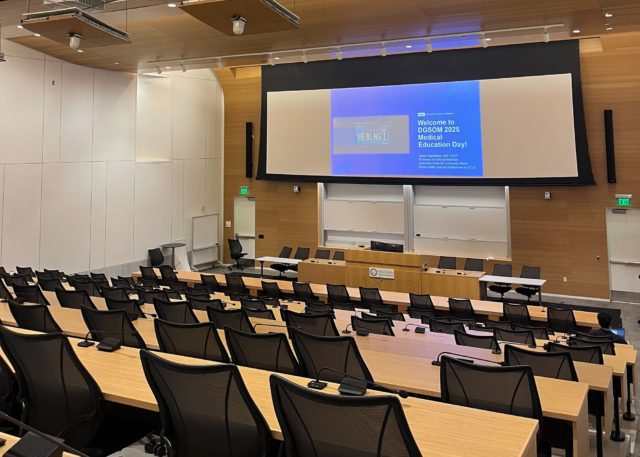
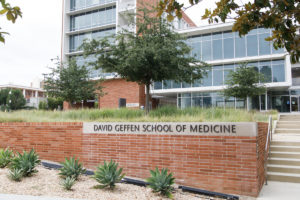
The David Geffen School of Medicine hosted its second annual Medical Education Day, featuring community-led workshops and presentations on educational innovations Nov. 13.
Medical Education Day was created by the school’s Medical Education Committee to foster an environment for educators to learn from one another and share personal experiences, according to Dr. Jason Napolitano, the associate dean for curricular affairs at the School of Medicine. While the School of Medicine created the agenda for last year’s event, the schedule was entirely community-driven this year, Napolitano said.
Dr. Kathleen Brown, the interim vice dean for education and assistant dean of inclusive excellence at the School of Medicine, quoted Maya Angelou to set the tone for the event.
“’When you get, give,’” Brown said. “’When you learn, teach.’”
Napolitano welcomed the event’s attendees, which included educators, students and faculty such as Dr. Tyler Larson, the co-chair of the MEC.
The MEC had oversight over the medical school’s constantly changing curriculum, according to Napolitano. One recent change was the introduction of the Healer, Educator, Advocate, Leader, Scholar (HEALS) curriculum in 2021, which had the goal of providing students with more time for research and a faster immersion into the clinical experience, Napolitano said.
Now that an entire class of students have completed HEALS following its implementation in 2021, the Educational Measurement Unit – led by Heather Davis, the director of student assessment, and Mark Grichanik, the director of program evaluation – will review metrics from assessments and evaluations to continue improving the curriculum, according to Napolitano.
Davis said Medical Education Day will help her determine which projects should be prioritized to best support learner performance.
“I was really listening for what curricular innovations are happening,” Davis said. “Which ones are in progress, what are people interested in.”
Attendees came together for a half day of workshops and educational innovation presentations that were submitted directly by UCLA faculty, residents, students and staff. This contrasted the first Medical Education Day event last year, which spanned all day and featured a poster fair and meetings curated by a committee, according to an email from the DGSOM Curricular Affairs office.
“We really wanted the sessions to be community-driven,” Napolitano said.
Artificial intelligence and technology in medical education, fostering receptivity in a learning environment, and coaching and communication were among the ideas highlighted in presentations throughout the event.
“I got to learn more about what the educators themselves are looking for, both in the students they onboard, but also what they’re looking to create in the students they’re currently training,” said Connor Curran, a second-year biophysics student at UCLA.
Curran said he was excited about the event but noticed he was one of the only pre-med students in attendance.
“It was a really valuable opportunity,” Curran said. “A lot of students would be interested if the word was out to their classes and their professors.”
Davis said she believes event organizers should invite experts from the medical community outside of UCLA to discuss the curricular redesign processes. She added that bringing in leaders from other institutions could broaden the represented perspectives on common education issues at the event.
“We have incredible expertise here, but it’s also nice to look outside these walls and learn from others.” Davis said. “I always think we’re better together, and so that might be an opportunity for a future year.”

Comments are closed.