Educator and activist Jesse Hagopian called for the defense of critical antiracist education in a talk about his new book Nov 10.
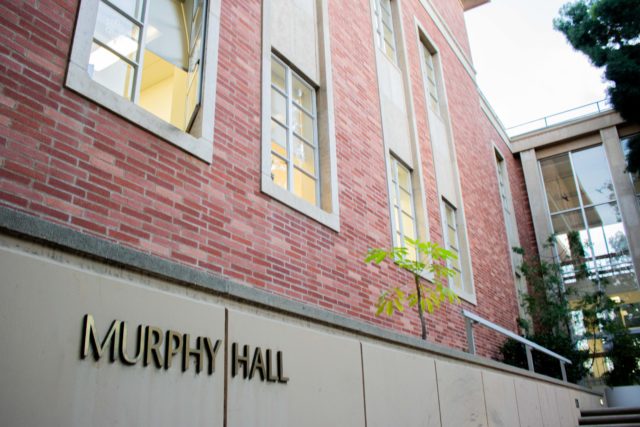
Organized in collaboration with UCLA DataX, the UCLA Luskin Center for History and Policy and the UCLA Meyer and Renee Luskin Department of History in Murphy Hall, the talk was moderated by Robin D.G. Kelley, a distinguished professor in the department of history. Hagopian’s book – entitled “Teach Truth: The Struggle for Antiracist Education” – was published in January 2025.
Kelley said he believed the discussion was important for understanding the role history can play in shaping law, public policy, activism and social change – especially under the Trump administration.
“Jesse might be the most famous school teacher of his generation,” Kelley said in an interview following the talk. “He made waves as an activist fighting to stop cuts in education.”
Hagopian is an award-winning educator with two decades of experience working as a public school teacher. In 2013, he made national headlines organizing a movement against standardized testing and has since authored and edited multiple books focused on education reform and antiracist pedagogy.
His newest book discusses the recent legislative efforts that aim to censor educators teaching about structural racism and other forms of oppression and outlines the movement teachers and students are building in opposition. Florida, where it is a felony for educators to carry certain banned books in their classrooms according to Hagopian in his speech, signed the Stop W.O.K.E. Act into law in 2022, which prevents schools from teaching about systemic racism – and threatens those that do with cutting funding.
Hagopian said he makes an effort to ensure his curriculum is reflective of and tailored to his students.
He also hosts a monthly class online in which he interviews historians about Black history, and provides a forum for educators to discuss how they integrate the session into their classrooms.
Hagopian said Oklahoma introduced a requirement this year which mandates that teachers moving from New York and California pass a “loyalty test” administered by PragerU, a conservative media organization.
Hagopian said opponents of critical race theory – which teaches that systemic racism is a part of American society – hide “behind neutrality and objectivity” to deny the existence of systemic racism.
He noted that a sixth-grade teacher from Idaho was told by school officials to take down a poster that said “Everyone is Welcome Here” because it was not content-neutral.
“We are really gathering at a dangerous hour when those in power are not only rewriting history, but trying to outlaw history itself,” Hagopian said during the talk.
With the upcoming 250th anniversary of the Declaration of Independence, Hagopian said it is important for students to think critically about the founding of this nation, and the contradictions present within its promise.
Chris Jadallah, an assistant professor in the School of Education and Information Studies, said he was happy to see an event like this and attended the talk with his students.
“This would be a good opportunity for our students, who are going into the teaching profession and are navigating really tumultuous and challenging political times that are restricting free expression, creating difficult conditions for teachers in the classroom,” Jadallah said.
Jadallah added that he found the event to be a great opportunity for his students to hear about a veteran teacher’s experiences with bringing anti-racist pedagogy into the classroom.
Shia Fisher, a graduate student in the teaching education program who teaches mathematics at a local high school, said he hopes to start a conversation about approaching culturally responsive education in an “intentional” way, without asking already under-resourced teachers to rewrite their curriculums.
Kelley said he hopes to develop a deeper partnership with DataX – a UCLA institute dedicated to exploring social and ethical issues at the intersection of data, justice and society – to continue conversations about antiracist education.
“When I was in college, that’s what we did. Most of our learning wasn’t in the formal classroom, but through visitors, lectures, teachings, debates and study groups,” he said. “That’s what we’re trying to promote with events like this.”

Comments are closed.