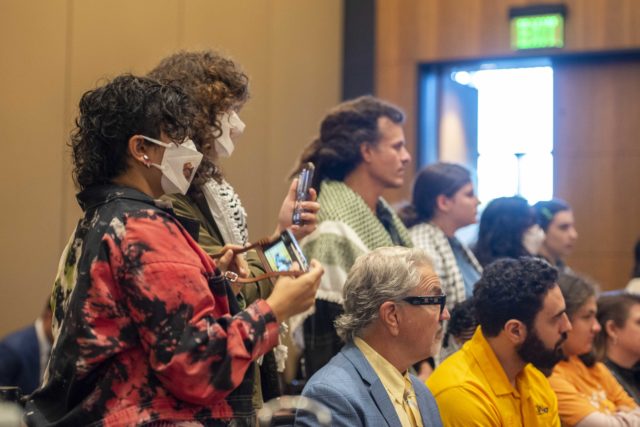
UC community members called on the University to stand up to the Trump administration, reject tuition hikes and renew funding for disability services during three public comment sessions at the UC Board of Regents’ November meeting.
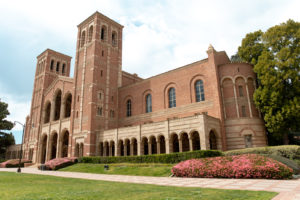
The board held the public comment sessions during its Nov. 18 to Thursday meeting at the Meyer and Renee Luskin Conference Center.
Varykina Thackray, a professor of obstetrics/gynecology and reproductive sciences at UC San Diego, said she believes the Trump administration has targeted the UC with demands that impact its research, teaching mission and its employees’ constitutional rights.
[Related: Judge bars Trump administration from threatening, freezing UC’s federal funding]
The Trump administration suspended $584 million of UCLA’s federal research funding in late July, alleging “antisemitism and bias.”
About a week after it first froze the grants, the federal government sent a proposed settlement letter to UCLA in exchange for the restoration of the funding. In the settlement, the United States Department of Justice demanded that UCLA pay $1 billion, as well as $172 million to a claims fund for those allegedly impacted by employment discrimination, and make sweeping policy changes across the university.
“As leaders of the UC, I call on you to make it clear that our University will not capitulate to financial coercion from the federal government by bringing to any of these demands,” Thackray said. “It is simply unacceptable to limit academic freedom in any UC educational space, be it a classroom, research lab or clinic.”
[Related: Trump administration’s UCLA demands target international students, DEI initiatives]
Donna Graves, an alumnus of UCLA and UC Santa Cruz, presented a petition from UC Unbowed – an organization of UC alumni advocating for academic freedom at the University, which held a press conference at UCLA on Nov. 17 announcing the letter. The petition called on UC President James Milliken, the UC Board of Regents and Gov. Gavin Newsom to protect the University’s academic freedom amid the Trump administration’s attacks on higher education.
“We’ve seen faculty, staff, students and campus unions speak out and push back against the Trump administration’s overreach,” she said. “UC Unbowed exists to bring alumni and supporters into this fight, to stand with them and to call on you to stand firm in protecting UC’s academic freedom and reject the Trump administration’s effort to exert authoritarian control.”
Nupur Agrawal, an assistant professor of internal medicine and pediatrics, called on the Regents to protect gender-affirming care at the UC’s medical centers. The Trump administration’s proposed settlement demanded that UCLA end gender-affirming care for minors at its medical facilities.
Natalia Ramos, an assistant clinical professor of psychiatry at UCLA Health, said that if the University caves to the Trump administration’s demand to end gender-affirming care for minors, there would be “devastating effects” on the mental health and safety of California’s LGBTQ+ youth.
[Related: Trump administration’s anti-trans actions spark advocacy across UC community]
Bryan Pitts, the assistant director of the UCLA Latin American Institute, said federal grants also made up many researchers’ salaries.
He called UCLA staff morale “dangerously low,” adding that he believes the Regents should create plans to supplement lost wages due to the suspension of grants at the University. While a federal district court judge reinstated UCLA’s frozen National Science Foundation and National Institutes of Health grants in August and September, respectively, the decision is temporary and will hold while the case – brought by UC researchers – moves through the courts.
The NSF has been instructed to not approve new grants to UCLA, said Rita Lin, a judge in the U.S. District Court for the Northern District of California, in a decision that barred the Trump administration from freezing or threatening to freeze the UC’s grants.
Community members also spoke about the President’s Postdoctoral Fellowship Program, which awards 30 scholars across the University with a $75,000 salary for research under faculty sponsorship. While the UC said it would stop offering the program’s associated hiring incentive – which supports hiring fellows into their first ladder-rank position – Milliken reversed the decision Wednesday, announcing that the University would continue funding the program.
Milliken also warned in the email that the number of incentives offered could change based on the UC’s financial situation.
[Related: UC to keep postdoctoral hiring incentive program it previously said would be cut]
Gregory Leazer, an associate professor in information studies, said he was grateful for the restoration of the PPFP. However, he added that faculty currently feel unheard on many other issues – including on revisions to the Academic Personnel Manual and Time, Place and Manner policies.
[Related: UCLA’s finalized Time, Place and Manner policy alters public expression guidelines]
Daniel Neuhauser, a professor in the chemistry and biochemistry department at UCLA and a member of the Jewish Faculty Resilience Group, said he believes the Regents must ensure “full institutional neutrality” across the UC, adding that he believes minority opinions are often silenced across the University.
Michelle Zeidler, a professor of medicine at the David Geffen School of Medicine, said there was an event held on Yom Kippur where a faculty member made negative comments about Israel, adding that Jewish students would have been unable to object due to the holiday. She added that this was not an “isolated occurrence” for the particular faculty member and called on the University to make a public statement against “political indoctrination.”
Daniella Abbott, a third-year sociology student, said during the Wednesday public comment session that she believes professors sharing personal opinions on Israel and Gaza undermines academic neutrality and creates discomfort for pro-Israel students.
“Today I’m asking the reasons for this consistent and transparent enforcement of anti harassment policies, clear guidelines and guidance to help students distinguish protected political speech from targeted hate and proactive efforts that bring students together in dialogue that recognizes everyone’s humanity,” Abbott said.
Several people spoke on behalf of unions during the public comment sessions.
Diana Dayal, the regional vice president for Southern California of the Committee of Interns and Residents/SEIU Healthcare, also urged the Regents to create an online option for union members to attend bargaining sessions. She added that she cannot travel for in-person bargaining meetings due to her professional responsibilities as an emergency medicine physician resident at UCLA.
Tamika Coleman, a member of the American Federation of State, County and Municipal Employees Local 3299, condemned the arrests of student protesters the morning of Nov. 18 and urged that any charges be dropped. The arrests occurred on the second morning of AFSCME Local 3299’s strike in response to the UC’s alleged failure to reach a fair contract.
Steve Lurie, the associate vice chancellor for campus and community safety, said in an emailed statement that UCPD arrested four students wearing AFSCME Local 3299 shirts who were blocking a loading dock in the UCLA Henry Samueli School of Engineering and Applied Science and refused to move. The arrests occurred around 7:57 a.m., according to a UCPD Instagram story.
[Related: Hundreds of UCLA AFSCME Local 3299 members strike Nov. 17 and 18]
Several community members expressed concern about proposed changes to the Tuition Stability Plan – which maintains undergraduate students’ fees and tuition from their first year at a UC school for up to six years of their undergraduate education.
The regents approved a 1% increase to tuition starting in the 2026-27 academic year during the Wednesday meeting, which can be used at the discretion of campus leaders for whichever projects they see fit. The Regents also approved a review process for increases at its November meeting, which will now take place every seven years.
[Related: UC Regents amend, renew progressive tuition increases for new students]
Amanda Dominguez, the director of public affairs for the Campaign for College Opportunity, said she believes modest tuition increases can create barriers for people pursuing higher education.
Sherry Zhou, the external vice president of the Undergraduate Students Association Council, also urged the regents to reject the proposed changes to the plan, particularly because the tuition increases would go toward capital development rather than student services.
“To ask students to run the bill for infrastructure projects at a moment where student programs are rampantly being cut across campuses is equally frustrating, especially when the budget that you all propose and are discussing today already puts forth billions of dollars towards capital investment projects,” said Zhou, a fourth-year communications and political science student.
Multiple community members urged the Regents to provide support services to both immigrants and students with disabilities.
Javier Nuñez-Verdugo, the former external vice president of USAC, said the Regents should review and reconsider funding allocations for disability services, alleging that they are “criminally understaffed, underprioritized and underfunded.” They added that the services are important to increase student retention, particularly for people of color.
Nataliah Cornejo-Ayers, the disability justice officer for the UC Student Association, urged the Regents to reinstate their $17.5 million allocation of one-time funding to Disabled Student programs, which she said are scheduled to run until spring 2027. The allocation has allowed the programs to hire more staff and improve response time, she added.
“Though there’s much more funding and manpower needed before we have our needs fully met, our current staff is indispensable to meeting our accommodations,” Cornejo-Ayers said.
Alan Peralta, an undergraduate student at UC Irvine and member of Students Advocating for Immigrant Rights and Equity, urged the Regents to implement the state’s SAFE Act – which Newsom signed on Sept. 20 and requires schools and colleges to inform their communities if federal immigration enforcement is on campus.
Jack Feng, the external vice president of the Graduate Student Association at UCLA, urged the Regents to create an immigrant legal defense fund and financial employment safeguards for students facing the sudden loss or revocation of legal status.
The Trump administration revoked the visas of UC students and recent alumni – including at least 19 at UCLA – last spring. However, the U.S. Department of Justice announced in late April that it would reinstate students’ legal statuses while it developed a consistent framework for revocation.
[Related: Trump administration revokes visas of multiple UCLA, UC students]
“These safeguards are essential and achievable risk mitigation measures that strengthen institutional stability and ensure all UC students can continue their education without disruption,” he said.

Comments are closed.