This post was updated Nov. 30 at 7:38 p.m.
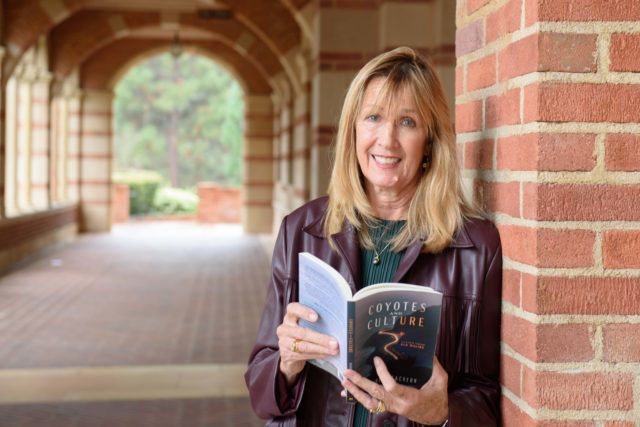
UCLA English professor Claire McEachern is stepping away from her typical scholarly writing with “Coyotes and Culture: Essays from Old Malibu.”
McEachern, who has spent her career writing about 16th- and 17th-century British authors like John Milton and William Shakespeare, was caught in the middle of the Malibu Woolsey Fire in 2018. McEachern said her newest book “Coyotes and Culture” is a collection of personal essays that starts with her experiences in that fire. The book hit the shelves Sept. 16, and her first essay “The Fire Flies” was published in the Los Angeles Review of Books quarterly journal. Prior to the fire, McEachern said she had never considered writing for a general audience after decades of academic publishing.
“It (the fire) was a close call,” McEachern said. “The trauma of that experience led me to write it up. It was one of the ways I was trying to deal with it … I found I really enjoyed that kind of writing, and I wanted to do more of it.”
McEachern said the essays flowed quickly once she began writing. She added that the collection took shape over four years, primarily during the pandemic when she could not access archives for her academic work.
She shared her essays with Jayne Lewis, an English professor at UC Irvine and longtime friend. Lewis said she watched McEachern’s writing evolve throughout the process. She added that McEachern’s transformation represented a kind of liberation after decades of scholarly limitations.
“The next stage (of her process) would have been about a process of freeing herself from the constraints of language, where you have blocks of footnotes and where you have to say what every other person who’s ever thought about your topic has thought about,” said Lewis. “The next step for her was moving into a kind of writing that was in that liberated, freeing mode.”
McEachern, who grew up in New England and has taught at UCLA for 37 years, said she chose to write about Malibu because of its personal meaning to her and her husband’s family, who have been living in the Santa Monica Mountains since the Civil War. McEachern said the book reveals a side of the city most people never see.
“It (nature) can kill you. It sometimes wants to kill you.” McEachern said. “Earthquakes, fires, atmospheric rivers – it’s a very crazy place. What I’ve learned about living in this so-called paradisiacal environment is just that nature is very volatile and very dangerous.”
Though McEachern writes about many aspects of Malibu, she said one of the central themes she explores is the juxtaposition between beauty and danger. She said after the devastation of the Woolsey Fire came 40 inches of rain in 2019, triggering a wildflower superbloom unlike anything she had ever seen. McEachern said the experience made her realize fire is necessary in that environment, and the tension between danger and beauty became a through line in the book.
After establishing this theme of “Coyotes and Culture,” McEachern said she continued to write essays over the next few years, exploring everything from East Coast versus West Coast cemeteries to LA as a paradise. In particular, she said she paid attention to how trouble and beauty operate differently in storytelling – an observation that became an opening line.
Susan Baltrushes, McEachern’s Malibu neighbor who experienced the Woolsey Fire alongside her, said “Coyotes and Culture” stands out for its depth of thought.
“She has a very personal voice,” Baltrushes said. “But she also takes it into places that I never really considered. She wrote in ‘The Fire Files’ about the responsibility we have for bringing our children into this environment where they could lose their parents or they could lose their home … She has this quality of thinking really deeply about things and making associations.”
As someone who has published numerous scholarly books, McEachern said her students and the process of teaching helped her develop a more accessible voice. Since the book’s publication, McEachern added that she has reflected on what it means to practice simplicity when writing for different audiences. She said she could not have written this book in her twenties, when she was entranced with complex professional writing.
“This book is a different kind of writing from what I’m used to doing,” McEachern said. “Even though I have written lots of other books, this one makes me feel like a writer in a way that the other ones haven’t.”
The fires ultimately drove McEachern and her husband out of Malibu, she said, and the couple decided to try their hand at cattle ranching in Oregon’s Klamath Basin instead, though McEachern still returns to UCLA regularly to teach. McEachern added that while Klamath Basin is a much safer place than Malibu, there is still a lot of ecological complexity. While fire is not an exact threat, she said there are conflicts between irrigation, agriculture and environmental protection that help examine how humans negotiate their relationship with the natural world.
McEachern said she hopes readers come away from her stories with a respect for nature that encompasses both its beauty and its danger. She added that she is drawn to writing about agricultural tensions for her upcoming works.
“I write in order to find out what I think,” McEachern said. “There is a lot about agriculture that gives me a lot to think about. How do you farm sustainably, responsibly in a world of climate crisis?”



Comments are closed.