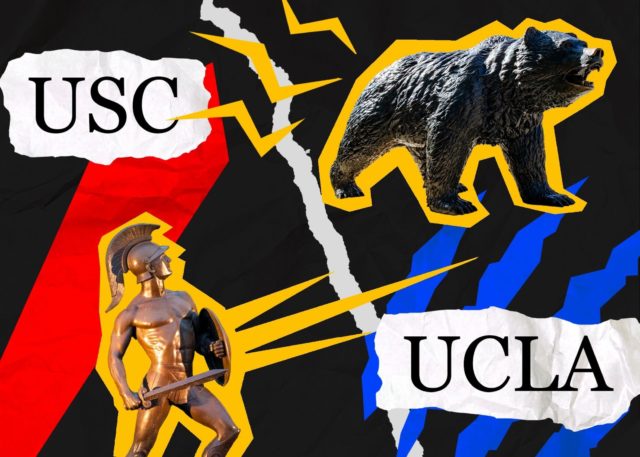
For the past 96 years, UCLA and the University of Southern California have faced off in an annual crosstown rivalry football game.
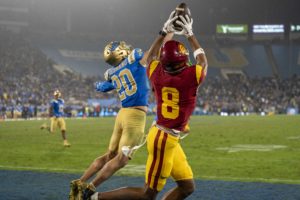
This year, the UCLA Bruins battle the USC Trojans at the Los Angeles Memorial Coliseum on Saturday. With less than 15 miles separating the two campuses, the historic rivalry between UCLA and USC spans sports, academics and student life. The rivalry culminates on the football field, with the Trojans wearing cardinal and gold competing against the Bruins donning blue and gold.
[RELATED: Rivalry Issue 2025]
The feud between UCLA and USC differs from other traditional college rivalries since both schools call Los Angeles home.
The distance exacerbates the tension between the two schools since many students may know someone on the other campus, said Eric Johnson, the faculty director of Center of Management of Enterprise in Media, Entertainment and Sports at the UCLA Anderson School of Management.
“It’s more personal; it’s more in your face,” Johnson said. “You cannot walk a day within this town of not seeing cardinal or seeing UCLA blue.”
Johnson added that the lack of a professional football team in Los Angeles in the 1990s fueled the rivalry between USC and UCLA.
“For many years – in the early decades – we didn’t have a professional football team,” Johnson said. “When the Rams left LA for St. Louis and then the Raiders left, you had a couple decade window again where there was no NFL, so the UCLA-USC game became a sold out opportunity for LA sports fans to go see high level football together.”
The rivalry between the two schools started in 1929 when the Trojans first faced the Bruins at the Coliseum in a football game that ended 76-0.
Both UCLA and USC’s football teams shared the Coliseum from 1933 until 1981, when UCLA left for the Rose Bowl the following year.
When the two schools shared the Coliseum, they both wore their home jerseys when playing the other football team.
“Because it was the same home field, they both wore their home uniforms for all those years,” Johnson said. “When UCLA moved to the Rose Bowl as their permanent home … they wanted to keep the tradition going, so they allowed USC to not wear whites, but to wear their Cardinal in 1982 to keep that spirit going.”
The agreement for both schools to play in their home jerseys was an important one, Jeff Fellenzer, a professor of professional practice of journalism at USC, said.
“There’s such great contrast there,” Fellenzer said. “You get the richness of red and blue versus, red and white or blue and white, wasn’t the same.”
Throughout the rivalry, USC has won more games with 51 wins, compared to UCLA’s 34 wins. The schools have ended the game in a tie seven times, an outcome not possible this year after the NCAA introduced regular season overtime in 1996. As a football program, the USC Trojans boast more accomplishments, with 11 national championships and eight Heisman trophy winners.
Fellenzer, who has been a Heisman Trophy voter since 2007, said the athletic level both schools perform at each year is what makes the rivalry so interesting.
“The proximity and the level of excellence of the teams over the years, historically makes it to me, the best rivalry,” he added.
Since 1942, the winner of the rivalry game has taken home a 295-pound Victory Bell, originally gifted by the UCLA Alumni Association in 1939. The winner of the cross-town rivalry is able to keep the bell for the rest of the year, painting the bell’s carriage in their respective school colors.
In the week leading up to the rivalry game, the two schools also participate in school-spirited festivities.
At UCLA, the week leading up to the game is called Beat ‘SC Week, while at USC, the week is called Troy Week, more commonly known as Conquest Week. This year, UCLA hosted performances in Bruin Plaza and businesses in Westwood Village decorated their storefronts with blue and gold in anticipation of the matchup.
Historically, the two schools have also taken part in various pranks during rivalry week, including vandalizing each other’s campuses.
Notably, in 2009, USC vandalizers splattered the Bruin Bear statue with red and yellow paint. The prank cost UCLA $40,000 in restoration fees and security measures.
Since then, to avoid property damage going forward, UCLA started taping up and constructing protective enclosures around statues during rivalry week.
While the pranks have declined after both schools implemented a zero-tolerance policy by 2005, student organizations have taken upon themselves to protect their campus.
The tradition of guarding the statues allows students to build up school spirit leading up to the game, said Liam Jenny, a fourth-year atmospheric and oceanic sciences and political science student and director of game day operations at The Den – the group representing the UCLA student section.
“At the same time that the boxes go up around the John Wooden statue and the Bruin statue to prevent any vandalism, like we’ve had in years past from the Trojans,” Jenny said, “members of The Den will sit outside of the Bruin Bear box from 12 a.m. to 5 a.m., basically like a night watch patrol.”
At USC, similar student groups, such as the Trojan Knights and the Helenes protect their iconic statues from potential UCLA vandalizers.
Leire Lizarralde, a USC student and member of the Helenes, said she and her peers organize shifts to take turns guarding iconic statues on campus.
“We basically camp out the week of the UCLA game in front of the Hecuba statue at the USC Village, and we just stay there all night making sure that nobody is going to come and vandalize,” Lizarralde said.
Despite this competitive spirit surrounding the football game, USC and UCLA are able to set aside their differences and collaborate effectively on off-field issues.
For example, after the Palisades and Altadena fires in January this year, faculty at the USC Lusk Center for Real Estate and the UCLA Ziman Center for Real Estate worked together to aid in rebuilding efforts to strengthen LA’s resilience against natural disasters, according to USC Today.
According to UCLA Health, USC and UCLA doctors have also performed the world’s first successful human bladder transplant in May of this year at Ronald Reagan UCLA Medical Center. This operation marked a breakthrough in new surgical techniques and development.
Still, despite these off-field partnerships, Fellenzer said when it comes to the football game, both schools shift their focus to winning over the other team.
Fellenzer added that students take the rivalry seriously, since they start to embrace the rivalry’s competitive school spirit as their own.
“You represent the school and you represent their successes and their failures,” Fellenzer said. “The football game is a measuring stick of success, representing the biggest college sport at most schools, then it’s something to celebrate.”


Comments are closed.