This post was updated Dec. 1 at 10 a.m.
As fireworks burst over the Rose Bowl after UCLA’s win over Iowa last year, Peter Dachtler and his family stood arm in arm on the field, singing the UCLA alma mater.
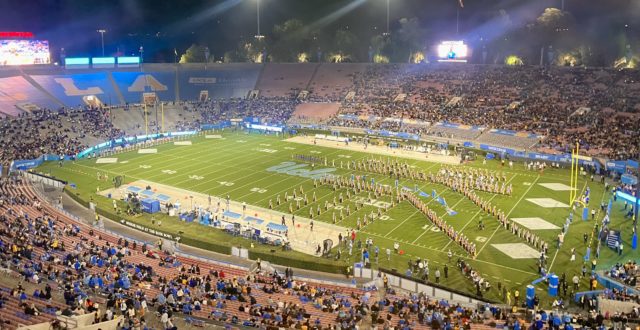
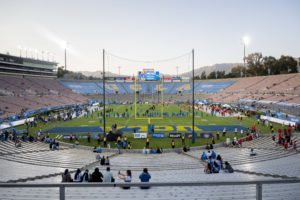
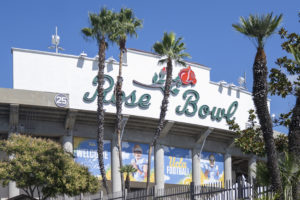
The second-year economics and environmental studies student’s lifelong goal was to attend UCLA and experience football games at the Rose Bowl alongside his family of Bruins. UCLA has played at the Rose Bowl – also known as “America’s Stadium,” which sits near the foothills of the San Gabriel Mountains – since 1982. The Rose Bowl is also home to college football’s oldest bowl game, which was first played in 1902.
However, Dachtler – and thousands of other Bruins – are grappling with the fact that these traditions could look different next year.
The City of Pasadena and the Rose Bowl Operating Company filed a lawsuit against UCLA and the UC Board of Regents on Oct. 29, alleging that the university breached its contract by attempting to move home football games from the Rose Bowl to SoFi Stadium in Inglewood.
The contract, which was signed in 2010, states that UCLA cannot hold home games at any other stadium in Los Angeles County until the agreement expires in 2044.
[Related: Lawsuit accuses UCLA of trying to move home football games to SoFi Stadium]
A judge later denied the City of Pasadena and the RBOC’s motion to file a temporary restraining order against UCLA on Nov. 12, which would have kept the Bruins at the Rose Bowl. The judge cited the “lack of an emergency” as reasoning for denying the order but said the plaintiffs could reapply for an injunction after both parties obtain more evidence.
The City of Pasadena and the RBOC alleged in their TRO request that UCLA met with SoFi representatives as early as March 2025. They also claimed that UCLA informed the plaintiffs’ council Oct. 18 that it was “moving on” from the Rose Bowl.
The plaintiffs said in the suit that approximately $184 million remained on city-obligated bonds tied to the stadium as of June 2025. They added that the RBOC relies on UCLA for its revenue, and that without the team playing there, the RBOC could have to lay off employees or reduce its hours.
[Related: Judge denies temporary restraining order to block UCLA from leaving Rose Bowl]
But lagging attendance has left UCLA struggling to fill the Rose Bowl, which seats around 90,000 people and is about 26 miles from campus. UCLA’s season-high attendance sits at 44,481 from its Nov. 8 game against Nebraska – a statistic to which Husker fans contributed greatly.
Dachtler, a contributing writer for The Den – which runs UCLA’s student section – said he was surprised about UCLA’s alleged intent to move to SoFi. He has visited the Rose Bowl for UCLA football games since he was three years old, he added.
“Honestly, I thought it was a joke,” he said. “I thought some troll had made a fake story about it. I pinched myself.”
The history and traditions of the Rose Bowl make it unique to UCLA, Dachtler said. For example, Brookside Golf Club – the stadium’s neighboring golf course – offers a space for fans to tailgate before games, he added.
Tailgating at SoFi looks different, with fans gathering in the stadium’s surrounding parking lot – a common practice for supporters of NFL teams. Both the LA Chargers and LA Rams use SoFi as their home stadium already.
Dachtler said the Rose Bowl tailgating tradition united Bruins across generations.
“Some people that I’ve talked to have been tailgating every game for the past 50 years, and that’s just what they do,” he said. “They just go and they tailgate.”
Isaac Balderas, a second-year public health student and member of the UCLA Bruin Marching Band, said the marching band has various traditions that are specific to the Rose Bowl. The marching band typically plays at the Chancellor’s Tent while tailgating and welcomes the football team as they enter the stadium, he added.
However, Nicholas von Germeten, a member of the creative content committee for Den Operations, said the SoFi stadium’s proximity to UCLA could make it easier for students to travel to games. SoFi stadium is about 13 miles closer to campus than the Rose Bowl.
Von Germeten said he believes the Rooter Bus, a shuttle that takes students from campus to the Rose Bowl, is inconvenient for many students due to the length of the trip. The Rooter Bus Pass costs $60 per season, while a single ticket for the Rooter Bus is $20 on average.
For games that begin at 7:30 p.m., students sometimes return to campus at midnight, or even later, due to the Rose Bowl’s distance from UCLA, von Germeten added.
With a 3-8 record as of Nov. 28, UCLA’s football team is no longer bowl eligible and was ranked 12th in the Big Ten. UCLA parted ways with its head coach, offensive coordinator and defensive coordinator in September.
[Related: Fos Era over in Westwood as UCLA parts ways with DeShaun Foster after 15 games]
Balderas said he believes the football team’s success is a larger driver of high attendance, rather than proximity. He added that if UCLA’s move to SoFi is an attempt to increase attendance, fans may be disappointed.
Despite the shock among students, von Germeten said he believes the move to SoFi should not stop Bruins from taking pride in UCLA football.
“It is our home,” he said. “We’re not going to like it, but I do think that Bruins are resilient and we will thrive wherever we are.”

Comments are closed.