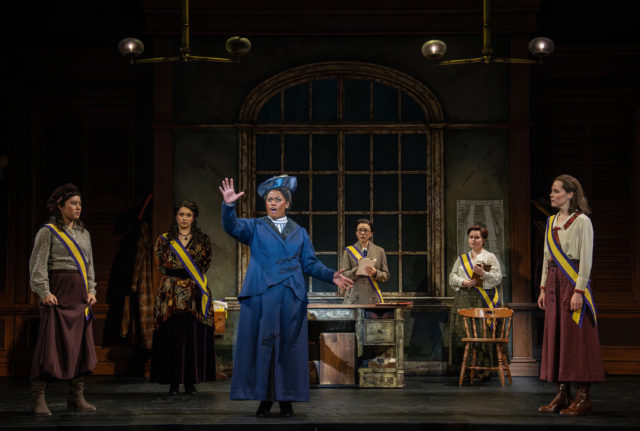


If “Hamilton” is the musical of America’s fathers, then “Suffs” is the mother of modern theater.
The Tony Award-winning musical’s first national tour marched its way into the Hollywood Pantages Theatre on Nov. 18, where it will stay until Dec. 7. The story follows the American suffragist movement from 1913 to 1920, focusing primarily on Alice Paul – played by Maya Keleher – the leader of the National Woman’s Party. Featuring an entirely female cast, who also play its few male characters, the show’s nuance feels important for audiences to see – now more than ever. Down to the detail of characters fighting for the attention of a president who would rather focus on tariffs, the relevance of the show is undeniable. While written as a period piece, its empowering messages endure to the present; perhaps among the most timely is the song “Great American Bitch,” encouraging women to embrace the derogatory names they are often called.
The strongest point of “Suffs” is undoubtedly the writing of book, music and lyrics by Shaina Taub. As the first woman to independently win both the Tony for Best Book of a Musical and Best Original Score, Taub – who also played Paul in both the original off-Broadway and Broadway productions – created a powerfully tight and near-sung-through musical. By the end of the third song, the audience is already introduced to practically all the major characters, yet it manages to avoid feeling rushed.
[Related: Movie review: ‘Wicked: For Good’ enchants with elevated magic, emotion as spellbinding sequel]
From its charming – almost disarming – opening number, “Let Mother Vote,” to disturbing scenes with its realistic depiction of the suffragists’ imprisonment and a final impassioned call for women to “Keep Marching,” the show manages to bring humor and truth to this part of United States history. The inspirational message of the production is undeniable.
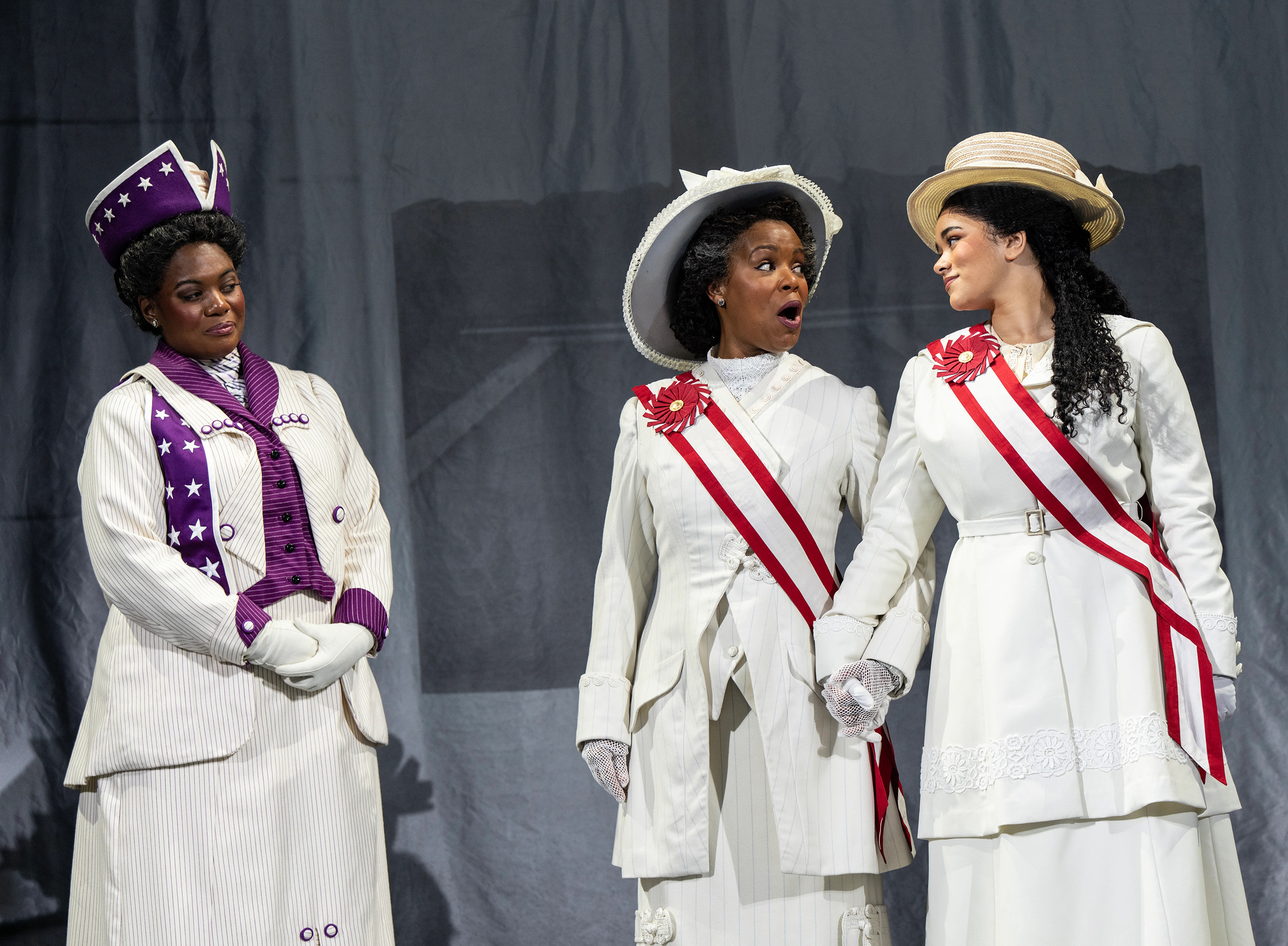
The show features a long list of thematic and musical oppositional parallels between many sets of characters, most notably Paul and Carrie Chapman Catt – the National American Woman Suffrage Association’s leader – played by Marya Grandy. A very close second pairing is Ida B. Wells, played by Danyel Fulton, and Mary Church Terrell, played by Trisha Jeffrey, whose harmonies, despite having significantly less stagetime than Paul and Catt, all but stole the show. Of note, Fulton’s introductory solo, “Wait My Turn,” was as powerfully written and composed as it was performed. Through these three different perspectives, agitators like Paul, “patient” ladies like Catt and the relentless African American women – who themselves are divided and marginalized for the sake of “progress” – the show celebrates the suffragist movement and tells its story beautifully.
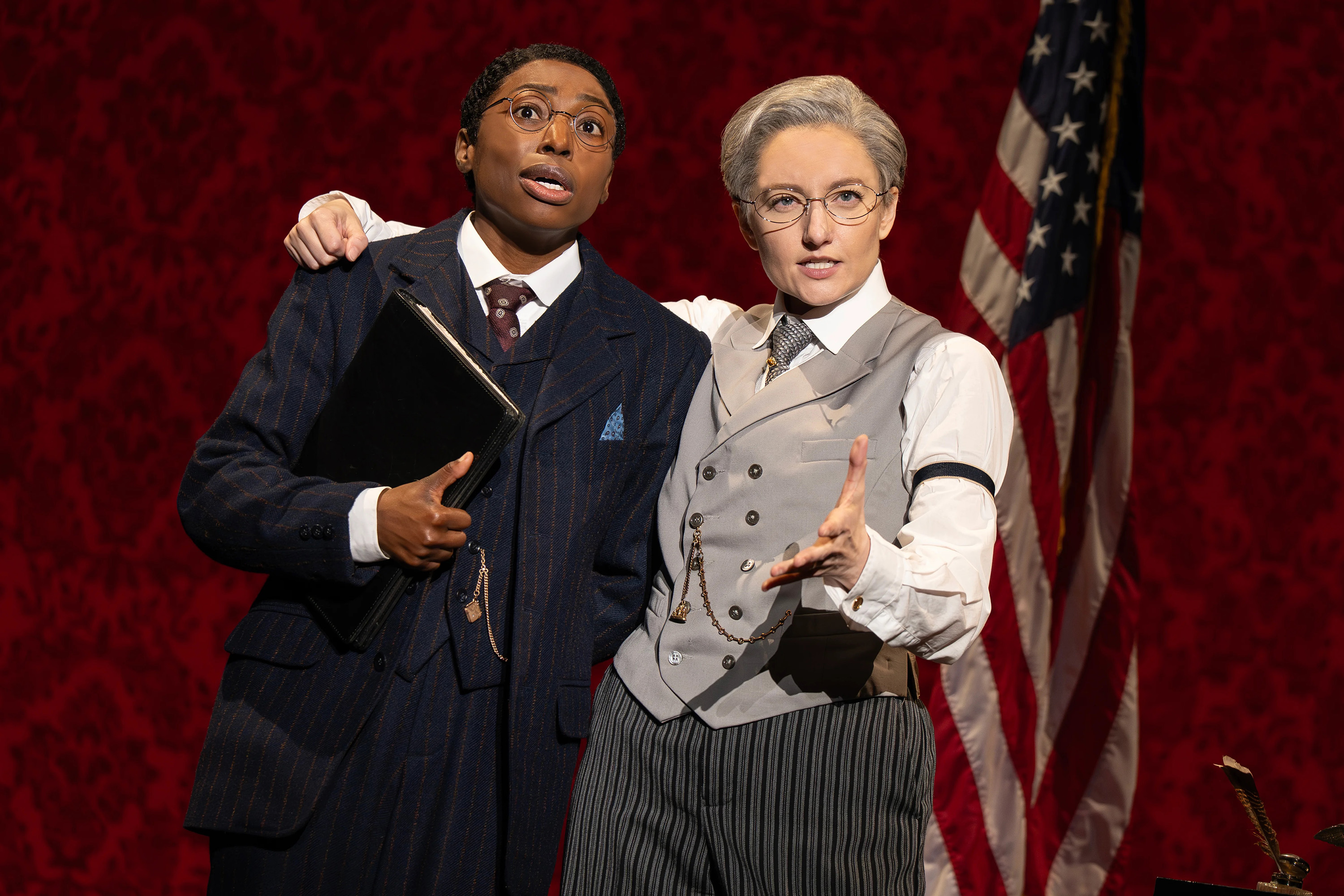
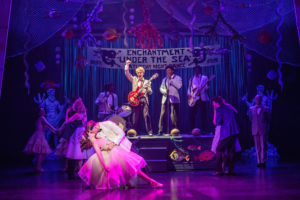
Alongside such powerful performances, the ensemble dazzled from start to finish with perfect cohesion in every scene. Their costumes, designed by Paul Tazewell, were reminiscent of his work in “Hamilton,” with their period piece styling complemented by a dose of modern flair. The sets, though fairly minimalist, were executed wonderfully with subtle coloring and staging supporting the actors. The flashiest set piece was certainly the oversized white steed that Inez Milholland, played by Monica Tulia Ramirez, rides down Pennsylvania Avenue as “a feminine reclaiming of the armored knight,” which feels perfectly extravagant in comparison to the staging around it.
The refined choreography struck a similar balance within the story; the women’s consistent in-sync movements added to their power as a cohesive force while subtly illustrating their societal constraints. Particularly phenomenal were the scenes in which Paul and her fellow suffragists’ protests are attacked by men – the choice to have them mime the assault and fight back without portraying the male aggressors was both visually interesting and thematically powerful.
Despite her incredibly strong vocal performance, Keleher’s acting felt by far the weakest of the cast. She spent entirely too long being excessively enthusiastic in the first act, seeming overly excited and too cheerful for her character. Joyce Meimei Zheng’s Polish accent for Ruza Wenclawska, one of Paul’s closest friends and a fellow suffragist, also seemed to fluctuate throughout the show, distracting from her otherwise perfectly uproarious performance.
Above all else, however, the greatest disappointment was “Fire & Tea,” in which Paul and her friends light an effigy of President Woodrow Wilson on fire outside of the White House. This being the moment Catt finally convinces Wilson, played by Jenny Ashman, to endorse women’s suffrage, it is easily the climax of the second act – if not the entire show. However, the effigy was lit only for around two seconds at the number’s close, feeling less like a burning culmination and more like a sad fizzle.
[Related: UCLA TFT’s ‘Rodrigo’ transcends time with Baroque artistry, evocative modern theme]
The strength of the second act’s writing dwindles somewhat, though only in comparison to the rest of the show, with some of the singing seeming more like melodic dialogue than intentional lyrics or scoring. The finale, “Keep Marching,” was easily the show’s best-written song, though this performance of it was rather underwhelming. A number where the entire cast sings directly to the audience ought to be passionate and moving, particularly through the strength of the lyrics, but this closing felt almost as though the cast was tired.
With the combination of its historical importance and powerful delivery, “Suffs” has earned a place in musical theater history. It is a shame the show has not yet fully cemented itself in that role. The theater was only around three-quarters full, though the audience was overwhelming in its support, even cheering mid-song at particularly potent moments. Further, it is a musical that aims to speak to young people, but the Pantages was filled, on average, with people seemingly over 50. A show so emotionally strong and culturally significant needs to be seen by younger audiences.
Simply put, anyone who considers themself an activist must find a way to see “Suffs.”


Comments are closed.