This post was updated Jan. 6 at 7:58 p.m.
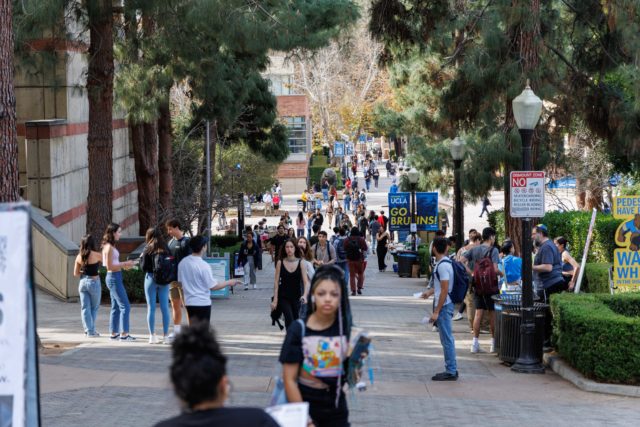
Imagine this: a student is walking back from class on Bruin Walk. Before they know it, they’re ambushed by a microphone, a camera and a controversial political prompt.
UCLA’s local and national significance makes it a destination for people who are trying to spread their beliefs.
It is common to encounter politically-motivated visitors on campus – interacting with students is a way to influence the next generation of leaders and decision-makers.
Political debate elevates UCLA’s campus and its student body. It educates students through a process where knowledge and reasoning are crucial for reaching the truth. It also motivates students to vote, as politically-charged conversations inspire us to take our beliefs to the ballot box.
Nonetheless, despite an increase in political rhetoric on college campuses, there are still students who do not follow up on their activism by voting. According to CIRCLE’s National Study of Learning, Voting and Engagement, not all college students who were registered in 2024 actually voted.
Census data shows 72.1% of voters aged 65 to 74 voted, compared to 43.9% of college-aged voters (18-24). Of every age demographic, college-aged students were the least likely to vote.
Statistics like these are tragic for a demographic as educated as college students.
Political debate might be the solution.
Studies consistently show that exposure to political issues increases the likelihood of civic engagement.
“We registered a lot of voters during the Florida special elections back in February,” said Zee Cohen-Sanchez, founder and executive director of National Ground Game, a left-wing organization that tours and debates on college campuses. “We are definitely changing minds.”
The organization’s tour provides an example of political debate benefiting students. Its open format allows students to develop their political beliefs and act on them by voting.
“Some people might not change their mind completely, but at least they become a little bit warmer to ideas on the other side,” said Steven Bonnell – a speaker for National Ground Game’s tour – who is known as “Destiny” online.
Many may associate this method of debate with right-wing commentators like Charlie Kirk. His organization, Turning Point USA, has hundreds of campus chapters, including one at UCLA. Meanwhile, left-wing organizations like National Ground Game have very few in comparison – a surprising fact, given college students are more likely to identify with the political left.
“The overall aim is to demonstrate that people on the left are capable of having challenging dialogue,” Bonnell said. “That’s not preserved just to the right.”
[Related: Ben Shapiro talks Israel-Hamas war, condemns left-leaning campus politics at UCLA]
A growth in left-wing campus chapters dedicated to political discourse would better represent students and encourage greater political participation.
Even if the overall impact of political debate is minimal, students are forced to reckon with their own positions. Ideally, self-reflection will make students think twice about who and what they vote for.
Conservative debaters Dennis Feitosa and Emilio Martinez have visited UCLA several times this quarter. The two frequently attract crowds with their controversial prompts and positions.
“I think that any day that ends with the conversation, whether you agree or disagree, whatever it is, however it ends, that’s a productive day,” Feitosa said.
Conversation and debate are important parts of discourse because they bring people together. The further we separate ourselves, the harder it is to find common ground and achieve social progress.
Recognizing that debate is not merely limited to convincing others is important.
“We have lots of conversations with all kinds of different people,” Martinez said. “I’m not here to necessarily change minds. I’m here to provoke thoughts.”
Just by listening to a conversation, audiences take in new perspectives that can further enhance their own views.
Ava Clovis, a second-year political science student, said she finds political debate an uncomfortable but necessary part of campus life.
“I know it’s part of a college campus. I always wonder, ‘What’s the underlying motivation?’” Clovis said. “Campuses are probably the only place that’s (debates) going to happen in a more productive sense of the word.”
Clovis is not alone in her belief that political discourse is difficult to welcome with open arms. In an environment where people have questionable motives and differing opinions, encouraging debate on campus is an uncomfortable ordeal.
Political debate acts like a foul-tasting medicine – while it can be difficult to swallow, it preserves an important part of who we are.
Only by navigating tough ideas together can we uphold a fragile democracy ravaged by division.


Comments are closed.