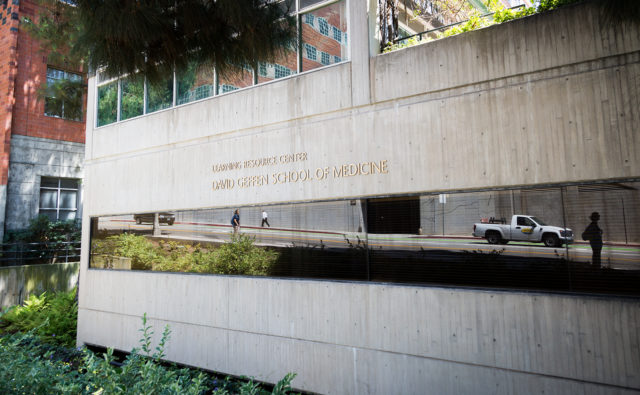
Dr. Allen and Charlotte Ginsburg pledged $31 million to UCLA Research Park and the David Geffen School of Medicine in November.
Their contribution will primarily support initiatives and facilities at UCLA Research Park – a new 700,000-square-foot hub for biomedical research located two miles south of UCLA’s main campus. The center will include both the California Institute for Immunology and Immunotherapy at UCLA and the UCLA Center for Quantum Science and Engineering, according to UCLA Newsroom.
[Related: Ted Lieu announces $1 million to fund UCLA Quantum Information Science Hub]
The recent grant follows the couple’s $29 million gift to UCLA Health in 2021, bringing the Ginsburgs’ total contributions to $60 million.
Ten million dollars will support the creation of the Dr. Allen and Charlotte Ginsburg Biomedical Frontiers Fund, through which money will be awarded to promising candidates in the biomedical field to conduct research at the UCLA Research Park. Another $10 million will cover capital needs, such as tools and laboratories, at the UCLA Research Park.
[Related: UCLA set to acquire former Westside Pavilion mall]
The final $11 million will go toward the Dr. Allen and Charlotte Ginsburg Fund for Graduate Student Support, which subsidizes books, tuition and housing for graduate students pursuing research.
Mark Peterson, a professor of law, public policy and political science, said in an emailed statement that the Research Park will allow UCLA scientists to expand their research ventures.
“UCLA is the smallest physical campus in the UC system, so space is at a premium,” Peterson said in the statement. “The new hub offers the opportunity to really build out the scientific and biomedical research enterprise infrastructure and do so not far from the main campus.”
The Palos Verdes-based couple – Dr. Allen, a retired ophthalmologist and Charlotte, a former professional dancer – previously gave $10 million to the University of Southern California’s Institute for Biomedical Therapeutics. They also assisted with the creation of the Ginsburg Center for Quantum Precision Measurement at the California Institute of Technology.
A foyer, paseo and bridge at the Research Park will be named for the Ginsburgs to honor their donation, according to a UCLA Newsroom press release.
Peterson added that the donation’s support for graduate students is significant because it comes during a particularly challenging time for scientific funding in higher education. The Trump administration suspended $584 million in research funding from UCLA in late July, alleging that the university allowed antisemitism, affirmative action and “men to participate in women’s sports.”
A federal district court judge temporarily reinstated UCLA’s frozen National Science Foundation and National Institutes of Health grants in August and September, respectively, in a case brought by UC researchers. The decision – which reinstated the vast majority of UCLA’s suspended funding – will hold while the case moves through the courts.
[Related: Federal judge orders Trump administration to restore $500M of UCLA research grants]
Peterson added that private donations offer institutions more flexibility compared to subsidies from the government, which often have stringent requirements for how they are applied.
“There is far more latitude with private gifts than there is in either research grant funding from the federal government through entities like NIH, NSF, the Agency for Healthcare Research and Quality,” he wrote. “Federal programs that support students also have fairly rigid guidelines. … Private gifts have to follow procedural rules as well, but they are far more open to what is negotiated between the campus and the benefactor.”


Comments are closed.