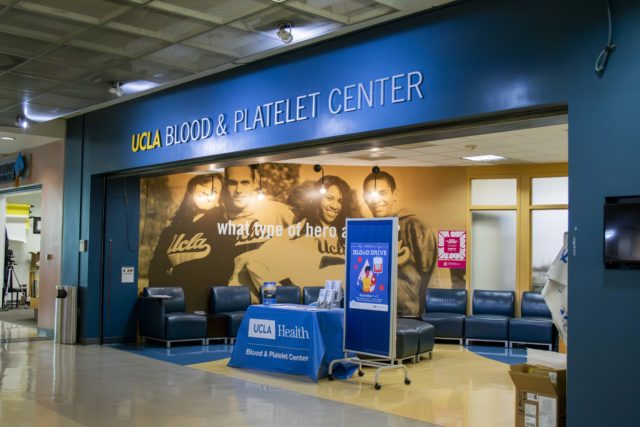
UCLA is looking for a last-minute push in this year’s Big Ten blood donation competition, as the Bruins lie in the bottom half of 18 participating universities.
The second-annual competitive drive, co-hosted by health care company Abbott and the Big Ten, addresses blood shortages across the nation. The drive, which began in late August, tracks the number of donors at each school and offers a $1 million prize to the campus with the highest number of donations.
[Related: UCLA participates in Big Ten, Abbott’s nationwide competition for blood donations]
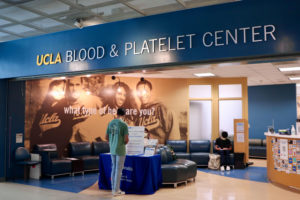
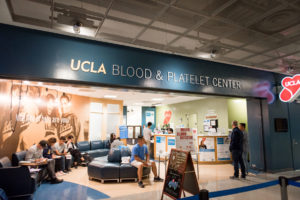
UCLA is currently 12th out of the 18 participating Big Ten schools, with a total of 2,492 donors as of 6 p.m. Wednesday. The nationwide campaign encourages students, alumni and fans to give blood at any certified center and log their donations online. UCLA can donate at the UCLA Blood & Platelet Center, one of the only permanent on-campus centers in the Big Ten.
The competition’s tracking system verifies each donation, said Ashley Brune, a spokesperson for Abbott, in an emailed statement.
“After someone makes … a blood donation, which can be done at any blood center or drive, they must go to BigTen.org/Abbott or text ‘DONATE’ to 222688 to log that donation and gain a point for their school,” Brune said in the statement. “Behind the scenes, we have a team that checks every donation to confirm its legitimacy.”
Brune added that schools across the conference have already surpassed last year’s totals, contributing to a more competitive field overall.
Regardless of UCLA’s current standing in the competition, organizers said the larger concern is addressing a continued need for blood donations. The American Red Cross Los Angeles Region has warned that blood donations routinely drop in October and continue to fall through the end of the year as people travel and shift into holiday schedules.
Ali Letchford, a UCLA student ambassador for Abbott, said it is a common misconception that hospitals have sufficient blood supplies, when they often fall dangerously short.
“Blood donations have a limited shelf life, so hospitals need a constant supply for surgeries, for trauma care, for cancer treatments, for emergency needs,” Letchford said. “There’s always the natural perception that someone else will do it, but I think it’s really important that people, especially in our age range, to tap into this whole sphere of the world that I think a lot of them are missing.”
Reuben Noorvash, the president of Bruin Blood Initiative – an organization that promotes awareness of blood-related issues and ways to donate – said many students underestimate how much difference a single donation can make.
Letchford, a fourth-year sociology student, said it was her first time donating, adding that she had always been nervous around needles growing up.
“As a first-time donor, I was a little nervous, and I was honestly really impressed by how quick and easy the whole process is,” Letchford said. “It was a very rewarding experience knowing how important it can be, and there’s a first time for everything. I think it’s absolutely worth it.”
Noorvash, a fourth-year psychobiology student, said he had a similar experience overcoming needle anxiety, recalling his first time donating during high school. However, he added that while needles can be intimidating, the chance to save lives outweighs the brief discomfort of donating.
“I wasn’t looking at the needle. I was really scared. And then when it was done, I saw it’s not that bad,” Noorvash said. “The benefit is just so much greater than that.”
Noorvash said UCLA gives students a unique opportunity to contribute, as it is the only West Coast Big Ten campus with a permanent blood center on campus. These donations can be done between classes due to the accessible site, Noorvash said, adding that they directly support UCLA Health hospitals.
And the goal of the competition, Brune said, is not only to increase donations now, but to help students form long-term habits.
“Once someone has donated blood once, they are much more likely to do so again,” Brune said. “We hope this campaign helps college students build a habit that turns them into lifelong donors.”

Comments are closed.