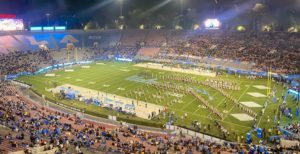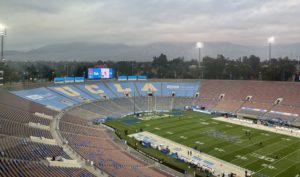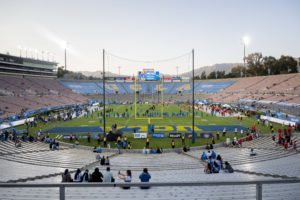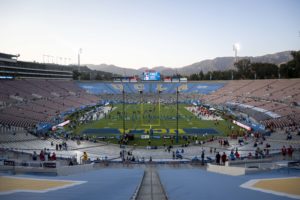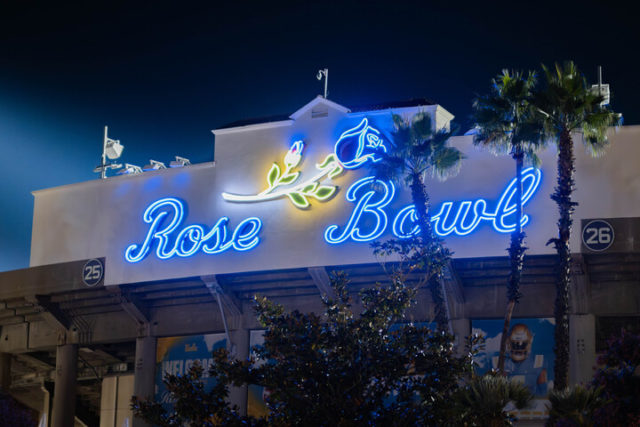
The City of Pasadena and the Rose Bowl Operating Company added SoFi stadium’s owner as a defendant in their lawsuit aimed at stopping UCLA from leaving its home stadium Thursday.
The plaintiffs amended the complaint to include Kroenke Sports & Entertainment and its subsidiary, Stadco LA, as defendants, alleging that SoFi was aware of UCLA’s contract with the Rose Bowl but still went on a “quest to facilitate UCLA’s attempt to leave.” The City of Pasadena and the RBOC initially sued the UC Board of Regents on Oct. 29, claiming that UCLA planned to move its football games to SoFi stadium despite signing a contract with the Rose Bowl through 2044.
A judge denied the plaintiffs’ motion to file a preliminary injunction and temporary restraining order against UCLA on Nov. 12, citing a “lack of an emergency.” The judge, however, said the plaintiffs could reapply for an injunction after both parties obtained additional evidence.
[Related: Judge denies temporary restraining order to block UCLA from leaving Rose Bowl]
KSE executives openly said in late 2024 or early 2025 that SoFi was pursuing UCLA, according to the amended complaint.
“The terms of RBOC’s and UCLA’s Agreement are public, explicit, and widely known throughout the collegiate sports community,” the lawsuit said. “Indeed, the SoFi Defendants actively participated in discussions intended to induce UCLA to abandon its contractual home in Pasadena.”
UCLA representatives and SoFi have discussed seating arrangements, revenue sharing and development projects regarding the move, according to the suit. The plaintiffs also alleged in the suit that UCLA’s failure to commit to the Rose Bowl for 2026 has caused the RBOC and the City harm, including by causing a Rose Bowl donor to pull out a $1 million pledge.
Plaintiffs said that UCLA’s move would devastate both the city and the stadium financially, alleging in the complaint that the City has invested nearly $200 million in the stadium in reliance on UCLA’s contract.
“The City issued substantial debt and invested in the stadium and surrounding areas to create more revenue for UCLA and improve its fan experience,” the lawsuit said. “The bond structure was designed so that stadium revenues, not taxpayer dollars, would service the debt.”
The City and the RBOC approved $26.5 million for stadium-related projects for fiscal year 2026 – including improvements to the south end-zone area, which is designed to enhance the UCLA gameday experience and generate additional UCLA-controlled revenue, per the amended complaint. The new project would include premium seating, a redesigned player tunnel and better press-conference infrastructure that is tailored to UCLA’s preferences, the plaintiffs alleged.
The plaintiffs also said in the suit that UCLA participated in meetings with RBOC related to the new project – including design reviews with Daniel Cruz, UCLA Deputy Athletics Director and Chief Revenue Officer – as recently as spring and summer 2025.
“UCLA representatives expressed enthusiasm for the south end-zone plans, discussed future years’ uses of the space, and provided detailed input concerning seating capacities, premium product mixes, and other design elements,” the lawsuit said. “At no point during these meetings did UCLA disclose any plan to leave the Rose Bowl Stadium. Not once.”
[Related: ‘It is our home’: Students react to UCLA’s possible move to SoFi stadium]
The amended complaint also claims that Jens Weiden, the RBOC’s chief executive officer, first learned of UCLA’s potential departure during a conversation with a high-level UCLA Athletics employee – who said he would “feel bad” if RBOC transitioned to UCLA’s preferred ticketing vendor only for the team to leave the stadium after the switch.
Weiden then met with Stephen Agostini, UCLA’s vice chancellor and chief financial officer, who told him that UCLA Football was “considering its options,” according to the suit. The plaintiffs alleged in the lawsuit that Agostini said a Rose Bowl site visit would help UCLA “get comfortable,” but never followed through on scheduling it despite RBOC’s efforts.
“This lawsuit arises in an era when money too often eclipses meaning and the pursuit of profit threatens to erase the very traditions that breathe life into institutions,” the lawsuit said. “At this moment, UCLA must be held to its contractual obligations with the City.”