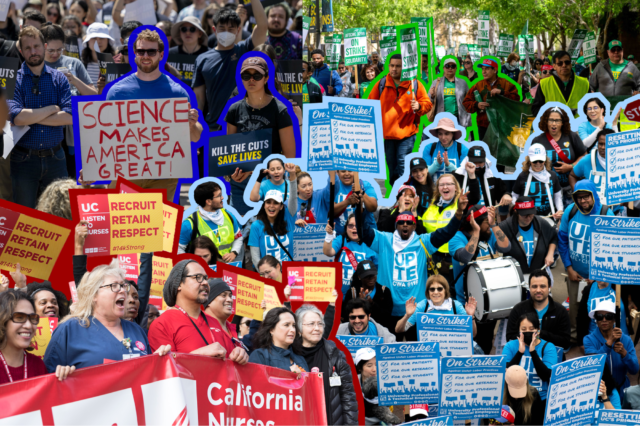
Unions representing UC workers have struck several times across the UC in the past year, limiting dining halls and campus services.
There are several UC unions who represent a variety of workers, from nurses to academic researchers. While they all represent different parts of the University’s work force, over the past year these unions have all protested against administrators – demanding fair wages, housing benefits, affordable healthcare and job security.
[Related: UPTE-CWA 9119, CNA ratify new UC contracts, secure benefits after negotiations]
The American Federation of State, County and Municipal Employees Local 3299 – which represents more than 37,000 service, patient care and skilled workers – held its latest strike Nov. 17 and 18 at UCLA. Its members represent the lowest-paid workers across the UC, including dining hall staff, custodial services and patient support.
The union has been in negotiations with the UC for nearly two years, after the contracts for AFSCME Local 3299’s patient care and service workers expired in 2024. The union struck in response to the University’s alleged failure to settle fair contracts, according to its website.
Heather Hansen, a spokesperson for the UC Office of the President, said in an emailed statement that the UC is committed to good-faith bargaining and continuing productive conversations with the different unions at UCLA. She added that the financially uncertain situation UC is in affects their ability to negotiate.
[Related: FEDERAL FUNDING CUTS TO UCLA]
The University Professional and Technical Employees-Communications Workers of America 9119 – which represents technical workers and researchers – and the California Nurses Association originally intended to strike with AFSCME Local 3299, but decided not to after they both reached a tentative agreement with the University in November.
Both UPTE-CWA 9119 and CNA ratified their new contracts late November, completing the process by which union members vote to approve a contract and making it a legally binding agreement.
Diana Dayal, the regional vice president for the union Committee of Interns and Residents/SEIU Healthcare, said collective bargaining is important for the union to advocate for its workers.
“You essentially collectively bargain, meaning you represent all of the workers who are part of that union, and you work together to get a contract in place that guarantees you fair wages, fair benefits, fair labor protections from your employer,” Dayal said.
Workers in the private sector – which do not include UCLA employees – gained the right to collectively bargain in 1935.
Congress passed the National Labor Relations Act that year, giving private sector employees the right to bargain collectively through chosen representatives, according to the National Labor Relations Board. The law also gave workers the right to self-organize, form or join labor organizations.
Most public-sector employees, including those at UCLA, did not gain the right to collective bargaining until four decades later.
The state legislature passed the Higher Education Employer-Employee Relations Act in 1979, extending collective bargaining rights to the faculty and workers in the UC.
Under the United States Constitution, states set their own laws related to workplace safety and fair employment, as these powers are not granted to the federal government, according to the U.S. General Services Administration’s website.
Trevor Griffey, a lecturer in the UCLA Department of Labor Studies, said both employers and employees are legally required to bargain in good faith, which means to approach negotiations with mutual respect and commitment to reach a contract.
According to law firm Miller Cohen PLC, bad faith bargaining includes when an employer uses delaying tactics during negotiations – such as refusing to deliberate during a reasonable time frame or stalling meetings. Employers can also bargain in bad faith through making unreasonable contractual demands.
“There’s lots of ways to stall, delay, disrupt and undermine bargaining as a tactic within bargaining,” Griffey said.
The law also gives employees the right to strike, according to the UCLA Faculty Association.
[Related: UPTE-CWA 9119, AFSCME Local 3299 negotiations with UC remains ongoing]
Unions can legally hold strikes if they fail to reach an agreement with their employer through bargaining. The parties may declare an impasse, after a failure to resolve any disagreements. At that point, a state mediator steps in. If no agreement is reached afterward, the unions are permitted to initiate a strike.
Dayal, a resident in emergency medicine at UCLA, said workers unionize because collective action holds more power than individual action.
The CIRSEIU represents more than 6,400 resident physicians and fellows across the UC, according to its website.
“The healthcare system runs on the labor of unionized workers, and it’s really important to remember that when you’re a student at the UC, so much of the operations of the campus relies on the work of unionized workers,” Dayal said.
Ursula Quinn, UPTE-CWA 9119’s vice president, said workers struggle with staffing shortages that negatively impact patient care. She added that employees cannot afford to live near their workplace, and long commutes place stress on employees’ mental health.
[Related: Long commutes, short-staffed – ‘We want to live,’ union leaders demand from UC]
According to a report by the California Legislative Analyst’s Office, California wages cannot keep up with the state’s rising housing costs and rents.
The cost of buying a home in California exceeds the state’s median household income, according to the report. Qualifying for a mortgage for a mid-tier California home also requires a household income twice the amount of the state’s median income.
Dayal said unions seek to address the issue of the high cost of living by pushing for contracts that include benefits such as improved wages and fair labor protections.
“Being able to negotiate a better contract means better working conditions for the folks that we work with,” she said. “That means that we are all better able to take care of patients, if we also take better care of our workers.”
The UC has also allegedly stalled negotiations with several unions due to budget cuts, Dayal said.
The UC has faced financial shortfalls in the past year, with the federal government suspending about $584 million of UCLA’s research grants, alleging that the university allowed antisemitism, affirmative action practices and “men to participate in women’s sports.” The state also deferred a payment of about $130 million to the University until July 2026.
Dayal said the cuts impact funding that could go toward paying its workers.
“A number of these unions are having a very extended bargaining process, really due to the UC dragging their feet,” she said. “They’re claiming that they’re facing these federal funding cuts… at the end of the day, the UC continues to be a very profitable endeavor.”
Through bargaining better contracts and striking, unions are fighting for a higher standard of working conditions for the incoming generation, Quinn said.
“The conditions of employment are getting harder and harder for all types of people,” Dayal said. “It should really inspire young people who are graduating from elite institutions like UCLA to remember that we need to stand in solidarity with other workers.”


Comments are closed.