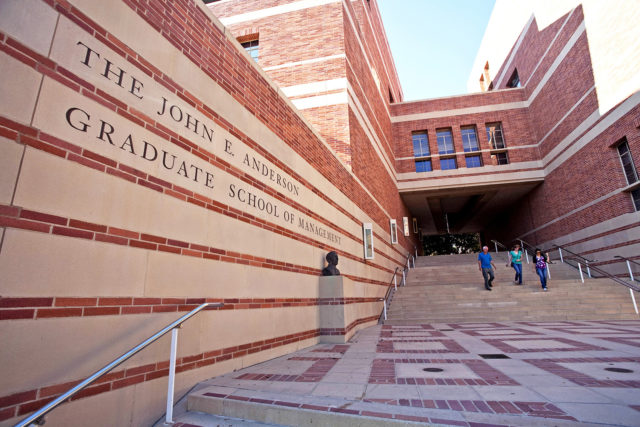
UCLA economists predicted that investments in artificial intelligence may propel the United States’ GDP in the first quarter of 2026, while the labor market will weaken.
The Anderson School of Management’s December forecast indicated that the economy will “muddle” in early 2026, but will strengthen by the end of the year. However, the economists added in the report that there is still great uncertainty in the economy due to the federal government shutdown – which lasted Oct. 1 to Nov. 12.
Thomas Ash, an economist at the UCLA Anderson Forecast, said the federal government shutdown – the longest in U.S. history – will not strongly affect the economy in the long run, as it was a “transient shock,” but it will impact economic data for this fiscal quarter.
Jerry Nickelsburg, a senior economist with the UCLA Anderson Forecast, said the government shutdown created a “dead reckoning” in which economists have little data on the present state of the economy. The federal government did not publish the October jobs report or consumer price index during the shutdown.
“We knew where the economy was prior to the shutdown,” Nickelsburg said. “We knew the direction it was going but we didn’t have the additional information, and so we extrapolated from that.”
Nickelsburg said in the report that, because of the lack of data from the shutdown, Anderson’s September forecast – which said the economy would slow through 2025 and early 2026 because of tariffs and shifting international trade policies before a new wave of growth – is likely still applicable.
[Related: Anderson Forecast finds Trump’s tariffs slow US, California economic growth]
Anderson economists also predicted that the deportation of undocumented immigrants and elevated unemployment rates would hamper economic growth. Despite this, California is experiencing GDP growth that is higher than the country, according to the report.
The federal government deported at least 8,000 people from California in 2025, according to a Monday report from the Sacramento Bee. Nickelsburg said in an interview that deportations could have the potential to heighten the state’s unemployment rate, but it is too early to tell the impacts.
“We studied 55 counties in California and found some evidence, weak evidence, that the same effect was happening,” he said. “But it’s really too early to see if there’s going to be a major impact on unemployment.”
Rising construction prices could impact rebuilding efforts in the wake of the January 2025 Los Angeles fires, Nickelsburg said in the report. Inflation, tariffs on building materials and deportations – which could minimize the amount of available construction workers – may also curtail the rebuilding process, he added.
[Related: The Bruin’s Full Coverage of the LA County Fires]
Clement Bohr, a senior economist at the UCLA Anderson Forecast, said continuous investment in AI – especially from large technology firms, such as Google and Nvidia – could spur economic growth. Anderson economists said AI-related investment surpassed $405 billion in 2025, and more increases are expected in 2026.
President Donald Trump’s tariff policies will likely slow GDP growth in the U.S., Ash said. However, he added that heightened investment in AI has the potential to counteract GDP decline.
Bohr added that House Resolution 1 – also known as the “One Big Beautiful Bill” – would bolster the economy.
“We’re going to get tax refunds from 2025 as well as having to pay less taxes in 2026 on our new income,” he said. “Households are going to have a lot more cash in their hands in 2026 than they did in 2025 because of these tax cuts, and the same is true for firms.”
The report expected unemployment to rise to about 4.5% in the fourth quarter of 2025 – a figure which actually landed at 4.4%, according to the Bureau of Labor Statistics. Consumer price index inflation is expected to peak in early 2026 at a rate of 3.5% and interest rates are expected to range from 4% to 4.4% in the long run, according to the report.
Bohr said in the report that the economy is ultimately in a state of instability, and has the potential to accelerate or decelerate in 2026.
“We’re going through a very unstable time, and so don’t overreact to anything that happens day by day because a lot of things cool off, or it becomes clear over time when things really matter,” Bohr added in an interview.

Comments are closed.