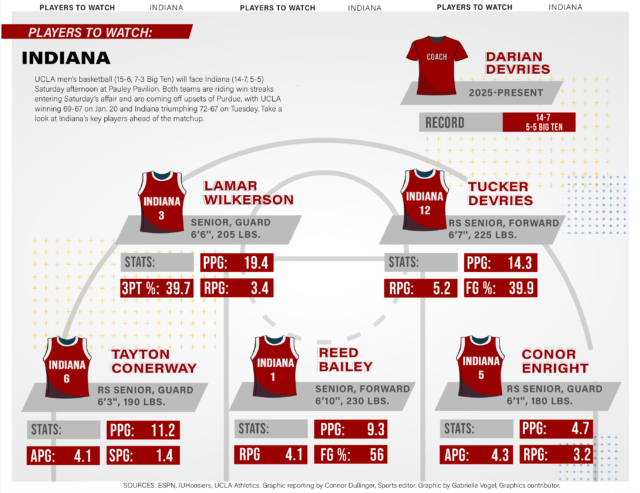
The Bruins have won five of their last six games, including against the then-No. 4 Boilermakers 69-67 on Jan. 20. The Hoosiers have won back-to-back games, including a similar 72-67 upset over the Boilermakers. Now, after both teams beat the same ranked opponent, UCLA men’s basketball (15-6, 7-3 Big Ten) will face Indiana (14-7, 5-5) Saturday afternoon at Pauley Pavilion. Daily Bruin Sports editor Connor Dullinger breaks down the Hoosiers’ strengths and weaknesses.
Personnel:
Coach: Darian DeVries
Starting lineup: Guard Lamar Wilkerson, guard Tayton Conerway, guard Conor Enright, forward Tucker DeVries, forward Sam Alexis
Best player: Tucker DeVries
X-factor: Lamar Wilkerson
KenPom ranking: No. 31
Adjusted defensive rating: 101.8 (No. 51)
Adjusted offensive rating: 122.1 (No. 28)
Adjusted tempo: 66.5 (No. 222)
There is a new look in Bloomington, Indiana.
Indiana’s roster is composed almost entirely of new athletes – just one player from last season’s Hoosier squad returned – all of whom came from different programs. In fact, the only two people to come from the same school are coach Darian DeVries and his son, Tucker DeVries.
Yet, despite the lack of continuity, the Hoosiers began the season 7-0, won five out of six from Dec. 9 to Jan. 7 and are riding on the high of an upset over the Boilermakers – their first ranked win of the season.
The Hoosiers’ success comes down to the roster Darian DeVries built – a squad that complements one another and boasts hot shooting and veteran leadership.
Spearheading Indiana is a two-man show of forward Tucker DeVries and guard Lamar Wilkerson. The latter ranks fifth in the Big Ten in scoring, averaging 19.4 points per game, while the former knocks in 14.3 points per game and a team-leading 5.2 rebounds per contest.
Wilkerson’s point totals are largely produced beyond the arc, shooting an ultraefficient 39.7% from deep on a high volume of 8.3 long-range attempts per game.
He has a fast-twitch jump shot that is within range from anywhere in the half-court. While he performs better on catch-and-shoot jumpers, Wilkerson can spray from all over the court, showing little hesitation to shoot even against pressure.
And when Wilkerson is hot, he is unstoppable.
The Hoosiers’ leading scorer has scored double-digit points in all but three games this season and exploded for 44 against Penn State on Dec. 9, 32 against Nebraska on Jan. 10 and 27 against Rutgers on Jan. 23. In all three of those games, Wilkerson hit five or more 3-pointers.
Wilkerson’s 6-foot-6 frame makes him a bigger guard compared to most opposing backcourts. And the Ashdown, Arkansas, local is not afraid to utilize his strength, whether by bullying smaller guards in the paint or leading the transition with contact buckets.
He is not the fastest guy on the court, but he may be the smoothest, using shot fakes, purposeful hesitations and a short, quick stroke to catch defenders off guard and find the bottom of the net.
In contrast, Tucker DeVries is a more versatile option, ranking second on the team in points, first in rebounds and third in assists. However, Tucker DeVries has struggled with efficient shooting all season, holding just a 39.9% field goal percentage.
But don’t let that fool you.
Even when Tucker DeVries fails to light up the scoring tally, he fills up the statsheet elsewhere. He is a great passer for his size at 6-foot-7, notching at least three assists in the last six games, and is a tenacious rebounder – evidenced by his most recent back-to-back games of 10 rebounds.
Most importantly, though, Tucker DeVries can make tough shots, and he is not afraid to let it fly – hitting 4-of-12 long-range shots against Rutgers on Jan. 23 and 4-of-9 against Michigan on Jan. 20.
But the Hoosiers are more than a two-man army.
Rounding out the starting backcourt are guards Tayton Conerway and Conor Enright. Conerway plays larger than his 6-foot-3 frame would suggest, boasting a more downhill approach that invites contact at the rim.
Conerway’s 53.6% field goal percentage and 28.1% 3-point percentage illustrate his shot diet. The guard follows Wilkerson and Tucker DeVries in the scoring department, averaging 11.2 points per game, most of which come from inside, but he is more than a willing shooter if wide open.
The former Troy player may struggle at Pauley Pavilion, given his recent slump, mustering more than 10 points just once since Jan. 7. But while Wilkerson typically sticks to shooting, Conerway helps find open teammates, averaging 4.1 assists per game, which ranks second behind the third starting guard.
Enright is nothing to write home about when it comes to seeing the ball go in the net – averaging just 4.7 points per game through 21 games played, despite 28.9 minutes of action per contest.
But he does everything else – leading the team with 4.3 assists per game while also adding 3.2 rebounds per game despite his 6-foot-1 frame. And while he shoots just over 40% from the field, he can let it fly from deep, shooting 34% from beyond the arc on the year.
Rounding out the team’s top scorers is forward Reed Bailey. Despite standing at 6-foot-10, he is quite springy and athletic for his slender frame. Bailey averages 9.3 points and 4.1 rebounds per game while shooting an efficient 56% from the field.
Bailey’s impact flourishes in the pick-and-roll game, where he excels at slipscreens to mix up opposing coverages. Bailey finds the open space very well, and the confusion he creates allows him to feast on easy baskets.
If Bruin defenders lose sight of him at the top of the key or in open space on the weak side, it could be a long day for the UCLA frontcourt.
Joining Bailey in the frontcourt is forward Sam Alexis, who has usurped Bailey as a starter. The former Gator was part of Florida’s 2025 national championship squad, and he now averages 4.8 rebounds and 7.1 points per game through 21 games this season.
Alexis is not the flashiest player, but he is assertive on and around the glass. And considering the Bruins’ struggles with rebounding this season, Pauley Pavilion could be seeing a lot of Alexis come Saturday.
While Bailey and Alexis dominate in the interior, guard Nick Dorn dominates outside.
Dorn averages 8.8 points per game on a 45.1% shooting percentage from beyond the arc, contributing to Indiana’s No. 23 3-pointer volume in the country. Dorn shows little hesitation from beyond the arc and could pull up from the parking lot, boasting a smooth and confident jumper.
The 6-foot-7 guard mainly contributes from long range and could be a Bruin nightmare if he catches heat Saturday. Dorn has scored 14, 23 and 18 in the last three games, respectively, shooting 4-for-9, 6-for-10 and 4-for-9 from beyond the arc in those contests.
While Tucker DeVries and Wilkerson garner a plethora of defensive attention, Dorn could go unnoticed, which may be fatal.


Comments are closed.