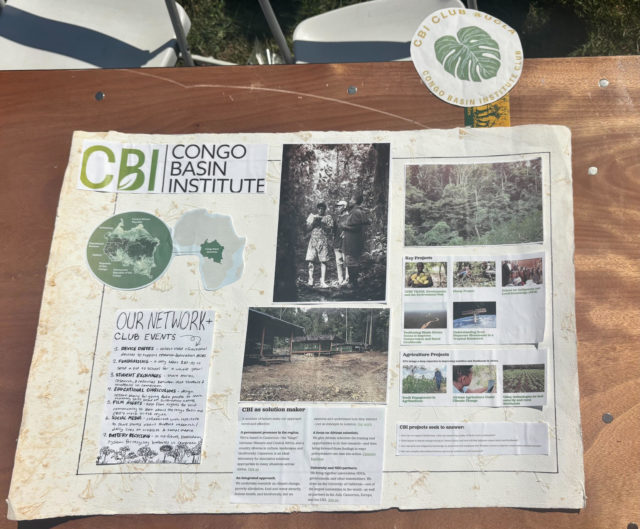
The Congo Basin Institute Club at UCLA provides Bruins with the opportunity to support environmental research conducted by UCLA’s Congo Basin Institute – both on campus and in Cameroon.
The CBI is a partnership between UCLA and the International Institute of Tropical Agriculture that is based in Cameroon and researches solutions to climate change, disease and food insecurity, according to its website. The CBIC’s focus is to connect UCLA students with Cameroonian students, said Sofia Brown, a fourth-year environmental science student and the club’s director.
The region suffers from “brain drain” – a phenomenon in which skilled workers move abroad, according to the Migration Policy Institute.
CBIC resumed its work under new leadership this fall after a year-long hiatus.
The UCLA chapter established a line of communication with graduate students in Cameroon via WhatsApp, Brown said. Graduate students use the chat to share their research papers on different environmental and conservation topics, Brown added.
CBIC plans to host informational workshops with the Center for Tropical Research – which is under the Institute of the Environment and Sustainability at UCLA, Brown said.
“Undergrads from both UCLA and in the Congo (Basin) can ask questions to researchers from UCLA in the Congo about what grad school is (and) what advice they might have,” said Noah Kamps, the deputy director of CBIC.
CBIC works on the ongoing projects of the students it connects with and hosts events to connect, he added.
Elsa Ordway, the club’s faculty advisor and an assistant professor in the department of ecology and evolutionary biology, bridges the undergraduate club’s connection to the CBI, as she is the co-director of the organization, Brown said.
Ordway has been a part of CBI for many years, having traveled to Cameroon’s Dja Faunal Reserve, and puts CBIC in contact with Central African students via Zoom, Kamps said.
CBIC encourages public donations through its device drive form for used phones, tablets and laptops, said Molly Milne-Gerlaugh, the head of the club’s device drive committee and a third-year psychobiology student.
The donated devices will help communities like the Baka pass down their knowledge to younger people in their community, Milne-Gerlaugh said.
Brown said the club is searching for students passionate about social work and public health – as well as students who speak French, Cameroon’s most widely-spoken language – to support their initiatives.
“At UCLA, we have so much access being this huge, leading research institution, to different research and papers that other people might not have available to them,” Kamps said. “We’ve set up this pipeline for communication where people in Cameroon can request access to research papers that we might have but they might not have access to, and we can then help translate it into French, which is spoken a lot in Cameroon, or just help them give access.”

Comments are closed.