This post was updated March 4 at 11:32 p.m.
Several student organizations have called for UCLA to designate itself as a sanctuary campus in response to the Trump administration’s mass deportation campaign.
The modern sanctuary campus movement – in which students across the country call for their universities to adopt the “sanctuary campus” title, as well as implement stronger protections and financial support for undocumented students – was conceived during Trump’s first term. The movement also calls for universities to not join or cooperate with immigration enforcement unless legally required – a policy already adopted by UC campus police departments.
Student groups such as the Socialist Students at UCLA and the Student Labor Advocacy Project of UCLA pushed for UCLA to become a sanctuary campus during Trump’s first term, but the university has not made the distinction.
[Related: Students, groups advocate making UCLA a sanctuary campus at town hall]
Several colleges and universities – such as Portland State University, Pitzer College and the University of Pennsylvania – adopted the designation between 2016 and 2020.
The Young Democratic Socialists of America, Labor Studies Student Union at UCLA, UC Divest Coalition at UCLA and Corazón de UCLA – an immigrant advocacy group – called for UCLA to establish itself as a sanctuary campus in a Jan. 30 Instagram post.
The post called for UCLA to commit to multiple policies, including refusing to disclose student, faculty and staff information to immigration authorities, expanding the BruinAlert system to notify community members if immigration enforcement officers are on campus and designating private areas as “safe zones.”
Steve Lurie, the associate vice chancellor for campus and community safety, redirected the Daily Bruin’s request for comment to UCLA Strategic Communications. The Office of Campus and Community Safety oversees both UCPD and the UCLA Office of Emergency Management.
A UCLA spokesperson said they recognize recent events have created a great deal of anxiety and uncertainty, and they remain committed to supporting all individuals’ ability to work, learn and thrive at UCLA.
Tommy Contreras, the Undergraduate Students Association Council’s internal vice president, said the fear and uncertainty he has seen within the student body show that the UC system has not done enough to make undocumented students feel safe, protected and welcome.
USAC passed a resolution calling for UCLA to become a sanctuary campus in February 2025.
“Undocumented students are not statistics,” Contreras said. “They’re classmates, researchers, leaders, future professionals, and I think the sanctuary campus policies that we were advocating for would set clear boundaries around how university resources are used and ensuring that campus police and administrators are not acting as extensions of federal immigration enforcement.”
USAC reaffirmed its position in a letter to UC President James Milliken and the UC Board of Regents, calling for the UC to declare all of its campuses as sanctuary campuses.
The Los Angeles City Council unanimously voted in November 2024 to establish the city of LA as a sanctuary city, prohibiting the use of city resources for immigration enforcement. The 2017 California law – SB 54 – also known as the California Values Act, limits cooperation between state and local law enforcement and federal immigration enforcement officers.
Gov. Gavin Newsom signed a bill into law in September requesting the UC – and California Community Colleges and California State University systems – notify community members if the university confirms the presence of immigration enforcement officers on campus.
UCLA plans to send an email to students, faculty and staff if it can confirm that federal agents are enforcing immigration law on campus, Lurie said in a December interview.
[Related: UCLA shares immigration enforcement policies, procedures in accordance with CA law]
However, the university will not use Bruin Alert, Lurie said, adding that the system is for active emergencies.
The Jan. 30 Instagram post also called on UCLA to improve financial resources for undocumented students, guarantee “Know Your Rights” training accessibility and communicate public support for its students.
UCLA does not release information on or related to the immigration status of its students unless required by law due to federal agents having a judicial warrant, subpoena or court order, Chancellor Julio Frenk said in a campuswide message last March.
Talia Inlender, the deputy director of the Center for Immigration Law and Policy at the UCLA School of Law, said she believes that while the University cannot prevent immigration enforcement from entering public areas on campus, there are other important steps the UC can take.
Clearly marking private areas where immigration enforcement is not permitted and establishing procedures for community members to take if immigration enforcement officers are on campus could help protect staff and students, Inlender added.
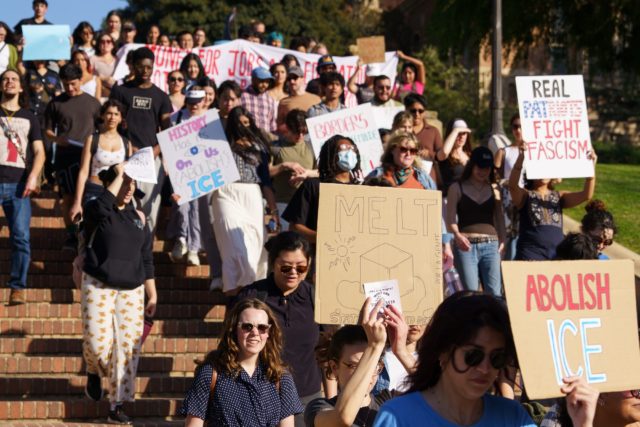
About 30 demonstrators gathered for a “Sanctuary Now” rally outside Murphy Hall on Feb. 19, which was organized by the same organizations that made the January Instagram post.
Aera Rege, a first-year gender studies and political science student, said they participated in the “Sanctuary Now” rally because they believe many students cannot focus on education if they are worried for their or their family’s safety.
Karla Vasquez Perez – a fourth-year Chicana and Chicano studies, labor studies and political science student – said she believes adopting the sanctuary campus protocols would help ensure the safety of students from vulnerable communities.
“We have not gotten raided, but we’re not far away from that,” Vasquez Perez said. “We have very vulnerable communities from students of color to us or workers and people that visit our school or different schools. We don’t have a place and system to alert students if there is ICE (U.S. Immigration and Customs Enforcement) presence.”
Andrew Lewis – chair of the Community Health, Homelessness, and Safety Committee for North Westwood Neighborhood Council – said UCLA designating itself as a sanctuary campus would send a signal that the university is completely against ICE presence on campus.
LA mayor Karen Bass signed Executive Directive 17 on Feb. 10, which prohibits the use of city-owned property for ICE staging and operations, as well as orders LAPD to preserve evidence of federal immigration enforcement activities. Inlender said the directive provides backing behind the city’s sanctuary designation by outlining clear steps that will be taken to ensure that immigration enforcement officers do not have access to city resources, something the UC could adopt.
“That can be a model for UC,” Inlender said. “It lays the foundation for transparency and accountability when immigration enforcement action does take place in our city.”
[Related: Over 1,000 demonstrators join on-campus walkout to protest ICE crackdowns]
Contreras, whose office organized a Jan. 28 walkout that drew over 1,000 attendees to protest the Trump administration’s mass deportation campaign, said it is important for USAC and the student body to continue their advocacy on this issue.
The U.S. Department of Homeland Security did not respond to a request for comment on the sanctuary campus movement.
“We don’t have an immigration policy,” said Vasquez Perez, who was an organizer and speaker at the walkout. “We don’t have an immigration system. We’ve been putting band aids to this form of exclusion and racism.”


Comments are closed.