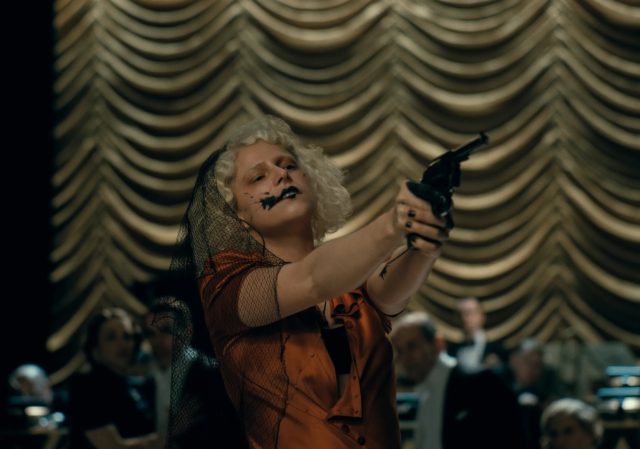


In “The Bride!” Maggie Gyllenhaal fails to breathe new life into a classic source material.
Landing in theaters March 6, actress and filmmaker Maggie Gyllenhaal’s sophomore directorial project trips and stumbles through grimy alleyways and ritzy clubs before finishing with an electrifying kaput. Maggie Gyllenhaal’s film reveals her affinity for adapting female-centric narratives, as she took a similar approach with her 2021 critically lauded work “The Lost Daughter” – an adaptation of Elena Ferrante’s novel of the same name. On the other hand, “The Bride!,” a gaudy, retro-futuristic remake of the 1935 sequel “Bride of Frankenstein,” is less a gothic black-and-white horror film and more so a rich feminist retelling left entirely unrealized.
The film opens with a prostitute Ida (Jessie Buckley) who has split personality disorder in the form of Mary Shelley (also portrayed by Buckley). After a fight with her mob employers, Ida takes a fatal tumble and is soon “reinvigorated” as the Bride by a lonely Frank (Christian Bale) seeking immortal companionship, with the help of (curiously normal) mad scientist Dr. Euphronious (Annette Bening). The newlywed couple escapes the laboratory to a fringe club soon thereafter and – once Frank curb stomps an assailant in the Bride’s defense – they embark on a cross-country odyssey as star-crossed outlaws.
What ensues in the following 90 minutes is no more comprehensible than the Bride’s mercurial rambling. Hot on their trail are Detective Jake Wiles (Peter Sarsgaard) and his assistant Myrna Malloy (Penélope Cruz), a parallel duo with contrasting dynamics: Wiles is the self-assigned ‘people person’ in the patriarchal world, covertly allowing the shrewd Myrna to advance their lead. At each stop in the film’s alternate 1930s America, Frank seemingly has one desire: To watch his idol, movie star Ronnie Reed (Jake Gyllenhaal), in romantic musicals at local theaters – a narratively cheap tactic Maggie Gyllenhaal doggedly recurses to keep the detectives in close pursuit.
Things crash and burn. The Bride and Frank infiltrate a high-society party at which Frank meets Ronnie and the Bride goes full Harley Quinn – resulting in a highly stylized flash mob. The Bride and Frank incite a citywide feminist revolt for, quite literally, less than two minutes of footage. The mob then tracks down the Bride, who turns out to have been the object of Wiles’ affection the entire time. Indeed, Maggie Gyllenhaal consistently struggles to explain her characters’ inscrutable actions as they whizz around in her pinball machine of a plot.
[Related: Oscars 2026: Daily Bruin predicts the 98th Academy Award for Best Picture]
In recent reviews, “The Bride!” is rife with cinematic comparisons. Many are quick to compare it to the landmark “Bonnie and Clyde,” while others consider it to be the spiritual successor to the widely-panned “Joker: Folie à Deux.” The latter may be more accurate. Realistically, “The Bride!” is perhaps harder to pin down in terms of genre than one might think. It is simultaneously a contemporary gothic romance, a political thriller, an homage to film noir, a mob flick and a musical. In the end, however, Maggie Gyllenhaal’s hodgepodge experimentalism bestows nothing new as a cohesive project, and instead appears as crudely stitched together as Victor Frankenstein’s grotesque handiwork.
As many current commercially accessible adaptations do, “The Bride!” seems to propel itself by means of a weakly diffuse sense of political potency – in this case, feminist overtones. Bringing to light the unexplored theme of female autonomy in “Bride of Frankenstein” seems to be the obvious and intellectually opportune choice. In fact, Maggie Gyllenhaal herself admitted in a recent interview with Deadline she could not “make a movie about the bride of Frankenstein without consent being really on the table because she fundamentally has no say in it.” Yet, the director demeans her audience in its execution. In a move evocative of the Greta Gerwig’s approach with her 2023 blockbuster “Barbie,” Maggie Gyllenhaal goes about lobbing educative reproaches at the audience. Each time a woman is belittled, harassed and even sexually assaulted, Buckley’s Bride retorts with the phrase “I’d prefer not to.” It is as if Maggie Gyllenhaal, like Gerwig, does not trust moviegoers to understand anything less than literal. At the first utterance, one is rightly smug with satisfaction – at the umpteenth, one begins to feel patronized.
Perhaps less glaringly, this misfire of a strategy also reveals itself in Myrna’s passive investigation. After Wiles becomes incapacitated, Myrna inherits his role as detective and assumes total control of the increasingly perilous case. In the final act, “The Bride!” seems to deprive Myrna of any actual productive agency – instead of intervening with the Bride and Frank when opportunity arises, she instead lurks nearby and merely observes as male-dominated police squads descend upon the couple. Here, Maggie Gyllenhaal shoots herself in the foot. Despite the absence of her consistently outward objection to sexism, she oddly does not allow Myrna’s actions speak for themselves, letting the chance for any substantive commentary fizzle out.
[Related: Film review: ‘How to Make a Killing’ fails to make the kill, is weakened by underdeveloped plot]
The only redemptive aspect of “The Bride!” is getting to watch the prodigious Buckley portray a deliciously enraged zombie for two hours. Juggling distinct characterizations of the Bride and her true creator Shelley – a creative reprieve from Maggie Gyllenhaal – Buckley is incandescent, oscillating between difficult accents and masterful physical acting quicker than plot holes open up. Narrative qualms aside, there is something deeply enjoyable in watching the generational virtuoso – who is flourishing during awards season for portraying a grieving mother – impressively return to a role featuring good old-fashioned thespian camp. After all, this isn’t “Hamnet” – it’s a stab at “The Rocky Horror Picture Show.”
Yet one continues to wonder why Maggie Gyllenhaal did not hone in on the Bride and Shelley’s relationship a little more. In thinking all the explorations gone repressed by history’s great female artists, constrained by social norms, it is a shame Maggie Gyllenhaal let her monstrous thematic direction eclipse what could have been a historical reinvigoration apt for contemporary discussion. One can even imagine what she thought when mulling over the mythology of the ‘Bride of Frankenstein,’” wondering if she could pick up where Frankenstein’s original creator would have liked to continue – I’d prefer not to.
Maggie Gyllenhaal’s “The Bride!” delivers electric acting and a power outage of a plot but sadly leaves various timely themes abandoned at the altar.


Comments are closed.