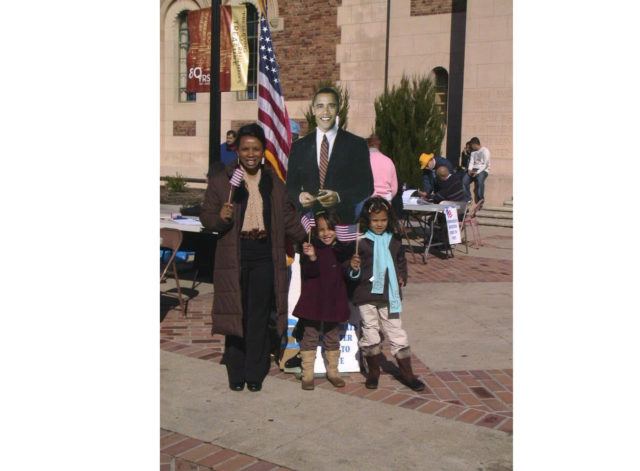
“This is not the America I knew.”
These were the words my mother said as we discussed the fatal shooting of Renee Good by a United States Immigration and Customs Enforcement agent.
This widely shared sentiment captures a growing sense that something fundamental about this country has shifted.
For centuries, the U.S. has stood as a symbol of opportunity and hope. While the country has long struggled with waves of anti-immigration hostility, immigrants have continued to see America as a place where they can build new lives.
Immigrants proudly contribute to this country, but the country does not always return that pride. Anti-immigrant rhetoric, increasingly aggressive ICE raids and family separations have reshaped the conversation about who belongs.
The question then becomes this: What defines an American?
As the daughter of an immigrant and an American-born parent, I have seen the answer play out in my own life. Being an American is not cookie-cutter. There is no single mold that defines who belongs. Rather, America is a shared project people come to from different starting points.
I grew up between two different understandings of America: my immigrant mother’s belief in America as something chosen and my father’s experience of America as something inherited.
To claim an American is defined by their birthplace, legal status or race is to reduce a complex national identity to a few narrow categories. One could go in circles debating the history of the U.S. – how it came to be, how immigrants built this country.
But at its core, the answer to this question isn’t about where someone comes from. The truth lies in what someone believes and what they contribute to the nation they call home.
We have all heard America is a melting pot, but that idea points to something deeper. There has never been a singular American identity. Over time, different cultures, languages and histories have shaped this country.
Watching my parents relate to this country in different ways has helped me understand that citizenship is experienced differently depending on whether it is inherited or chosen.
I remember watching my mother prepare for her citizenship test. At the time, I did not understand its importance. In my eyes, my mother was an American, so why did she have to prove it?
As I got older, I came to grasp the significance of this test and more importantly, what it represented: my mother’s commitment to a country she had chosen to call home.
On the other hand, my father never had to study civics questions at the kitchen table. Being American was simply the background of his life.
The rhetoric that America is the land of opportunity dates back to the nation’s founding. Immigrants have come to this country for generations, believing in the possibility of building a better life.
For many, being here is the result of a conscious decision and significant sacrifice.
Immigrants leave everything they once knew in pursuit of a possibility.
I have seen this through my own mother’s experience. She left the country she grew up in to create a life here, leaving behind family, friends and the familiarity of her home to start over in a country that was not hers to begin with.
Others have also built their lives through working, raising families or contributing to their communities. They are participating every day in a country they choose to call home.
We must not reduce the meaning of belonging in the U.S. to legal definitions or political rhetoric.
My mother chose this country and believes in the promise of America because she made a life within it. Growing up between her experience of choosing America and my father’s experience of inheriting it has shown me that belonging isn’t defined by birthplace alone.
She is a true American, like all those who choose to work toward the shared project of building a better nation.


Comments are closed.