A fast break to the basket in transition.
A layup she had made thousands of times before.
A misplanted right foot and a buckled knee.
Pauley Pavilion watched as Charlisse Leger-Walker struggled to get up off the court, rolling on the hardwood as she grabbed her leg.
UCLA women’s basketball’s now-starting guard had just torn her ACL.
At that point she was not a Bruin but a Washington State cougar playing in what would soon become her home arena.
“In that moment I was in so much shock,” Leger-Walker said.
The Anne Meyers Drysdale Award Midseason Top-10 Finalist and Naismith National Player of the Year Award Midseason Top-30 Finalist sat out the rest of the game, an upset her team won in part thanks to her 17 points and, ultimately, her senior season in Pullman, Washington.
Having already recorded two triple-doubles and reached the third-most career points in Washington State history in the first half of the 2023-24 season, Leger-Walker was on track to end the year as one of the best players in a national field that included Aaliyah Edwards, Angel Reese and Caitlin Clark.
But all that was put on pause.
“One of the biggest things that was really hard – other than it just being my senior season and not being able to end it the way I wanted to – was I was meant to actually go to our Olympic qualifiers for our national team,” Leger-Walker, a Waikato, New Zealand, local, said. “We haven’t been back since 2004, so that was a big year for us.”
By the end of 2024, she had to decide what came next. While she said her original plan was to go professional after her fourth and final collegiate season – she was a preseason top-10 projection in the 2024 WNBA Draft – Leger-Walker now had a foggier idea of what would come next.
She could go home, nearly 7,000 miles to Waikato, where she had grown up and started her basketball career. She could remain at Washington State where her mid-season injury guaranteed her another year of eligibility. Or she could relocate to a new school.
Instead of going home, where she said she would not have had the same resources of a collegiate program, Leger-Walker opted for another year in the NCAA. She entered the transfer portal to find a championship contender with the best medical assistance.
Ironically, UCLA was where she found the support, opportunities and community she wanted.
“When I came on my visit, I really clicked with the girls well and loved what the program was about and what the coaching staff had to say,” Leger-Walker said.
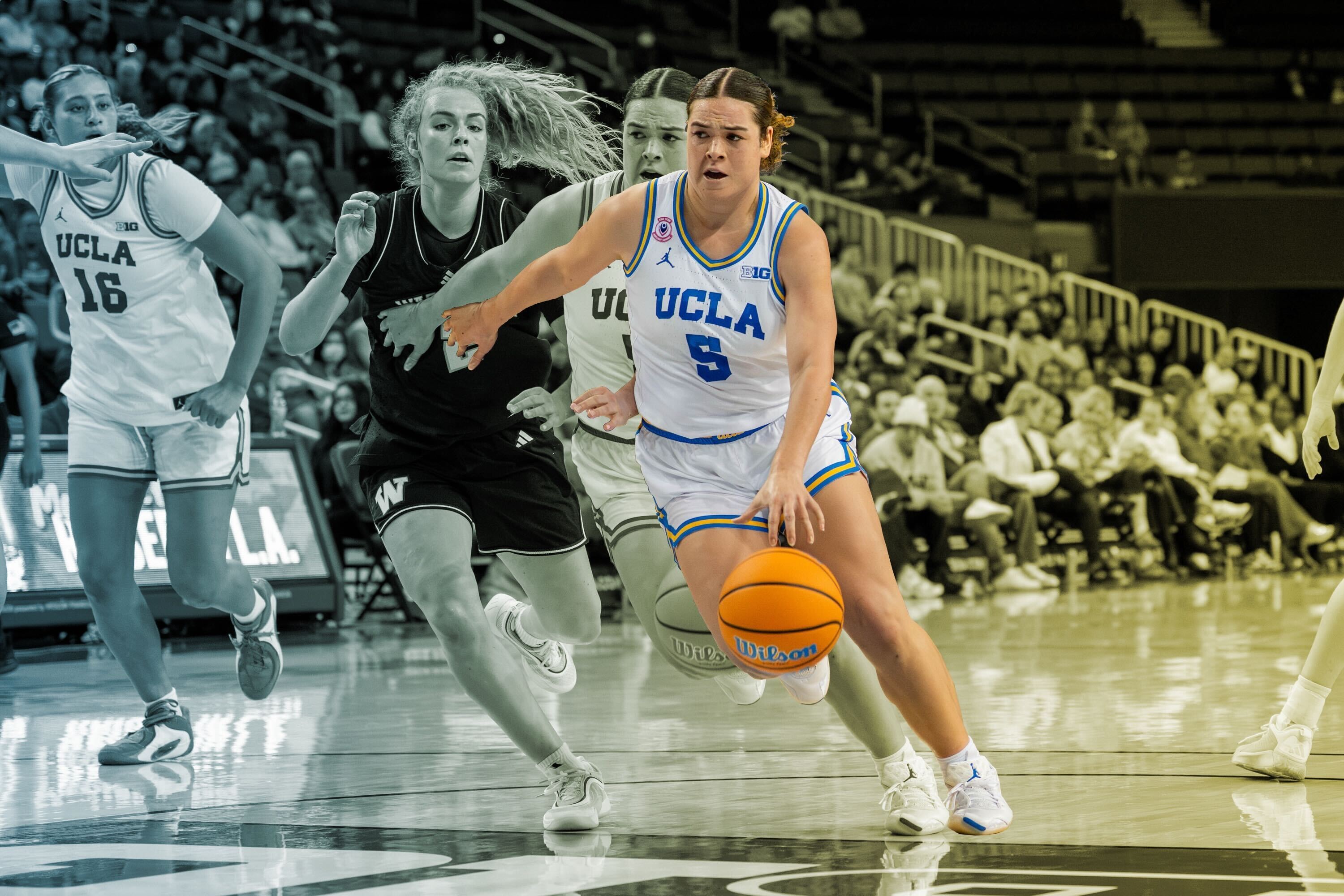
The recovery process was far from linear for the graduate student, who had to have a second surgery after a build up of scar tissue in her knee was discovered. The additional procedure prolonged Leger-Walker’s recovery in what was an already demanding timeline due to the impact injuring a knee ligament has on overall mobility.
“You have to teach your body how to do movements again that you learn when you’re a kid,” Leger-Walker said. “I had to teach myself how to walk again, how to jump again, how to run again. Having the patience to do that and not trying to rush to get back or skip steps along the way, (was hard) because it’s really easy to do that when you are starting to feel good.”
Recovering from such a major injury hinders regular training too, and Leger-Walker said having to deal with the setbacks she went through while prioritizing regaining strength in her knee was difficult.
And for Leger-Walker, who was at the peak of her collegiate career pre-injury, the feeling of setback was magnified.
“The biggest thing I learned is you have the ability to control how you perceive things,” Leger-Walker said. “When I reflect on my journey, it could have been so easy for me to kind of feel sorry for myself the whole time or be like, ‘This is it. This is the end of my career. I’m never going to be the same again.’”
Being an international student, Leger-Walker was away from her unconditional support system back home. As a transfer, too, she did not have preexisting relationships with the UCLA staff and players to lean on. She quickly found those, though, she said.
Leger-Walker was able to turn to fellow graduate student forward Angela Dugalić, who had sat out the 2022-23 campaign due to an ACL tear. Although their injuries and recovery processes differed, Dugalić – who is also now in her sixth and final collegiate season – understood the physical challenge and mental frustration of taking a medical redshirt year.
“We didn’t live together last year, but we were in the same complex, so she would come over,” Leger-Walker said. “There were times where I would be frustrated or (need to) have someone to get a different opinion or advice – or even someone to relate to me. She was always that person willing to be there, willing to listen, willing to give her perspective.”
Sitting on the sideline during the Bruins’ 2024-2025 campaign, Leger-Walker’s role as an athlete shifted to her off-the-court impact. As both a veteran collegiate athlete and a field general at the point guard position, her experience and game IQ could be utilized even if she was not playing.
“Being in the position that I am as a point guard, I see a lot of things. Not even just basketball-wise, but I see a lot of dynamics between people, and I see a lot of different things going on behind the scenes. Usually I’m the one who has to mediate that,” Leger-Walker said. “I feel like I’m a pretty good connector and relationship person, so making sure I was spending a lot of time with the freshmen last year and our other transfers – as well as the vets who are well established.”
At Washington State, Leger-Walker made an impact in every statistical category. At UCLA, the transfer was joining a lineup of five other projected first round draft picks who were all entering their fourth or fifth collegiate seasons.
The depth and experience of the Bruins’ roster allowed Leger-Walker to hone in on a specialized role. Taking over the traditional point guard position from senior guard Kiki Rice, Leger-Walker is a facilitator on the court who executes plays while also being the link between the players and the coaches – a skill she developed sitting on the sideline during her injury year, she said.
“I have a lot of conversations with Cori (coach Cori Close) all the time about what we want to get out of this game, specifically – are we looking to have a guard attack? Are we looking to get post rim touches?” Leger-Walker said. “A lot of it filters through me, and I have that responsibility of, if things aren’t working, it’s also on me.”
This has alleviated Rice – UCLA’s leader in assists last year – of some of the coordinating duties, allowing her to make plays of her own.
“Kiki, for example, obviously she’s an amazing attacking point guard – gets downhill, she has so many strengths,” Leger-Walker said. “I think me being able to take a lot of that decision-making, getting everyone organized, allows her to play her game.”
It is unlikely that Leger-Walker will come close to replicating the offensive production she achieved as a Cougar. It is hard for anybody to recreate 40-point nights like the one she had against Washington in 2022.
Instead, she leads UCLA in assists and steals, with 5.6 and 1.7, respectively, per contest and often finishes games with one of the highest plus-minuses of any player on the court.
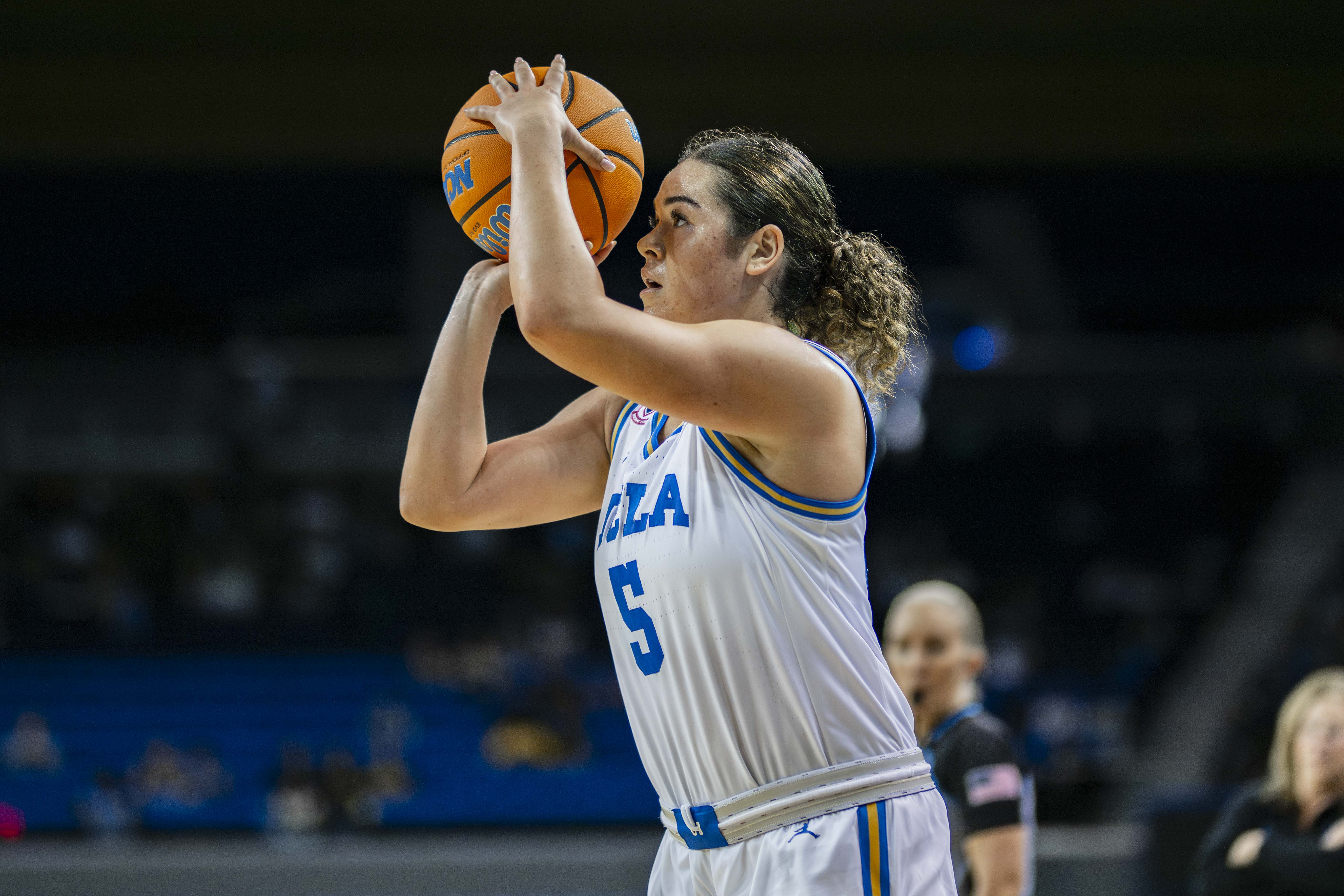
“I remember my first two years in college playing against her and always knowing that she’s one of the best guards in the country. … She was super hard to scout, super hard to guard,” Rice said. “It’s so incredible to have another point guard in the backcourt. The way she works, the way that she leads – just how mature Char is is something we really value on this team.”
But her dampened scoring numbers – she averages 8.9 points a game – do not mean she still does not have standout nights.
Leger-Walker scored a team-high 20 points en route to a 73-50 victory in the Bruins’ final rivalry game against USC this season on Mar 1.
“I remember last year thinking I can’t imagine what Charlisse’s impact is going to be once she plays because she’s already impacting us so much, and she hasn’t even played a game,” Close said. “I could not be more grateful for her leadership, for her basketball IQ, for her scoring mentality. She is probably our most consistent defender off the ball and on the ball. She’s our emotional glue – pretty much everybody looks to Char when things need to get steady.”
Two years after tearing her ACL, Leger-Walker was back on the hardwood of Pauley Pavilion.
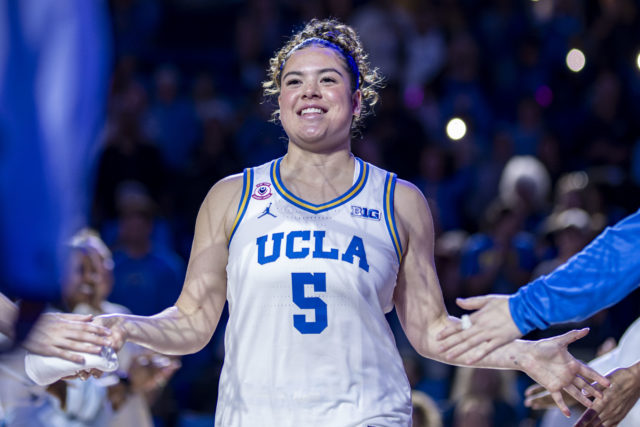
She was not donning Washington State crimson or UCLA blue and gold, though. Instead, Leger-Walker’s jersey was sequined as – alongside seniors center Lauren Betts and guard Gabriela Jaquez – she performed with the UCLA dance team during a men’s basketball halftime show.
“I think being injured, in a way, taught me to take a step back and look at other things outside of basketball that I probably wouldn’t have spent time on,” Leger-Walker said. “Like, ‘OK, what has this allowed me to do?’ I probably never would have come to LA. I never would have had the chance to play for a championship. I never would have had the chance to network and meet so many amazing people.”
Less than a week after their first performance, the trio would do an impromptu rendition of their dance as “Just Keep Watching” by Tate McRae blared from the Gainbridge Fieldhouse speakers in Indianapolis, Indiana. The Bruins had just won the Big Ten tournament by the largest margin in conference history.
UCLA has one last opportunity to show off its moves at the Big Dance.
And Leger-Walker, six years and 137 starts into her collegiate career, will make a final run.

Comments are closed.