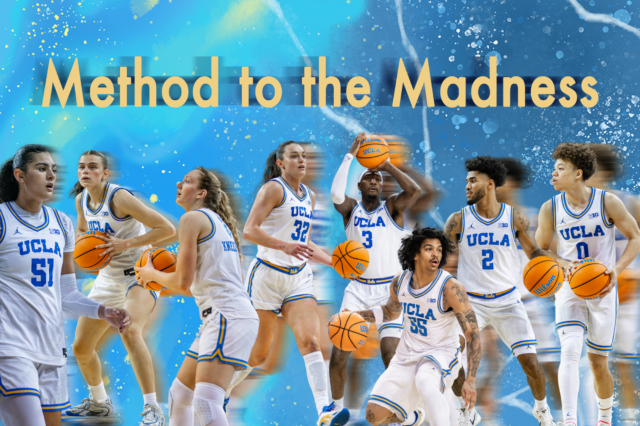
No. 1 seed UCLA women’s basketball and No. 7 seed UCLA men’s basketball are both returning to the “Big Dance” for the 2025-26 campaign – with the former holding a stake of the title odds and the latter looking to go past the Sweet Sixteen for the first time since the 2020-21 season. In “Method to the Madness,” Sports editor Connor Dullinger and assistant Sports editor Willa Campion analyze the trends going on within both Bruin squads, focusing on the individual players on the men’s team and the record-setting women’s roster. By identifying the gaps in the men’s team and the most important strengths of the women’s, this summary explains how and why each team could prevail in March.
On. Fire.
No one is hotter than Donovan Dent. The senior guard boasted 77 assists to just six turnovers over a seven game span to end the season, omitting the Big Ten semifinal against Purdue where he left injured. Dent has transformed himself since the new year, garnering six 20-plus point scoring games and eight double-digit assist games. His triple-double against Rutgers in the third round of the Big Ten tournament – the first triple-double in conference tournament history and the first from a player in the blue and gold since Kyle Anderson did it in 2013 – illustrated the all-encompassing effect Dent can have on the Bruins’ game. The All-Big Ten honorable mention will be imperative to the longevity of UCLA’s March Madness run. If he can continue to carve opposing defenses, split double teams and find open shooters on the pick-and-pop or screen-and-roll, then the Bruins have a chance against any team in the bracket. Sure, Dent can be hot-and-cold shooting the ball, but there is no doubt that he is one of the most prolific facilitators in college basketball – ranking fourth in assists and fifth in assists to turnover ratio in the nation. The offense runs through Dent, and when the Riverside local is at his A-game, there is no telling the heights that the Bruins can reach. Dent’s run has to stop at some point, but who says he cannot help the Bruins win some games in March first – maybe even some upsets too.
The New Four
Since coach Mick Cronin has turned to a three-guard lineup, junior guard/forward Eric Dailey Jr. has assumed the starting power forward role – and he has excelled in it. Standing at 6-foot-8 and weighing 230 pounds, Dailey boasts a unique blend of size and speed that allows him to dominate the boards and interior on smaller opponents or blow by bigger, slower-footed players on the downhill attack. The Palmetto, Florida, local may not be the Bruins’ most prolific passer or scorer, but he does all of the little things that keep UCLA’s engine humming. Dailey can be a solid defender, working well in one-on-one pressure and even more proficient as a help defender, sliding over for weak side block shots, intercepting crosscourt passes or getting the steal on a double-team. He is also an elite rebounder at his position, using his relentless work ethic, passion and grit to dominate the rebounding department. As a versatile scorer, he reaches deep into his bag to score in the iso, pull-up from the midrange or shoot the turnaround, hit catch-and-shoot corner 3-pointers and excels in transition offense attacking the rim. Dailey does a little bit of everything, and he is the exact player that the Bruins need down the home stretch of the season. The junior guard/forward has gone nonexistent at times this season, scoring a combined six points against Michigan and Michigan State on Feb. 14 and Feb. 17, respectively, while also dropping one, two and four points against USC, Penn State and Iowa, respectively. If UCLA wants to dance further than the first weekend, then Dailey needs to do all of the little things he does on a consistent basis while also being a key scoring contributor.
The Rise
UCLA men’s basketball coach Mick Cronin prides himself on player development. And no player on the roster has seen more of a jump in skill than sophomore guard Trent Perry. The West Covina, California, local played just 11.4 minutes per game in his true freshman season, averaging 3.7 points on a 36.9% field goal percentage. Just one season later, and Perry has proven to be one of the most impactful Bruins, averaging 12.7 points on an ultra-efficient 41.2% shooting percentage from beyond the arc. Since senior guard Skyy Clark’s hamstring injury, Perry has moved into the starting guard role opposite Dent and has not left since. Perry gives the Bruins versatility in the backcourt, being able to handle the rock and run the offense while also playing off the ball as a two-guard, where he can focus on scoring. A key reason for his versatility is his frame at 6-foot-4 and 190 pounds, giving him the athleticism to blow by bigger guards and smaller wings, as well as the strength to beat smaller guards into the paint and power through contact at the rim. Despite Perry’s significant rise, he is still a relatively inexperienced guard on a veteran Bruin team that can go far in the tournament. The sophomore has proven that he can handle the bright lights and lofty expectations at Harvard-Westlake and in the Big Ten tournament. But can he do it in March?
Is He Back?
Senior guard Skyy Clark was on an absolute tear to start the season, continuing the end-of-season rise he saw at the tail end of his first year in Westwood. He had three games where he hit six 3-pointers, and scored 20-plus in three games, including 25 against Washington on Dec. 3 and 30 against Cal Poly on Dec. 19. But after a hamstring injury suffered Jan. 3 in UCLA’s loss to Iowa, Clark missed 10 consecutive games, and has yet to reach the same level of play he was on trajectory for before his injury. Clark will always be one of, if not the best, one-on-one defenders the Bruins have, and while his defensive pressure in opposing backcourts is paramount to UCLA’s postseason success, the squad needs his scoring to go toe-to-toe with the nation’s most prolific offensive squads. Clark has been in a shooting slump as of late, combining for 5-for-21 shooting from the field from March 3 to March 12, but has seemingly gotten over the hump after scoring 15 against Michigan State in the Big Ten tournament semifinals, hitting three of his eight 3-point attempts. Clark was critical to UCLA’s success in March last season, scoring 32 between both NCAA tournament games – hitting four 3-pointers in both games – and shouldering a large chunk of the offensive production in the Bruins final game of the season against then-No. 2 seed Tennessee. Don’t let the plethora of scorers and offensive weapons on the Bruins’ roster detract from the necessity of Clark in the team’s winning formula. If UCLA wants to dance past the Sweet Sixteen – something it has not done since the 2022-23 season – Clark has to pave the way.
Sweet Shooting
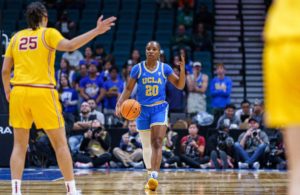
Largest win over a top-10 team in Division I history, a 31-1 record and an unblemished conference slate – the Bruins can take their pick. UCLA’s 96-45 victory over Iowa in the Big Ten tournament championship certainly made a statement. The performance even makes No. 1 overall seed UConn’s 39-point win over Villanova in the Big East finals look insignificant. There were many differences on both the offensive and defensive ends that allowed the Bruins to achieve an unprecedented margin of victory. But shooting was arguably the most important variable. UCLA held Iowa to just a 28% clip from the field and 22% shooting from beyond the arc while posting 63% and 50% tallies itself. To maintain a 60%-plus shooting percentage on 63 attempts requires a level of discipline and talent that is virtually unheard of.
Such offensive production is made possible by 50%-plus field goal shooting averages from four out of five members of UCLA’s starting lineup, plus Big Ten Sixth Player of the Year and graduate student forward Angela Dugalić. Additionally, all four starting guards average 35%-plus completion from beyond the arc, with graduate student Gianna Kneepkens leading the way with a 44.2% clip. Come tournament play, this precision could be lethal. But as coach Cori Close said after the Hawkeye win, the Bruins cannot get so comfortable with shots falling that they stop fighting for offensive boards. Luckily, the Bruins rank second in the nation in rebounding margin in addition to field goal percentage.
Elite Facilitation
When a team has a starting lineup full of projected first-round WNBA Draft picks, it can be anybody’s night. But in order to weaponize this, the Bruins need to identify who is hot and know how to get them the ball. And the Bruins can do just that.
A different Bruin has led UCLA in scoring in four of its last five games. This diversity in offensive production will not only sustain the Bruins deep in bracket play, but will also allow them to have prolific scoring nights, like their most recent 96-point performance. With all players making an impact on the court, a double-team on senior center Lauren Betts – who has proven to battle through them regardless as UCLA’s leading scorer – or a dry spell from a guard on the perimeter does not dampen the Bruins’ attack.
Efficient passing certainly aids the squad’s ability to have all-around production. UCLA ranks second in the nation in assists per game, trailing only UConn, and holds steady in this ranking when you compare it to the turnovers averaged. Graduate student guard Charlisse Leger-Walker helms the Bruins’ facilitating efforts with a team-high 5.6 assists per game. Senior guard Kiki Rice, while stepping away from a traditional point guard role since the return of Leger-Walker, contributes to the efforts as well, averaging 4.5 assists.
Considering UCLA also ranks fifth among Power Four teams in fewest turnovers per game, its passing efforts have proven successful. Any team tasked with limiting the Bruins in bracket play will have to come up with a creative way to limit every player on the court, as the Westwood bunch has proven it is as deep as it is well-rounded.
Final Shot
The allure of March Madness is that any team can make a Cinderella run. There is something exhilarating about picking a school that should not have any chance of success to win an opening round upset. The Bruins’ No. 1 seed may place a target on their backs, but the Westwood squad boasts something that few other teams in the bracket have – a starting lineup made up entirely of graduating athletes. The talent that the starting five – Betts, Kneepkens, Leger-Walker, Rice and senior guard Gabriela Jaquez – bring to the table provides hefty backup for a national championship argument. But their all-or-nothing mentality – a forced reality – could prove to be their biggest weapon.
UCLA and UConn lead the nation in assist-to-turnover ratio and field goal percentage, with the latter claiming the top numbers in both. Strength of schedule is likely part of the reason the Huskies hold an edge over the Bruins, who have endured a sufficiently more difficult slate, but the technical proficiency of coach Geno Auriemma’s squad is nonetheless undisputed. In the quite possible case the Bruins rematch the Huskies, who eliminated them in the Final Four last year, they will need an extra edge to power past a team that has remained undefeated all season. While Sarah Strong has two more years to add to UConn’s crowded trophy case, just four active Bruins will have a second chance to bring an NCAA title to Westwood.
Grit, while difficult to find a basis for factoring into seed, is what it takes to win in March. And there is little doubt that UCLA’s starting five, some of whom have been chasing a championship for six collegiate seasons, will do whatever it takes to be the last ones dancing.
Close at Hand
Coach Cori Close is the only head honcho who has eclipsed 300 wins at the helm of UCLA women’s basketball in program history. Guiding the Bruins to their first Final Four berth – in addition to shattering a hefty list of program records – last season earned Close a sweep of the Coach of the Year awards. And she has not taken her foot off the gas pedal since, garnering this year’s Big Ten Coach of the Year honor after UCLA earned just the fourth undefeated season in conference history. The Bruins’ unprecedented graduating class that made an undefeated Big Ten slate possible is no coincidence, either. Betts may now be known as a National Player of the Year contender, but before falling under Close’s guidance, she averaged just 5.9 points per game at Stanford as a background player.
In all likelihood, Close is not concerned with the individual accolades she has received but the ones her team has. And one major honor still looms within reach of the Bruins – an NCAA title, something that has eluded UCLA since the league’s creation. The Bruins have the pure talent to make a run to the championship game. They lack the tournament experience of a Blue Blood like UConn, though, and so it will fall to Close to guide her team through relatively new waters. Close has proved adept at this leadership thus far in her career, narrowing in on a 70% win rate while at the helm of UCLA. And the most important win of Close’s career could come this April.

Comments are closed.