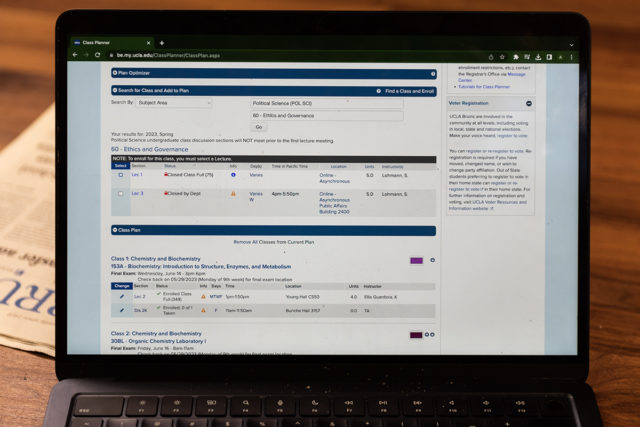
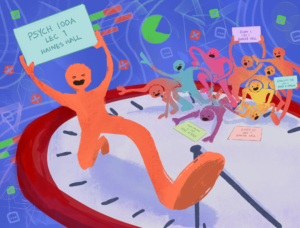
Class waitlists cause stress for students and faculty alike at the start of every quarter.
Class waitlists are designed to offer flexibility and manage limited seats for popular classes until the second week of the quarter, according to the UCLA Registrar’s office. While students are able to join waitlists for classes, it does not guarantee a spot in the class. Students should not assume they will be added into the class as a result of their position.
Students are able to stay on the waitlist until the end of Week Two, at which point the waitlist is deleted. Additionally, students are not permitted to enroll in classes after week three without school approval.
It is up to each academic department to decide whether or not they offer waitlists for their courses in a given quarter, said Megan McEvoy, the UCLA Academic Senate chair, in an email statement.
“Departments determine which courses to offer in a given quarter as well as how many sections and seats to schedule,” McEvoy said in the statement. “Departments and instructors determine whether to have waitlists for a course and how many waitlist seats to allocate.”
McEvoy added that the senate has no oversight over class waitlists; the task of setting enrollment rules falls to instructors and departments. Instructors and departments determine class capacity based on factors such as class type and level, she added.
It is possible class capacities are potentially influenced by other constraints, such as the size of lecture halls. John Branstetter, a continuing lecturer in the political science department, said he believes there are too few classes for the number of students who attend UCLA.
Branstetter said he often deals with a full waitlist for Political Science 10, a highly demanded lower-division course for political science students and offered to students outside of the major looking to fulfill their general education credit. He said the persistent waitlists for this course are less a result of how waitlists are managed and more about how the university fails to fund high-demand undergraduate instruction.
“The bottom line is, there’s not enough classes that students want to take,” Branstetter said. “Political science is always one of the top two biggest majors on campus, and our department is drastically underfunded.”
Hung Pham, an associate adjunct chemistry professor who often teaches highly demanded lower division chemistry courses, said the same is true in the chemistry department.
“There’s just too many students. There’s not enough funding, and the school just keeps accepting more,” Pham said. “But they asked us on the department level to sort of accommodate the student population, and so it’s really hard for us to be able to accept everyone whenever they want.”
Pham added that he sees the waitlist as a compromise that comes with giving students the freedom to choose any classes they want, whenever they want.
The mathematics department’s website stated that one student may drop a class on Thursday of Week 8 because they found another course they are more interested in, while another may drop at the end of Week 2 after realizing their course load is too heavy.
Branstetter said because so few students drop his class, however, the waitlist itself is rarely an effective path into Political Science 10. He added that he tries to triage the waitlist, prioritizing students facing serious academic or financial consequences if they failed to enroll.
“First come first serve is great, but it really isn’t fair,” he said. “There’s people that literally will not graduate, and you know it’s not fair to let somebody else who’s a freshman who just happened to get on the wait list first.”
Students express similar frustrations. Sophia Longman, a second-year biochemistry student, said she felt pressure to attend a class she was waitlisted for but stressed about balancing the work for that class with the work for her courses she was actually enrolled in.
“You could be doing all the work for a fourth class for a week and a half, and then not get off the waitlist,” Longman said. “Then you just do all that work and stress for nothing.”
She added that being waitlisted for classes is particularly stressful as a STEM student due to the fact that many of her classes must be taken in sequential order – not getting into a class can set her overall course plan behind. She said she sometimes appreciates when classes have a waitlist, as it gives her hope that she may get into the course she needs, but it adds additional stress to the beginning of the quarter.
The waitlist also impacts professors, as it forces them to deal with fluctuating class rosters for the first two weeks of the quarter. Branstetter said while the waitlist does not alter the content he teaches in the first two weeks, it causes logistical problems for assignments later in the quarter.
“I’ve been doing a thing where I assigned students partners and there’s a weekly writing assignment,” Branstetter said. “If I have a bunch of people on the waitlist who are showing up, and they partner up with people, and then they all get dropped – then I’m suddenly left with a bunch of people to partner.”
He added that dealing with waitlist-related questions during the first week is a major drain on his time and resources.
“I don’t ever do office hours in the first week because I know I’m going to be packed, busy dealing with PTEs,” Branstetter said. “It does diminish the quality of the first couple weeks lecture, which bothers me.”
Petition to Enroll numbers, or PTEs, are five-digit codes issued by instructors or departments to ensure that specific students can register for a course. Instructors or departments may choose to issue PTEs to allow selective enrollment in full classes, grant exceptions to class restrictions or override a closed waitlist so a student can enroll.
Additionally, Pham said the fast pace of the quarter system makes it difficult to accommodate students who do get into the class off the waitlist.
“If you missed the whole first week of class, that’s 10% of the class already,” Pham said. “Pretty much the class starts when the class starts, and I think the waitlist is courtesy.”
McEvoy said while each university has their own waitlist system, managing course enrollment is a common issue at other UC campuses and large public universities. Student-run newspapers at other UC campuses ran stories expressing similar frustrations with waitlist and enrollment policies at their institutions.
However, Branstetter said students in the political science department have started to take action.
The Political Science Undergraduate Council launched a petition urging senior administrators, including the executive vice chancellor and provost, and dean of undergraduate education, to address the enrollment crisis within the political science department and make courses more accessible. They hope to collect signatures from at least roughly half of the students in the major, and organizers are planning classroom visits and outreach efforts, he added.
Branstetter said in order to effectively address issues surrounding the waitlist, more dialogue between students and administrators is necessary, and administrators need to be reminded that students are at UCLA primarily to learn.
“They need to listen to students about what they want, what they need, what their goals are – and make budgets that way,” Branstetter said. “I think the higher levels of the administration have totally lost sight of that.”


Comments are closed.