

This post was updated April 16 at 8:55 p.m.
The next generation in the “Dragon Cycle” is lighting up the stage.
Sara Porkalob’s solo show “Dragon Mama” – directed by Andrew Russell – is the second in a matrilineal trilogy based on the star’s family following “Dragon Lady” and preceding the in-development “Dragon Baby.” “Dragon Mama” made its Los Angeles premiere March 4 and will play at the Geffen Playhouse through April 26. The play takes place from 1979 to 1994 and focuses on the life of Maria Porkalob Jr. – Sara Porkalob’s mother – through her childhood and early motherhood in Bremerton, Washington, and later Anchorage, Alaska. With Sara Porkalob’s charismatic presence and shining vocals, “Dragon Mama” continues the “Dragon Cycle” in excellent form despite some underwhelming production elements.
The Daily Bruin’s Eleanor Meyers and Reid Sperisen both watched “Dragon Lady” when it was performed at the Geffen Playhouse in 2024 and returned to the theater together to watch “Dragon Mama.”
‘A Production of Professionalism and Personality’
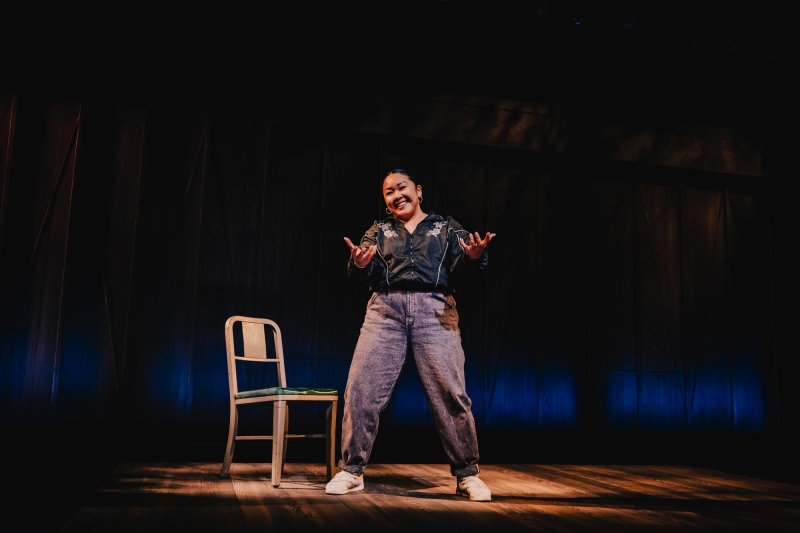
Starting with a critique, the staging for this production unfortunately felt too minimal compared to “Dragon Lady.” Where the prior production had a huge serpent archway, a bar and a variety of furniture for performer Sara Porkalob to interact with, the set design for “Dragon Mama” was limited to just one chair. Sara Porkalob’s dynamism is sufficient to keep the momentum rolling even with a scaled-back set up, but she has already proven that she excels in a larger-scale format.
[Related: Theater review: ‘Dragon Lady’ lights up stage with expressive multi-generational tale]
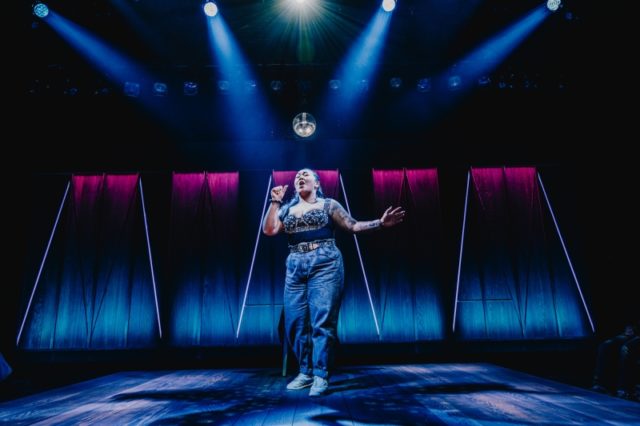
That said, the lighting for several of the scenes was particularly strong and immersive, especially when Sara Porkalob – as protagonist Maria Porkalob Jr. – was at a nightclub or inside the Anchorage airport. The sound effects were also used well to create a sense of setting, especially with hit songs of the 1980s and 1990s – from Cyndi Lauper to Sade – being incorporated to establish the era.
If credit is to be given anywhere, though, it has to be showered upon the quality and believability of some of the original characters Sara Porkalob portrayed. In Act I, the popular girl in the trailer park, Arlene, really stands out for the attitude and rebelliousness she exudes. Likewise, the closeted Alaskan sailor Greg in Act II has the gruff exterior necessary to convey the coldness of the scenery but also shines as a supporting character the audience is automatically rooting for. Sara Porkalob’s switching from character to character is extremely smooth while juggling several thematic beats simultaneously.
One noticeable similarity between Sara Porkalob’s plays is the overlap in events between the second act of “Dragon Lady” and the first act of “Dragon Mama.” For audience members who had not seen “Dragon Lady,” this was helpful, but some comedic scenes – like the naming of Sara Porkalob after the food company Sara Lee – were even more funny the first time around.
Ultimately, no matter how amazing “Dragon Lady” was, it does not take away from the quality of Sara Porkalob’s showmanship and storytelling in “Dragon Mama.” This story concludes on a slightly more optimistic note, but features the same level of professionalism and personality that Sara Porkalob brings to every production.
– Reid Sperisen
[Related: Theater review: Writing flaws, overacting mean ‘Spamalot’ fumbles the Holy Grail]
‘Compelling Though Lacking Movement’
Performed at Audrey Skirball Kenis Theater, the staging of “Dragon Mama” proved to be both a strength and a limitation, defined largely by its intimate proximity to the audience. While a one-woman show might suggest a natural ease within the smaller venue, Sara Porkalob’s performance occasionally felt constrained, particularly given her demonstrated ability to command the larger stage in her show “Dragon Lady.” Still, the production’s technical elements – most notably its immersive surround sound and thoughtfully designed lighting – worked to expand the space. The illuminated back panel, in particular, established shifting narrative locations with clarity, allowing moments of heightened emotion and musicality to resonate beyond the stage’s physical boundaries.
This sense of uneven momentum extended into the structure of the play itself. The opening sequences of both acts – especially a prolonged plane ride scene following intermission – stalled a bit when it could have advanced the narrative, reading more as a recalibration on Sara Porkalob’s part than a deliberate storytelling tactic. Yet, when Sara Porkalob broke the fourth wall at the end of Act I to explain an interaction between Maria Porkalob Sr. and Junior – Sara Porkalob’s uncle – this strategy provided a compelling counterbalance, injecting personal depth and immediacy into the performance. This moment of direct address was singular but impactful. This suggests that, while more could have enriched the narrative, overuse might have fractured the cohesion of “Dragon Mama.”
Compared to its predecessor, however, “Dragon Mama” certainly lands on a quieter note. Whether due to its scaled-down production, absence of live music or more subdued staging, the show lacks the same visual spectacle and climactic force that audiences might anticipate. Even so, it broadens the thematic scope of the “Dragon Cycle,” particularly through the inclusion of Maria Porkalob Jr.’s exploration of sexuality alongside enduring themes of generational trauma and familial strife. Though the character feels less fully realized than protagonists before her, Maria Porkalob Jr.’s segment of the story signals a meaningful shift toward contemporary cultural dialogue.
Ultimately, Sara Porkalob’s performance remains most compelling when she leans into the physicality and boldness of her characters. While her movement at times felt limited within the space, moments of full-bodied expression – most memorably in her fantastic performance of Whitney Houston’s “I Have Nothing” – revealed the dynamism that defines her celebrated work. In these instances, “Dragon Mama” transcends its constraints, emerging as a testament to Sara Porkalob’s feminine charisma, comedic timing and undeniable theatrical dedication.
– Eleanor Meyers


Comments are closed.