This post was updated May 3 at 7:21 p.m.
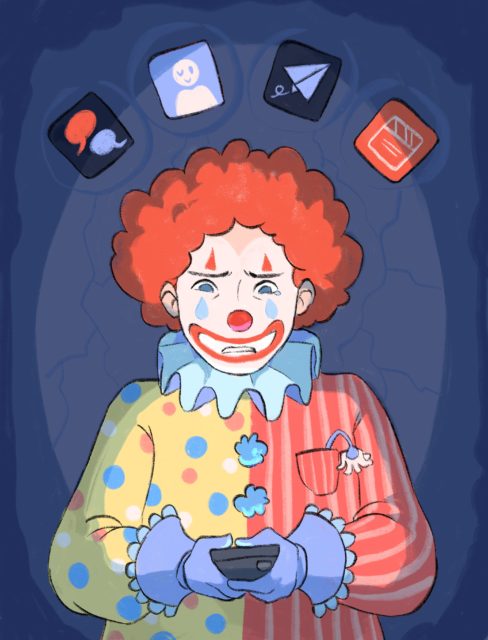
Countless internet creators have employed dark humor as a means to go viral.
Some have made posts joking about people being sent to war amid the United States’ military action in Iran. Others have produced insensitive content that consequently downplays the Epstein files.
But when did wars, suffering and heinous crimes become something to joke about?
Laughing at these “jokes” is a common pastime for many. But the out-of-touch social media content we consume shows a disconnect between our words and the people they may hurt.
UCLA students must realize the irreversible effects of mindlessly wielding humor online. If we continue prioritizing our own entertainment and comfort through tasteless jokes, we lose our sense of reality and humanity.
Some students view such dark humor as a coping strategy.
“It can be pretty amusing – maybe because it’s so extreme, what’s happening in the world, that to make light of it makes it easier,” said Andrew Lopez, a third-year business economics student. “But also, people are good at creating entertaining media, and, sometimes, that is the topic it takes.”
Lopez added that finding humor in tragedy is a human response, especially because many students feel hopeless.
[Related: Opinion: Student optimism, hope for the future can spark, fuel social change]
Meanwhile, money-focused algorithms register that viewers stay hooked on dark humor for a longer period of time. This generates more similar content, taking the viewer down a desensitizing rabbit hole.
A study from the 2025 Proceedings of the Information Systems and Computing Academic Professionals Conference found that popular Gen-Z platforms such as YouTube and TikTok produced higher engagement when implementing ads that incorporated dark humor compared to ads that did not.
Social media platforms normalize these dark jokes, reinforcing the notion that they are merely a form of entertainment we have gotten used to. Nonetheless, students should not lightheartedly excuse our generation’s growing lack of empathy. These memes cultivate ignorance and negligence toward others’ experiences.
And we Bruins are not immune to this.
As high-achieving individuals in a competitive society, we devote our efforts to our own goals. Prioritizing personal ambition means that sometimes we fail to care for others when there is no tangible return. Though we might acknowledge its value, we ironically see our empathy as a resource we should not share.
But this defeats its very purpose. Empathy is something that can enable us to recognize ourselves and others as a part of the same story, empowering us to take ownership of it.
Isaiah Jung, a second-year political science student, said he used to feel powerless within the world’s weighty narrative.
“But, I realized, the more people think that, the more there is never going to be change,” Jung added.
It is a lie that each of us does not make a difference.
It starts with caring. Your thoughts are what motivate your actions, so fill them with things that matter – with ideas that are lifegiving and uplifting, not jaded and inconsiderate.
Hunter Lahr, a third-year political science student, said we are bound to one another when it comes to upholding the fragile integrity of justice.
“The reason I personally care is because you can’t look at these things in abstract,” Lahr said. “Even if it’s not affecting you personally, you should be able to connect with people on a human level where you would care.”
Lift your head from your screen and see that you are a part of something bigger than yourself.
Your perceived protection from what is happening across seas should not disqualify you from caring about it. We must no longer see deaths as mere statistics but instead value each number for the person they were.
Next time you come across a meme about civilians being bombed or victims of severe suffering, dare to be inconvenienced and consider others as yourself – human.
We need more compassion for others. After all, it is what makes us human.



Comments are closed.