This post was updated May 3 at 7:48 p.m.
“This Is Our Youth” may be a play centered on young people, but it is meant for everyone – a reminder of the universal experience of youth.
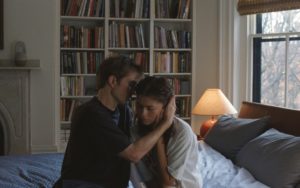
A production of “This Is Our Youth,” written by Kenneth Lonergan, opens May 1 and plays for three weekends through May 17 at the Two Roads Theater in Studio City. The three-person play, directed by Avi Sol, stars Paul Zenas as Dennis, Henry McLaughlin as Warren and Taylor Thompson as Jessica. Set over 48 hours in a cramped Upper West Side apartment in 1982, the show follows two aimless, drug-addled 20-year-olds as they burn through a stolen $15,000, with nowhere to be and nothing to lose. Without any scene breaks, the result is two hours of volatile, funny and uncomfortably honest talk about class, youth and the particular damage that comes with having every advantage.
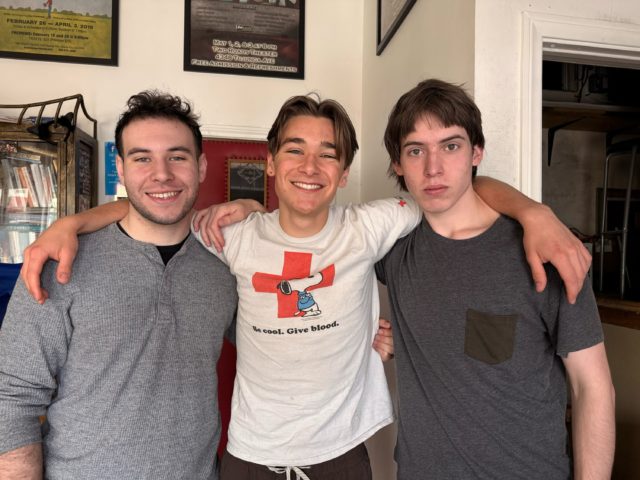
Zenas, McLaughlin and Sol spoke with the Daily Bruin’s Alexis Coffee at the Two Roads Theater about the meaning and approach to this play.
This interview has been edited for length and clarity.
Daily Bruin: How did this play get started and come together? Who had the initial idea, and how did you all meet?
Paul Zenas: Henry and I have known each other since fifth grade – we met in musical production, both growing up in Pasadena. I was in college for a year and got assigned the play as a final. I thought, “Oh, that’s a really good play.”
Henry and I were doing an acting class together here in LA, and I brought the material for us to work on. We were working on scenes for a while, and then Henry said we should just do the whole production.
Henry McLaughlin: It was so clearly a good idea. We were just like, “We are going to do it. I don’t know when, but it’s going to happen.”
Avi Sol: (McLaughlin and I) met at a workshop. I hadn’t met Paul before we started working on this, but I remember very early on getting a feel for their dynamic – not just how similar their relationship can be to these characters but because they’re 20 and 21 and the characters are 19 and 21, they’ll never be more like these people than right now.
DB: Why did you choose this play specifically? What was the draw?
PZ: Dennis and Warren’s banter and relationship really parallel me and Henry’s relationship. I don’t think I’m that brutal to Henry, and Henry doesn’t needle me as much as Warren needles Dennis, but having known each other for such a long time, before we started doing this, I feel like we had a brotherly relationship – we loved each other, but also, like, this guy pisses me off so much. And still, I love him to death. It worked well because we were able to just naturally play off of each other.
DB: What is the tone of this play?
AS: I’m a huge fan of Lonergan’s writing. It’s really sad and really dark – he’s got that Irish gallows humor, but then he’s also just got a lot of funny lines in there, which is why you can return to it over and over. He did “Manchester by the Sea,” which is one of my favorite movies, and it’s as sad as anything – but you find yourself laughing throughout.
This play has something similar. It’s volatile – there’s a lot of emotional stakes – but then there’s also just these goofy guys doing drugs and being friends, which makes the drama a lot more palatable – the bitter and the sweet.
PZ: It does a really good job of making you feel connected to these guys. Lonergan does such a good job of making you still tug on the heartstrings even when Dennis is just a jerk.
HM: The writing is very Shakespearean in its intelligence and detail – we’ll talk about two lines for like five minutes. There’s so much detail even in the stage directions. And yet he’s (Lonergan’s) not afraid of sitcom stuff, which I love. He’s such a deep, intelligent writer, but he’s also not afraid of cheap gags.
DB: How does the tone shift knowing that these characters do have somewhat of a financial safety net?
AS: Most of what they’re dealing with is utter bogus. The troubles they’re in are a product of their own ineptitude. That’s where you can inject the humor – if the stakes were life and death, it’d be a lot harder to laugh at. But because it’s so on them, you can find ways to laugh at them. They’re just goofy 20-year-old guys.
DB: How closely have you stuck to the original script of the play? Is it still set in New York?
AS: It’s a pretty faithful adaptation. It’s such a colorful place and time. The music – the artists they listen to and the albums – are specific in the script, so it’s clear that Lonergan also cares a lot about the specific time of the play. He’s a New Yorker. He’s clearly including a lot of his own sensibilities through these characters. Early ’80s New York, coming out of a garbage strike, the dark cloud of the ’70s – it still has all of these touchstones and throughlines coming through, whether it’s visual or music. It grounds you in where it is.
DB: Are there any places where you strayed away from the original script a little bit and tried to put your own twist on it?
PZ: There are slurs and pretty intense language in it, and I think those would be easy things to grasp onto and steer away from. But I think those are the things that are really, really important. The play itself isn’t delicate. It gives the audience a further challenge – how are they going to sit there and watch these people for the next two hours if they’re shown, right off the bat, that they fundamentally disagree with this person?
This country is in constant turmoil, and this is a very similar turn of capitalism as we’re in right now. I hope we’re able to paint the picture of how cyclical we are as people existing in this broken, capitalistic system of America.
DB: What are your favorite character qualities that each of your characters has? What has been the most fun to get to play and embody?
HM: Discovering the underlying maturity in Warren. It really doesn’t seem like he’s mature or that he could be emotionally intelligent, but I think he is – he finds out how to be. That was just a surprise where I was like, “Oh, I actually really like this guy.”
PZ: Dennis goes on these really long rambling tangents, and they’re so funny. In one monologue, he has multiple two-word sentences, and then the next sentence is five lines with a bunch of commas that your English teacher would say were wrong. He’s so quippy and quick on his feet. And it is fun to be a jerk in this relentless way – how he is over the phone with people – just brutal and relentless.
DB: Because of the very small, intimate venue, you are all so physical. You touch your nose, put your hands in your pockets and rub your ears. Was that something you (Zenas and Mclauglin) mentioned, or was it the natural course of how your characters went?
AS: To me, it’s a lot of where you want the audience’s eye, especially in the second act, because the characters are on such contrasting wavelengths. Dennis is so constructed in the first act – every quality he has is considered and chosen. In the second act, we watch that crumble.
Then, by contrast, Warren comes in with what I call the “I-just-got-laid force field” – he’s kind of above all the rest for a minute. The way I described it to Paul and Henry is that in the second act, Dennis is almost orbiting Warren. Warren’s the sun. Dennis is all of the planets flying around doing their own thing.
DB: How has the venue influenced any of your choices?
PZ: The play is set in Dennis’ studio apartment – described as a pillbox studio – so the size is perfect for what we need. This is a very intimate show. It’s just three people throughout the whole thing, but basically only a two-hander at any time. All three of us are on stage together for maybe a total of two pages.
AS: It’s supposed to feel like, as an audience member, you’re intruding on something private. Here they’re on top of you, and it’s almost like you’re in the room. You get all of it in a way that you might not be able to in a bigger space.
DB: Why is live theater, as an art form, so important in this day and age?
PZ: In an age of AI, we don’t know what is real and what’s fake. I think there will be a rise of live performance – live theater, live dance, live concerts – and I hope they can become more accessible. The thing we’re really on this planet to do is to live and to experience and not stare at a little black box all day. Live theater right now is more important than it’s ever been.
HM: Theater is one of the only art forms that is really about now, now, now. Film is the past. Theater is all about this moment, which is something people really struggle with nowadays. You go on the metro – everyone’s on their phone. You go to any public place – no one’s enjoying the moment with each other. Attending theater can be like practice for us, getting out of our phones and back into life.
AS: Part of the beauty of live theater for an audience is the creator’s commitment to them. You are one of 58 people being given this experience. It means a lot as an audience member to feel that level of commitment. In the same way, as a creative, having someone show up in person to your thing feels good.



Comments are closed.