UC students say they want a voice in University policies – and an amendment to the state constitution could be the way to get it.
Assembly Constitutional Amendment 18 would require the UC Board of Regents to appoint one undergraduate student and one graduate student to serve two-year terms on the board, replacing the current policy that only allows one student regent and student regent-designate. The amendment, which was introduced in February, must pass the state legislature with a supermajority before going to the ballot for Californians to vote on.
Miguel Craven, the student regent-designate, said he believes the student regent and regent-designate provide key perspectives to the regents, helping them better understand the diverse needs of students across the UC.
“A lot of the board members do really care about the students and want to know what’s happening, because oftentimes they hear the administrative perspective,” Craven said. “They do really value what we have to say and what we share about what students experience on the day-to-day level.”
The board would appoint one undergraduate and one graduate student regent to two-year terms in alternating years if the amendment is passed.
Only six student regents since 2000 have been undergraduates. The most recent undergraduate to hold the position was Alexis Zaragoza, who served from 2021-22 as a fourth-year UC Berkeley student.
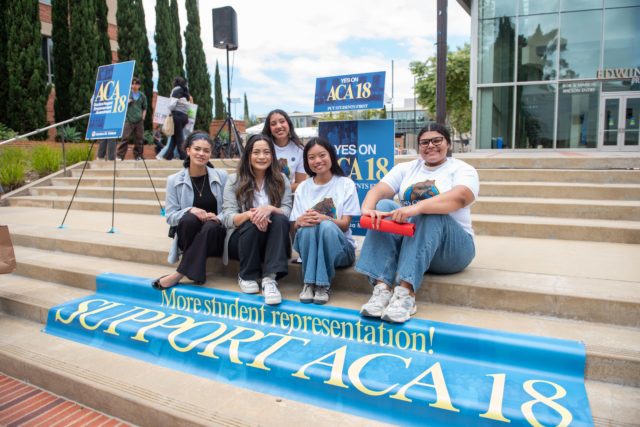
The USAC external vice president office, transfer student representative office, Facilities Commission and UC Student Association hosted a rally Tuesday morning in support of ACA 18. About 60 demonstrators attended the event and listened to speeches from Assemblymembers Jessica Caloza and Patrick Ahrens, who authored the amendment, as well as student and faculty representatives.
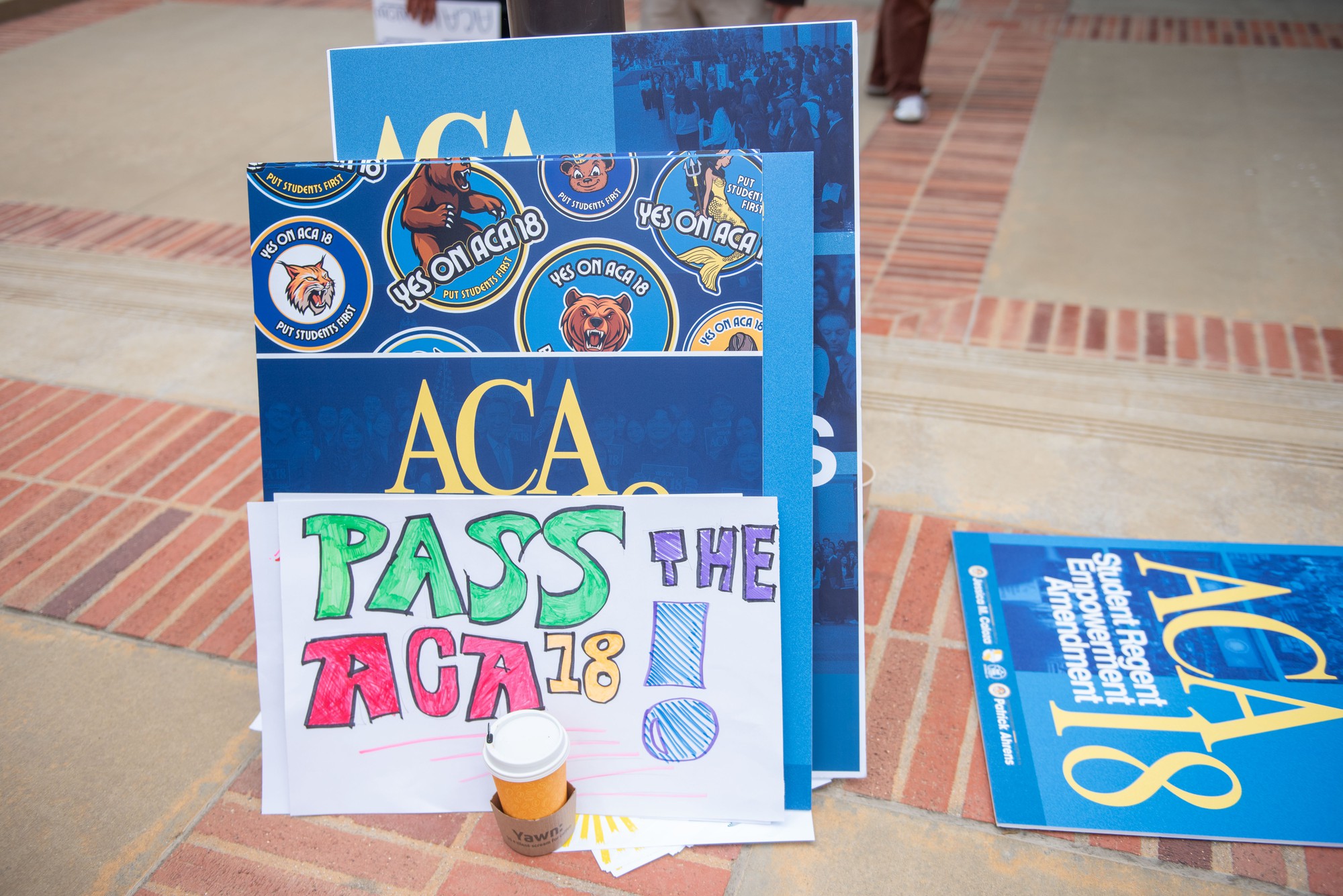
Attendees wore shirts reading “Yes on ACA 18” and held signs – distributed by event organizers – with slogans including, “No Tuition Without Representation” and “Students Are the Future.”
Caloza also led attendees in chants including, “What are we going to do? Put students first,” and “Whose power? Student power.”
“It’s (ACA 18 is) about making sure students are not just impacted by decisions but a part of making them. Because right now, too many decisions about your lives are made without you in the room, and that has real consequences,” she said in a speech.
Ahrens said in a speech the UC system can change lives – citing himself as an example – but it must continue to evolve so it can work for new generations of students.
“We cannot just allow the status quo to continue when it leaves out so many voices, when so many problems are unanswered and unheard,” he said in the speech.
Samantha Zavala, the vice chair of the UCSA’s UCweVote campaign – which encourages civic engagement across UC campuses and supports ACA 18 – said she believes passing the amendment would indicate to UC students they can make a difference within the system.
“We’re (students are) not just a part of the institution, but we are the institution,” Zavala said. “It would be a great way to show there is student power.”
Student support will be key in securing the amendment, Zavala added.
The Undergraduate Students Association Council passed a resolution April 7 urging state legislators to pass the bill, and the assembly rereferred the bill to the appropriations committee April 30. The council also called on Chancellor Julio Frenk and other UCLA administrators in the resolution to write letters to the Assembly voicing their support for ACA 18.
“ACA 18 will increase students’ shared governance in their university system, allowing them to have more influence on policies and financial allocations that directly impact them,” the USAC officers said in the resolution.
Sherry Zhou, USAC’s external vice president and the resolution’s primary sponsor, said Sonya Brooks, the current student regent, has been helpful in setting up meetings between Zhou’s office and the regents. She added that students feel their voices have been excluded.
“This is a really important step in ensuring that more students have direct access to advocate, but also that those students are able to loop in those who are back on their campuses and across the UC and make sure that student concerns are being met in a way that is real and tangible,” Zhou added.
Anna Markowitz, the president of the UCLA Faculty Association and a speaker at the Tuesday event, said in a speech that the regents are unable to represent the UC as effectively as students and faculty can, citing the Faculty Association’s fight to restore federal research funding, $584 million of which the Trump administration withheld from UCLA in July. A judge in November blocked the Trump administration from freezing any more of the UC’s funding – and from imposing a $1.2 billion fine on the university – in response to a lawsuit brought in part by the UCLA Faculty Association.
“It hasn’t been the regents standing up for what it means to be a California public good, what it means to be an educational institution in this state,” she said. “It’s been faculty. It’s been our union colleagues. And most importantly, it’s been students.”
[Related link: Judge bars Trump administration from threatening, freezing UC’s federal funding]
Caloza, a UC San Diego alumnus, said in an interview that her experience as a student trying to make her voice heard to the regents motivated her to advocate for the amendment in the state legislature.
“I know the importance of a vote because I get one myself, and I know how critical that is in advocating for your own lived experiences,” she said in the interview.



Comments are closed.