This article was updated May 10 at 8:34 p.m.
LA Metro opened the D Line subway extension Friday, connecting downtown to Beverly Hills.
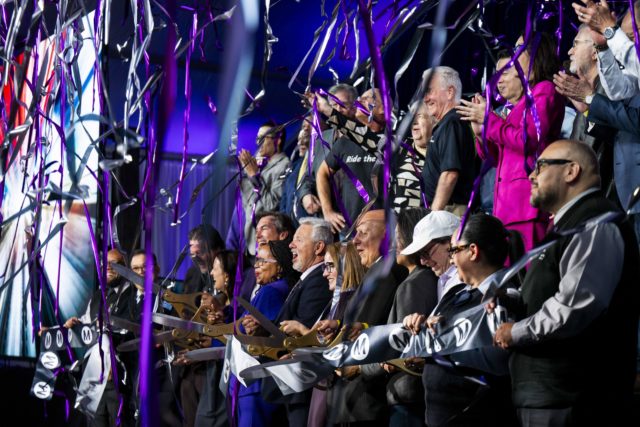
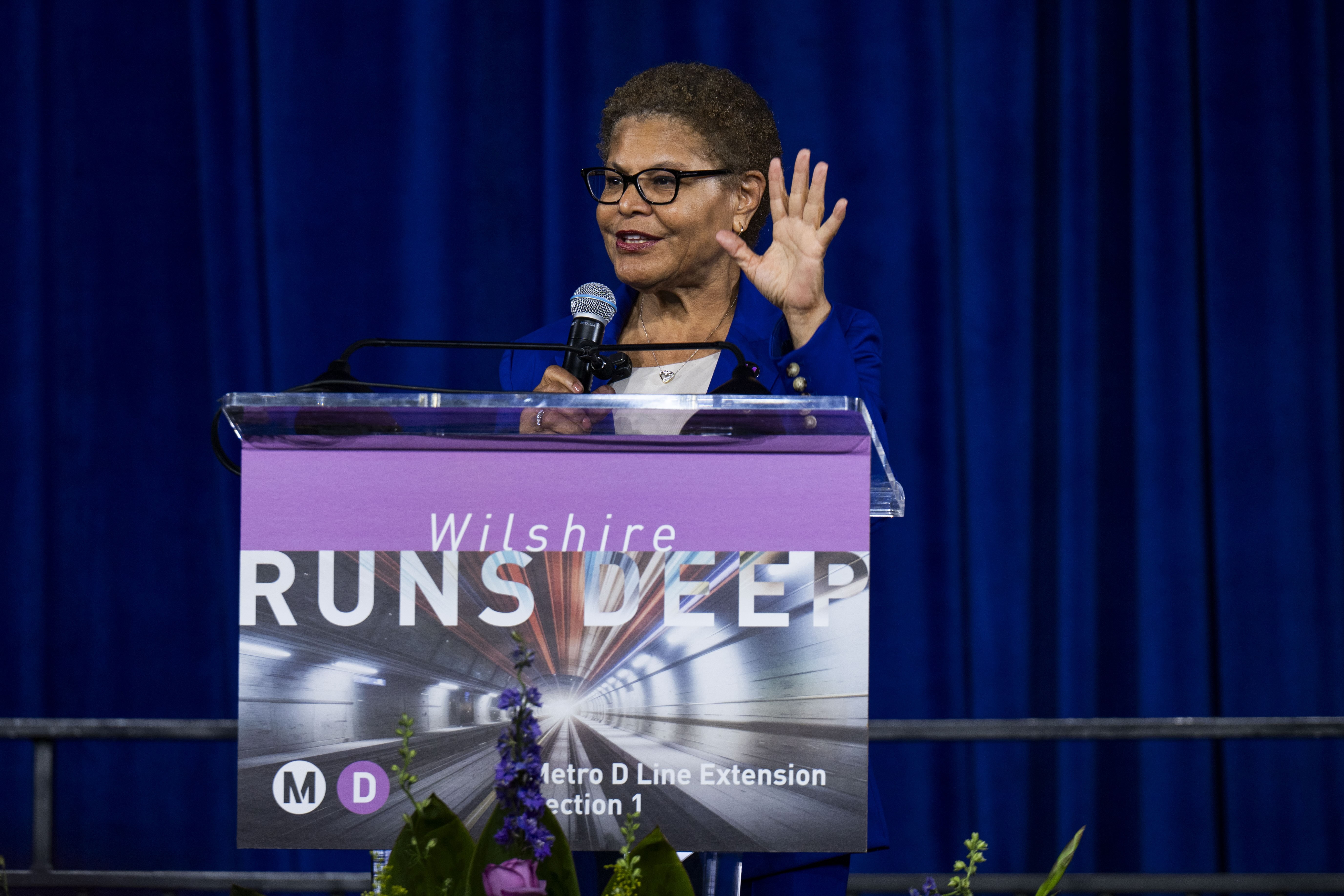
Hundreds gathered at the Petersen Automotive Museum in Wilshire/Fairfax at 8:30 a.m. to celebrate the three new stations – Wilshire/La Brea, Wilshire/Fairfax and Wilshire/La Cienega. United States Senator Adam Schiff, Mayor Karen Bass and Los Angeles County Third District Supervisor Lindsey Horvath gave speeches at the event, and Bass rode the extended line to the new Wilshire/Fairfax station – which is around 5 miles from UCLA.
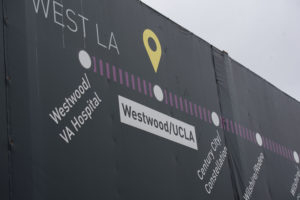
The three new stations mark the first section of a long-term subway project that is intended to reach UCLA by 2027. Forty-nine thousand riders are expected to board trains daily between the seven stations, according to a Metro infographic.
Rides across the Metro system are free from Friday through Sunday to commemorate the grand opening. Trains are set to arrive every 10 minutes much of the day and every 20 minutes in the early morning and late evening.
Connor Webb, the chair of North Westwood Neighborhood Council’s transportation, environment and public space committee, said the expansion of the D Line will make it easier for students and staff to live in areas further from UCLA that are more affordable.
D Line extension aims to reduce travel time over the length of Wilshire Boulevard, expand job and educational opportunities and improve air quality, according to the Metro website.
Gladys Kwong, a third-year Southeast Asian studies student, said she often uses public transportation to travel outside of campus and Westwood, adding that it is hard to get outside of the city without a car. Kwong’s friends who live in East and South LA spend two hours daily to get to Westwood on public transportation and must switch between multiple lines, she added.
Kwong said that while she is excited for the extension, she hopes the city maintains its cleanliness after the 2028 Olympics.
India Mandelkern, the author of the book “Wilshire Subway: The Making of the D Line Subway extension,” said people should recognize the workers who made the D Line extension possible.
“The engineers, miners, carpenters, surveyors, cement masons, electricians and inspectors – that’s a huge part of the story,” Mandelkern said.
Photographer Ken Karagozian, who partnered with Mandelkern on the book, said he believes the D Line extension will revitalize areas near Wilshire Boulevard.
The first section of the D Line primarily received funding through LA County’s Measure R – a voter-approved sales tax passed in 2008 – to finance new transportation projects and programs and accelerate those already in the pipeline, according to a Metro press release.
The Measure M sales tax – passed in 2016 – has partially funded Section 3, which began construction in 2019 and will be completed in 2027.
Webb said he bikes to Westwood for work and looks forward to seeing how his commute evolves. He added that he looks forward to Westwood becoming more accessible for others.
“It’s going to be totally game changing in what our stakeholders can reach for very inexpensively and very quickly,” Webb said. “Those are two things that don’t really often exist together for mobility in LA so really excited for that.”
Lindsey Horvath, the county supervisor whose district includes UCLA and Westwood, said Angelenos should expect further public transportation developments beyond the D Line extension.
“We turn the page to the next chapter, one that belongs not to politicians but to the people of Los Angeles,” Horvath said. “We can’t wait 65 years for the next big change, and with your support, more investments will come, but for now, welcome to the D Line Los Angeles.”