A UCLA student who amassed more than 300,000 followers on social media by sharing his experience as a Latino and first-generation Bruin in medicine spoke at an on-campus event May 8.
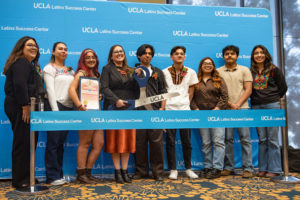
The Brown Bag Plática series connects students with professionals in a casual setting, said Mireya Gutierrez Vasquez, a member of the Latinx Success Center student advisory board. UCLA medical student Alexis Alemán – who co-created the Instagram account @foosinmedicine in 2022 – and School of Law student Andrew Mecatl spoke about their experiences as Latinos who were the first in their families to pursue advanced degrees.
Con Sabor, a Los Angeles-based Salvadoran restaurant owned by a former UCLA custodian, served pupusas at the event, said Arlene Cano Matute, the executive director of the LSC.
Mecatl said during the talk that he struggled to ask for academic and career support as a first-generation college student. Alemán added that he learned to navigate standardized exams, networking and paying for school alone because his family did not know how to support him.
“This whole time, I was working towards this idea, this dream. I had never even met a med student,” Alemán said. “It was hard in that aspect. I had to keep myself motivated and believing that I could do it despite all that. Something in me just kept telling me, ‘Just do it.’”
Alemán said during the talk that he chose to attend college after first working in construction during high school. He added that his younger brothers’ chronic blood disorders inspired him to pursue medicine, while his father’s and uncle’s experiences working in construction shaped his decision to attend college.
Alemán, a student at the David Geffen School of Medicine, said he was told he would not get into medical school. He added that he did not tell anyone he was applying to medical school until his fourth year at Cal State Northridge for fear of being judged.
“Take ownership of, ‘I don’t belong here,’” Mecatl said. “Despite everything that’s happened that has sought to prevent myself from being here, I’m still here.”
Meeting medical students as part of the School of Medicine’s Pre-Med Enrichment Program – a summer program for third- and fourth-year students and recent college graduates from educationally underserved and low-income backgrounds – solidified Alemán’s decision to pursue medicine, he said during the talk.
Mecatl said during the talk that he hopes to bring his Latino identity into the courtroom and provide legal support to his community, as well as other people from marginalized backgrounds.
“We are not the center of our own legal advocacy,” Mecatl said. “When there is a lawsuit that’s affecting Latine communities, more than often, the lawyers who are leading this effort do not come from our backgrounds.”
While the United States Census Bureau reported that about 20% of the population is Hispanic or Latino, about 5% of U.S. lawyers are Hispanic, according to the American Bar Association, and about 6% of physicians identify as Hispanic, according to the Association of American Medical Colleges.
The U.S. Department of Justice alleged in a report published May 6 that the School of Medicine illegally considered race in admissions, admitting Black and Latino students with lower academic qualifications than white and Asian applicants. A spokesperson for the School of Medicine said in an emailed statement that the school uses a merit-based admissions process.
Alemán said he sees the increased diversity in his medical school class that the DOJ spoke about in its investigation as a sign of progress.
[Related: DOJ alleges David Geffen School of Medicine illegally considered race in admissions]
Gutierrez Vasquez, a fourth-year Chicana and Chicano studies and sociology student, said holding events where Latino students see themselves represented in their field of interest is important.
“You could feel the impact today,” Cano Matute said. “People felt safe, valued – to be their full selves, to be vulnerable and to be inspired.”
Audrey Melendez, a second-year biochemistry student who attended the event, said @foosinmedicine’s social media content inspires her as an aspiring oncologist.
“It’s inspiring Latinas and Latinos that they do belong here, that they deserve to get a higher education and be in all these different spaces here in society,” Melendez said.
Mecatl said at the talk that being in spaces where he was the only Latino motivated him to disprove assumptions that he did not deserve to be there or that he was admitted to fulfill a diversity requirement.
“You got to wear your culture with a badge of honor,” Mecatl said. “That’s how I’ve been able to survive throughout my tenure at UCLA Law, in a room full of faces that don’t look like mine.”


Comments are closed.