This post was updated May 27 at 8:31 p.m.
Several campus organizations hosted an April 14 event where Omer Shem Tov, a former Israeli hostage, spoke about his experience in captivity.
The Undergraduate Students Association Council published a letter that same day. It condemned the event and the university for promoting what USAC alleged were one-sided, biased narratives.
It is well within USAC’s right to condemn the messaging of a particular speaker. But by urging the university to reconsider sponsoring similar events in the future, USAC tried to position itself as a regulator of free speech on campus.
[Related: UCLA student government accused of antisemitism for condemning Israeli hostage talk]
The circumstances surrounding the approval of the letter remain unclear.
Talia Davood, a USAC general representative who helped organize the event that featured Shem Tov, alleged that the letter was purposefully introduced and passed at a meeting she could not attend. Furthermore, in the meeting minutes, no discussion surrounding the letter is noted except for the fact it was introduced and passed unopposed. The overall lack of transparency regarding these vital questions about free speech is especially concerning.
This letter isn’t an isolated incident. It reflects a concerning pattern of USAC attempting to limit free speech on campus.
Some candidates for USAC offices this election have mentioned they hope to collaborate with the UCLA Events Office to have more of a say in what events are permitted on campus. While USAC’s stated goal – making students feel safe on campus – may be well-intentioned, the Editorial Board firmly believes censoring speech is not the right way to create an inclusive campus environment.
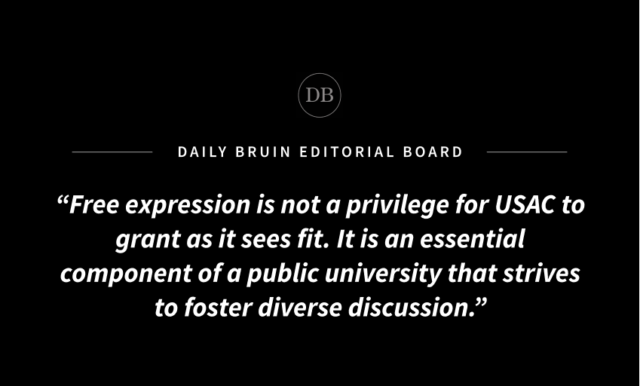
Ultimately, free expression is not a privilege for USAC to grant as it sees fit. It is an essential component of a public university that strives to foster diverse discussion. If we do not allow viewpoints we disagree with to exist on our campus, we lose our identity as an institution defined by inquiry.
When USAC begins judging what speech is acceptable and what isn’t, it normalizes when other UCLA departments and bodies enact similar restrictions.
As we look toward the 2026-27 school year, a new group of USAC officers will need to navigate divisive campus issues. At the same time, they must protect the rights of their constituents – which means they must decide how they treat free speech on campus. As such, the Editorial Board urges USAC candidates to halt the progression toward our student government acting as regulators of free speech.
After all, USAC shouldn’t dictate what speech is permissible on campus.
The United States Constitution should.

Comments are closed.