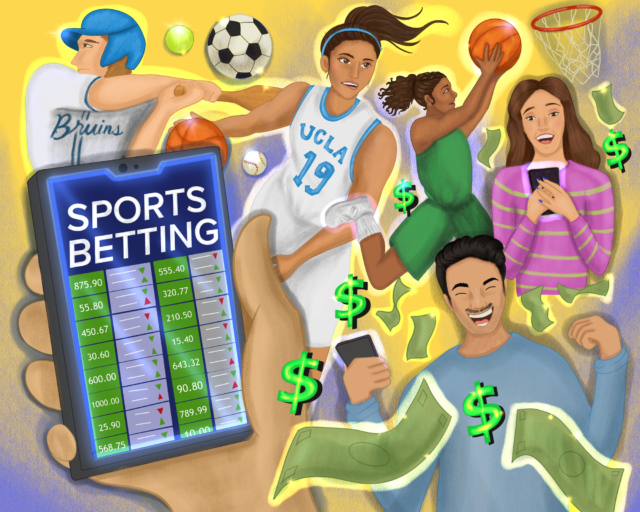
Americans were estimated to have legally bet more than $3.3 billion on the NCAA March Madness tournament this year.
Sports betting has gained traction among young people in recent years. More than two-thirds of college students living on campus participated in sports gambling in 2023, according to an NCAA report. Since the landmark 2018 Supreme Court ruling that allowed states to legalize betting individually, sports betting has increased, surging more than 50% over the past three years.
The Supreme Court struck down the Professional and Amateur Sports Protection Act, a 1992 law that restricted state-authorized sports betting nationwide and effectively left Nevada as the only state where individuals could legally wager on the outcome of a single game.
Declaring the law unconstitutional, the ruling gave states jurisdiction over gambling laws. Despite 11 states having a total ban on sports betting since 2018, online prediction markets continue to operate even in states that ban gambling, according to Stateline.
California has outlawed sports gambling, but prediction markets, such as Kalshi or Polymarket, still operate in the state by classifying sports wagers as financial contracts rather than outright sports bets. While the purchase of these contracts remains almost indistinguishable from a traditional sports wager, the difference in legal definitions allows people in states that have banned sports betting to still participate.
Some experts worry that the increased accessibility of gambling will lead to a growing population of people developing gambling problems.
Dr. Timothy Fong, the co-director of the UCLA Gambling Studies Program, said young adults – including those in college – may be more susceptible to sports gambling than other adults
“The nature of gambling itself is addictive, it’s risky, it’s seductive,” said Fong, a clinical professor of psychiatry. “If you don’t have a full adult brain, it’s harder to resist those urges and temptations that come with risk.”
He added that the normalization of sports betting has made people less critical of the practice. The UCLA Gambling Studies Program has trained professionals at the Arthur Ashe Student Health and Wellness Center and UCLA Counseling and Psychological Services on how to treat gambling behaviors, Fong said.
Fong added that the Gambling Studies Program is partnering with the UCLA Interfraternity Council to educate fraternity-affiliated students on gambling behavior, as he said studies show they gamble at higher rates than the general college population. He also said UCLA student-athletes have policies banning them from participating in sports gambling in any capacity.
According to the National Council on Problem Gambling, gambling addiction occurs when a person can no longer control their gambling habits despite negative consequences in their personal and professional life.
Every year, the NCPG reports that nearly 2.5 million American adults are classified as having a severe gambling problem, while another almost 8 million meet the criteria for a moderate gambling addiction, which consists of the bettor exhibiting significant distress or clinical impairment as a result of their gambling habits.
Fong said it is important to recognize and treat gambling addiction seriously.
“The first step has to be to talk to a healthcare professional or a behavioral health professional,” Fong said. “You can go online and try and learn about what’s happening, but there’s a lot of false information online.”
For those struggling with a gambling addiction, seeking community may help in the recovery process.
A 2023 study published in the Journal of Gambling Studies found that a stronger sense of belonging predicted reduced gambling urges, and social support was linked to better quality of life in those recovering from a gambling addiction.
Colin Camerer, the Robert Kirby professor of behavioral finance and economics at the California Institute of Technology, said biological factors also play a role in gambling behavior.
“There’s some evidence that pathological gamblers actually have less of a brain reward to winning,” Camerer said. “The theory is, because they have less reward, they have to bet bigger amounts.”
Gambling outcomes are often distorted, Camerer added.
“It’s easy to get a perception that gambling is great because you only hear from the winners,” Camerer said. “We call this a survivorship bias – the people who survived tell you how great things were, and then you don’t hear from the rest.”
Atma Joshi, a third-year computational and systems biology student, said sports gambling is often seen as a social activity. He added that betting can make watching games more engaging and stressful.
“It can make games more entertaining … It can give you something to root for,” Joshi said. “It’s a fine line between making the viewing experience more enjoyable versus getting more stressed out because maybe you’re worried about not making money.”
With the prevalence of gambling among young people, Fong also said universities must regulate and outline gambling policies for their students.
“Colleges and universities that do a lot more training, not just on gambling, but on financial responsibility, financial literacy and understanding this new digital world,” Fong said. “Recognizing that gambling should not be something that you do every day is important.”





Comments are closed.