This post was updated May 28 at 10:23 a.m.
Crochet, corsets and camp took center stage Friday night.
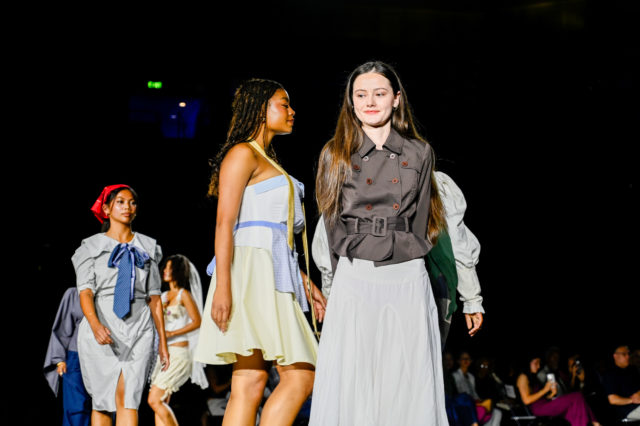
Fashion and Student Trends at UCLA held its 25th annual spring runway show at Pauley Pavilion on Friday at 7 p.m. As the culminating project of this year’s 230 members, the show featured 25 original student collections. To kick off the evening, FAST co-presidents Lianne Calvo and K Salgado stepped onto the zigzag runway, addressing the crowd with thanks for the club’s year-long efforts that went into the night’s production. Calvo, a fourth-year cognitive science student, said she has been honored to lead the group of creatives and that the organization has pushed her to dream bigger.
“An unimaginable amount of hard work has brought us to tonight’s show, this year’s magazine and every project we’ve created together,” Calvo said. “Behind all of it were sleepless nights, endless dedication and so much passion.”
Salgado, a fourth-year sociology student, called FAST a pivotal and defining part of her undergraduate experience.
The opening collection immediately established the show’s theatricality. Models emerged in flowing earth-toned garments with floral hair adornments and layered green, tan and cream textiles. Ethereal glam and soft instrumental music faded into singer Wang OK’s “Before spring ends,” before the designer of the collection appeared on the runway in an off-the-shoulder gown mirroring the collection’s earthy palette.
Subsequent collections shifted between aesthetics. One punk-inspired line featured black patchwork, chains, metallic accents and mirrored details sewn into jackets that models incorporated into their choreography. Another line paired billowing burgundy and white garments with leather, fur and head coverings, and a later group of models walked to Tame Impala’s “Dracula” in black gowns, gold dresses and sheer cloaks, all tied together by multicolor-beaded accents that made the items progressively more colorful as the looks evolved.
“We definitely wanted to lean more into the campy theme, more eccentric,” Calvo said. “We want to push the boundaries of fashion and creativity.”
The runway also mixed gender presentation and style conventions. One menswear collection featured male models carrying tennis rackets while walking to trap music in neutral-toned streetwear. Another displayed retro maximalism with flashing blue lights, mixed patterns, fur, feathers and animal print, all accompanied by Wham’s “Everything She Wants.” The designer entered after the models’ first looks, wearing an avant-garde top made of duct tape, which was accompanied by a large fur coat and sunglasses.
Calvo said the organization significantly expanded the scale of this year’s production through new lighting effects and larger promotional campaigns.
“We pasted posters all over LA, Silver Lake, Westwood area, and that’s something we’ve never done,” Calvo said. “Everything is just heightened.”
Second-year environmental science student Soel Solis presented his line, “Del Tiangüis,” which was inspired by Mexican outdoor markets and incorporated repurposed denim and recycled materials. Solis said his interest in sustainability shaped the line’s design.
“I wanted to show people that you can give stuff a new life,” Solis said.
Solis said his vision of the project evolved after sourcing the fabrics, particularly black denim, which connected to both Mexico’s industrial history and the large quantities of discarded clothing shipped across borders. Working from a suite on the Hill, Solis added that he faced challenges with space given the scale of the project. He also said FAST provided the confidence and resources necessary to create his set of designs.
His line drew from metallic punk influences with layered accessories, Solis said. One of the most meaningful items was part of the final look, Solis said, referring to the skirt he created out of a tablecloth from his house.
“It reminded me a lot of my grandma’s house in Mexico,” Solis said. “Working with those materials reminds me of home.”
Another collection came from designer and second-year theater student Obsidian Manley and explored Indian identity and nonbinary self-expression through the use of colorful sari fabric, hand-sewn garments and corsetry, they said. The collection’s title, “Bari Esho!,” means “come home” in Bengali, which is the language their family speaks in India, Manley said.
“The inspiration is basically just me coming home to a place where I feel like I belong for being Indian and nonbinary,” Manley said.
The line featured voluminous crinoline skirts, metallic textiles and colorful eye makeup. Manley later appeared wearing a crown-like headpiece.
“My goal is to make people so joyful, like tears of joy,” they said.
Manley said the collection represents years of personal and creative evolution, with some items requiring months of hand sewing and others incorporating sari fabric sourced from family friends.
One collection presented at the event incorporated overt political messaging. The outfits featured a continuous navy and black color scheme with plaid and lace accents, and the models walked to instrumentals from Ariana Grande’s “7 Rings,” layered with audio clips referencing the Israel-Hamas war, United States Immigration and Customs Enforcement raids and U.S.-Iran war coverage, prompting audience applause.
Salgado said fashion’s connection to politics and activism is an important piece of FAST’s mission. They said this intersection is important to be aware of because blocking it out is ignorant in a political climate like today’s.
“Throughout history, it’s (fashion has) been a way for people to express themselves in a place that denies them,” Salgado said.
She added that FAST aims to create a space where members feel free to express themselves creatively as artists.
“It provides a space where people don’t need to feel like they have to redact themselves in any way,” Salgado said.
For both co-presidents, the runway marked the climax of years spent growing alongside the organization. Salgado said they joined FAST as a first-year student, before becoming editorial director and eventually co-president. They said seeing the final production come together was emotional.
Salgado said seeing the final production come together evoked a sense of pride, while Calvo added that bringing the runway to life required months of collaboration and dedication from FAST’s members and leadership. Calvo said producing an industry-level runway depended on teamwork, communication and students learning from one another across generations of the organization.
At the conclusion of the runway, the co-presidents returned to the stage to introduce the 2025-26 executive board and address the audience one final time. They also acknowledged the political aspect of fashion and encouraged attendees to continue using creative work as a form of expression.
“Nothing is a no for the ambitions that you have,” Salgado said.


Comments are closed.