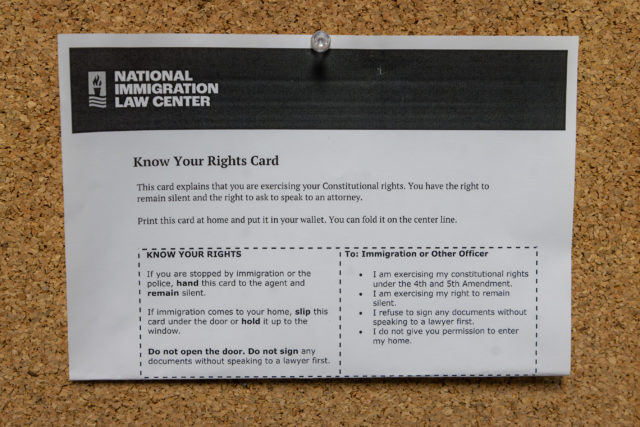
Immigrant community members shared fears of detention, deportation and family separation with UCLA School of Law students at a “Know Your Rights” presentation last fall.
But one interaction during the presentation – which students held in a South Central Los Angeles church – stood out to Katelyn Zou, who graduated from the School of Law this spring.
“There was this woman who was really concerned about her family,” Zou said. “When you’re in a desperate situation – or when things are really bad – concerns about privacy, or wanting to keep family details private, just fall to the wayside because you see this opportunity for help.”
This experience, among others, inspired Zou to continue advocating for immigrants living in LA through volunteering, she said.
The Immigrant Rights Project is a student-run initiative under El Centro Legal Projects, the School of Law’s student-coordinated network of volunteer legal aid projects. The initiative aims to help immigrant communities by providing them with legal education and accessible information on immigration processes.
El Centro Legal Projects, which was founded in 1973, places more than 200 law student volunteers in attorney-supervised projects related to immigration, labor rights and education, according to its website. The organization offers legal aid for people who could not otherwise afford an attorney in LA County, its website said.
The Trump administration ramped up immigration enforcement activity, with United States Immigration and Customs Enforcement officers arresting about 1,264 people per day between December 2025 and January 2026, according to the American Immigration Council. The administration targeted LA as part of its immigration crackdown, conducting large-scale raids beginning June 2025, though arrest rates have since slowed down.
El Centro previously led a project focused on assisting asylum seekers and immigrants looking to become citizens, said Hayden Fuchino, a law student and volunteer director for El Centro Legal Projects. However, members discontinued the initiative after the Trump administration closed off asylum pathways that had existed for decades, he added.
The Trump administration proposed sweeping changes to the asylum system, including by implementing new security checks for asylum applicants in April and new annual asylum fees starting in May, according to the Asylum Seeker Advocacy Project.
“Now, the community is really needing information,” Fuchino said. “They need to know what to do if ICE comes to their door, if ICE comes to their community.”
Zou said increased immigration enforcement activity has created fear within immigrant communities, making them increasingly reluctant to attend group presentations at public venues. El Centro shifted toward conducting outreach online in response to these issues, Fuchino added.
“We’re seeing a general fear of going outside of one’s living space to the streets,” Fuchino said. “One big shift that we’ve been seeing is a shift towards Zoom and providing information digitally and trying to make sure that we can get information out to people in their homes instead of having them come out to a meeting where they might feel vulnerable.”
The Immigrant Rights Project has faced difficulties in bridging the gap between community members’ needs and the help law students can provide, Zou said.
“It’s been disheartening to see people come in with a lot of questions,” she said. “They’re really scared, and you aren’t able to provide them with something that they can act on, or something that could comfort them, or address their situation. You can only give them general advice.”
However, Zou said law students created new projects focused on providing live client work to address these gaps.
Students began providing legal manuals on U visas – a form of immigration relief for victims of certain crimes who have experienced mental or physical abuse and are willing to assist law enforcement, Zou said.
Claire Procter-Murphy, a law student and one of El Centro’s executive directors, said the project’s expansion reflects growing student interest in hands-on immigration advocacy. El Centro allows students to use their legal education to make a direct impact on communities beyond the classroom, Procter-Murphy added.
“Even though it (the Immigrant Rights Project) is student-run and our ability to provide actual legal advice is limited, law students really do want to show up for our community, uphold the rule of law and be there when it feels like no one else is,” Zou said.


Comments are closed.