This post was updated July 12 at 7:27 p.m.
A journalist sends an email to a UCLA administrator.
The administrator then forwards it to the university’s strategic communications team. Days later, the journalist gets back a carefully sculpted and minimally detailed statement. The journalist’s questions go unanswered, and their request for an interview with the administrator is turned down.
This communication policy fails not just our students and taxpayers but the university itself.
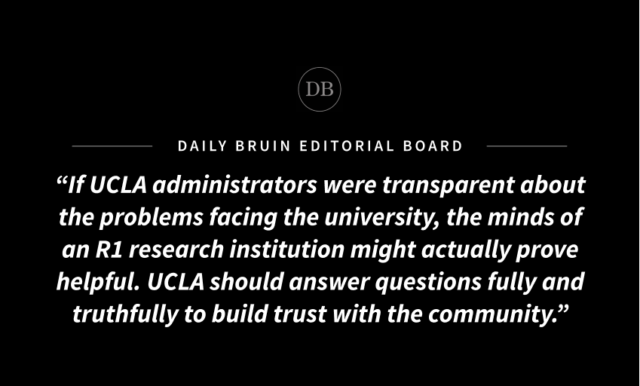
UCLA should stop rerouting questions with scripted statements and instead adopt a policy of answering questions in an open and honest manner. If UCLA administrators were transparent about the problems facing the university, the minds of an R1 research institution might actually prove helpful.
UCLA should answer questions fully and truthfully to build trust with the community.
Some of California’s taxpayers already see universities as elitist, self-serving institutions. When administrators answer questions about federal funding cuts and major budget deficits with half-truths written by public relations specialists, it only reinforces this perception.
Failure to answer questions also makes the university seem hypocritical in pursuing its teaching and research mission. Students respond to questions on tests. Researchers ask them in libraries and laboratories. Professors answer them about their theories and theses.
Why can’t our leaders do the same?
Chancellor Julio Frenk hosted the university’s first State of the Campus event May 26. The campuswide livestream was ostensibly designed to reflect on the university’s operations.
His address also seemed to be modeled on those of statesmen worldwide. The mark of those great statesmen is openness to accountability and regularly answering questions from their constituents. The chancellor, by doing the same, could earn the same respect.
But his State of the Campus address instead came across as a poorly conceived public relations exercise.
Administrators read from scripts at an undisclosed campus location. Attendance was invitation-only. The livestream was carefully controlled. And Frenk didn’t take questions.
This stab at transparency only reinforced the perception of a cryptic and unresponsive administration. It suggested UCLA administration thinks students and taxpayers do not have the capacity to engage in unscripted dialogue in good faith.
Even the premise of a strategic communications team invites worrying connotations: The university wishes to manipulate the truth.
We need a radical rethinking of the way our university conducts communications. Instead of hiding behind the nebulously named strategic communications department, deans, chairs and vice chancellors should commit to regularly speaking directly and honestly with their community.
The Board recognizes that administrators are stretched thin across many responsibilities, and responding to every request for comment may not be possible. However, high-profile decision-makers need to seek honest ways to conduct communications. Addressing the community needs to be a forefront responsibility for UCLA administrators, not a nuisance passed down to their strategic communications team.
A more open approach to communicating about the university’s problems – including budget deficits, spiraling overheads and distrustful labor relations – would allow the university’s most brilliant minds to come together in finding creative solutions. By failing to be transparent, UCLA risks losing out on the expertise of its thousands of faculty members.
But perhaps most importantly, if administrators like Frenk and the members of his cabinet truly believe that what they are doing is best for students, faculty and California taxpayers, they should be prepared to defend it in open, rigorous and unscripted debate.
Because for a public university, strategic communications is just bad strategy.


Comments are closed.