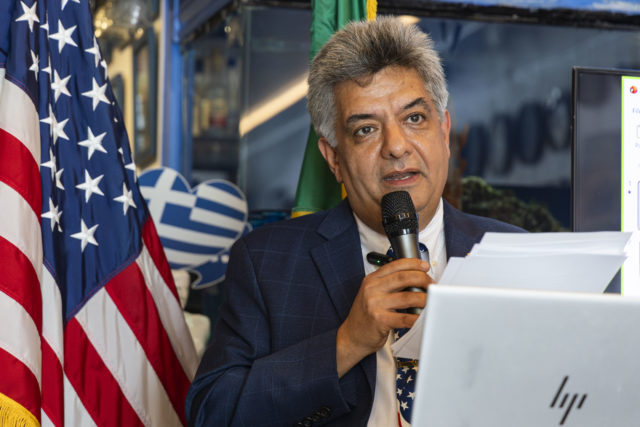
An activist and Westwood restaurant owner raised awareness about historical and current conflicts in Iran at a Thursday luncheon.
The most recent United States-Iran conflict began Feb. 28 after the United States and Israel launched strikes on Iran that killed its supreme leader, according to CNN.
President Donald Trump, Vice President JD Vance and Iranian parliamentary speaker Mohammad Bagher Ghalibaf signed a memorandum of understanding – a formal, non-binding agreement – Wednesday that gives the U.S. and Iran 60 days to negotiate a final peace deal, according to CNN.
Roozbeh Farahanipour, the owner of Delphi Greek Restaurant and Bar, said in a talk that he hopes the agreement resolves the war in Iran.
The Rotary Club of Westwood Village – which works to combat global social issues through promoting peace and education – organized the luncheon.
The Rotary Club of Westwood Village is one of over 60 rotary clubs in Los Angeles alone, said Benjamin Fisher, the co-president of the Westwood Village Rotary Club. The organization meets for lunch every Thursday to hold group conversations and host speakers, he added.
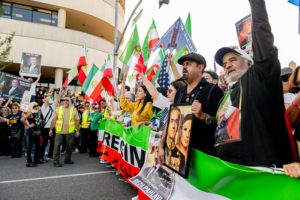
Ed Gauld, a former president of the Westwood Village Rotary Club, said gatherings and street protests in LA show that the conflict in Iran is an important issue for many people. He added that events like the luncheon allow people such as Farahanipour to educate the public.
Farahanipour, who was born in Tehran, Iran, said in a talk that he was seven years old when he witnessed the Iranian Revolution overthrow the Pahlavi monarchy in 1979. The revolution, fueled by discontent about Iran’s autocratic regime, turned the country into an Islamic Republic, according to EBSCO.
After the revolution, Farahanipour said a group of people, who later became part of the Islamic Revolutionary Guard Corps, attacked his Catholic school in Iran and arrested priests.
Farahanipour, a co-founder of the Marze Por Gohar resistance movement, an opposition group against the Islamic Republic, said he encouraged people to participate in the series of Iranian student uprisings in 1999.
Student uprisings and protests broke out following the Iranian government’s forced closure of media outlets, which police responded to by attacking dormitories at Tehran University, according to PBS.
Farahanipour said in his talk that he and 12 other people involved in the demonstration were arrested during the uprisings.
“The next day, the IRGC (Islamic Revolutionary Guard Corps) attacked my home,” he said during the event. “I got a death sentence from the regime. I escaped the country – I came here in 2000. Since then, I live, work and serve the community.”
The Persian community in LA is divided over the United States’ current involvement in Iran, Farahanipour said in an interview.
About 30% of Iranian Americans live in LA, according to Pew Research Center.
West LA became a new home for Iranian refugees – including Beverly Hills, Bel-Air and Westwood – after the revolution, Farahanipour said in his talk. The intersection of Westwood Boulevard and Wilkerson Avenue was officially named “Persian Square” in 2010.
Farahanipour said many people feel hopeless about the war in Iran, with some being for and some being against the war. The use of the Lion and Sun flag – which protestors have used as a symbol of resistance against Iran’s government – has divided Iranian Americans, he added.
About 66.1% of Iranian Americans oppose the conflict, up from 49% at the beginning of March, according to an April poll by the National Iranian American Council.
The community must be open to people with different beliefs, Farahanipour said.
Farahanipour added that Iranian Americans are serving in many federal and local government roles.
Gauld said he was impressed by the drive of the many Iranians who immigrated to the U.S. Local elected officials should support the Iranian immigrant community in the U.S., Gauld said.
“They need to support the Iranian community,” Gauld said. “Especially if they’re leaving because they’ve been oppressed.”

Comments are closed.