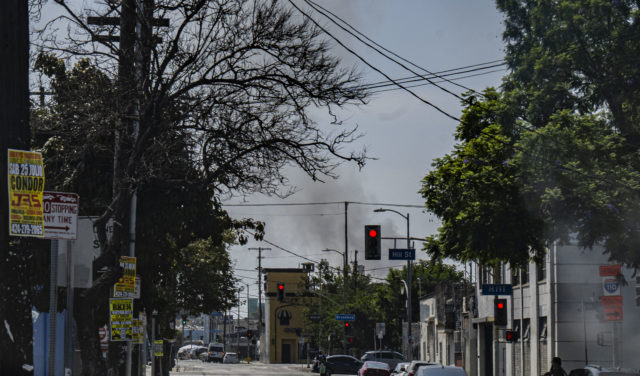
Black smoke billowed. The stench of rotting food permeated the neighborhood.
This is not a scene from a science fiction novel. It is the reality of the seven-day Lineage warehouse fire in Boyle Heights, which began June 17.
The fire is no isolated incident. It represents a pattern of environmental consequences disproportionately placed on low-income communities of color in Los Angeles.
In the aftermath of the weeklong blaze, LA must provide Boyle Heights and surrounding communities with resources that meet their needs. This includes stipends for residents and accessible information in Spanish and English.
Further, UCLA students should inform themselves about the fire and the history of Boyle Heights. Bruins – who are future scientists, policymakers and leaders – should understand the past to prevent similar disasters from recurring.
[Related: Opinion: LA is more than just luxury, UCLA students should explore its rich history]
In the 1930s, city officials redlined Boyle Heights. They marked the neighborhood as unsafe to invest in based on racist principles, leading to systemic neglect and housing discrimination. Later, city planners built the Interstate 5, Interstate 10, Route 60 and Route 101 freeways over Boyle Heights. This displaced over 10,000 residents, according to PBS.
“The fire didn’t create the environmental inequities in Boyle Heights – it exposed them,” Councilmember Ysabel Jurado said in an emailed statement. “Too often, communities like this are asked to carry environmental burdens while fighting harder than anyone else for basic information, resources, and protections.”
These consequences still harm residents of Boyle Heights.
Residents in the smoke advisory zone disproportionately face environmental injustices, like air pollution and diesel particulate matter from cars and traffic, said Julia Silver, a senior research analyst at the UCLA Latino Policy & Politics Institute. Residents had a higher rate of emergency room visits for health problems like asthma and cardiovascular conditions than average in LA County, Silver added.
The city is making an effort to help. LA is providing air purifiers, food kits and financial assistance to affected residents out of the Community Resource Center. They set up mobile health clinics and made other recovery efforts. Mayor Karen Bass signed two executive orders aiming to accelerate recovery June 29.
But due to increased health concerns, there should have been a more urgent and intentional effort to help when the fire started. The city should have tailored its response to meet the needs of Boyle Heights residents specifically, Silver said.
For example, the city recommended that people in Boyle Heights avoid unnecessary outdoor activity and stay indoors.
However, a study from the UCLA Latino Policy & Politics Institute found over half of the workers who live in the smoke advisory zone may have limited access to remote work, paid leave or health insurance. Additionally, nearly half of the resident workers earned less than LA County’s very-low-income threshold.
These residents cannot take time off of work – even if it is outdoors – when the trade off is losing their homes, food or utilities. The city should prioritize providing financial assistance such as stipends, which residents can easily access.
Silver added that about 40% of residents in the smoke advisory zone have limited English proficiency, adding that not enough resources have been provided in Spanish. The city should ensure that important information is easily accessible in both languages.
“Residents deserve clear information they can trust, strong public health protections, and a recovery that puts their health and safety first – not one where they have to fight for answers every step of the way,” Jurado said in the statement.
Customizing emergency responses is a vital step for city officials to take. It will not only help residents in the smoke advisory zone but also better prepare LA for future disasters.
Even now, consequences of this fire stretch beyond Boyle Heights.
Sara Borja, a rising third-year sociology student, said she was born and raised in Crenshaw, a neighborhood about nine miles west of Boyle Heights. Despite her distance from the fire, Borja said she still dealt with smoke.
“Even though I wasn’t right next to the fire, it was still concerning knowing how far smoke can travel across Los Angeles,” Borja said. “It made me think twice about spending long periods of time outside.”
Experts warned pollution from the fire would blow into the San Gabriel Valley, creating heavy smog in Pasadena, a city over 10 miles northeast of Boyle Heights.
Environmental justice is everyone’s problem. When Angelenos cannot breathe without possibly inhaling toxins, the city must provide tailored support – and UCLA students should hold the city accountable.
Borja added the city’s response to the fire makes her concerned about future disasters in LA.
“It really leaves people of Los Angeles scared,” Borja said.
Email Green at [email protected].

Comments are closed.