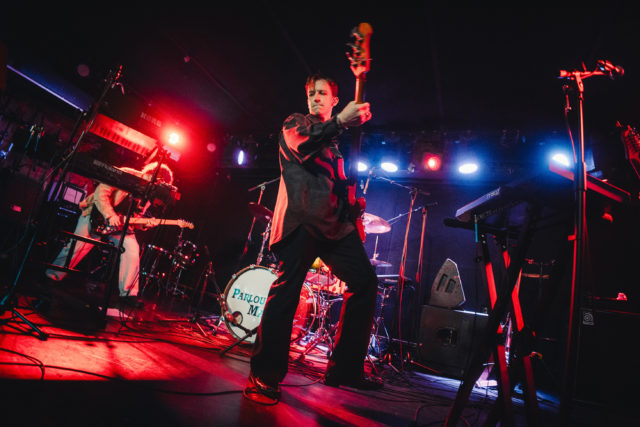
Although “The Embassy” was inspired by solitude, Parlour Magic’s third album shows how collaboration creates art.
Parlour Magic is an NYC-based synth-pop band led by producer and composer Luc Bokor-Smith. The band released its third album “The Embassy” in June, blending vintage synth-pop, art rock and cinematic electronica. Produced by Bokor-Smith, in addition to Bailey Kislak and Fab Dupont, the album was recorded at Flux Studios in New York and Funkhaus in Berlin.
Before Parlour Magic brings its national tour to Los Angeles with an Aug. 8 performance at Gold Diggers, frontman Luc Bokor-Smith spoke with the Daily Bruin’s music and fine arts editor Alexis Coffee about balancing studio experimentation with live performance and exploring the intersection of music, production and media art.
This interview has been edited for length and clarity.
Daily Bruin: Can you tell me a little bit about how you got into music? How did this all start for you?
Luc Bokor-Smith: Music’s been my life for as long I can remember. From being in the car with my parents to playing in bands in high school to studying it in college, I never thought that I would be fronting a band.
DB: How did Parlour Magic come together?
LBS: It was right before the pandemic. I made this album without any real sense of what I was going to do with it. I certainly didn’t have it named, and Parlour Magic wasn’t really a thing yet. But I made the first album in Las Vegas, and I decamped there for six weeks right before COVID hit. I made that first record and sat on it for the rest of the year, not sure what to do with it. And then I finished it back in New York over the summer. That was the first moment where I knew I didn’t want the album to be out under my name. I had no desire to be identified with it at all. That was where the Parlour Magic name came from, as I was preparing to release the first album.
[Related: Q&A: Andrés Charvel on BelicoFest’s mission to promote música mexicana in LA and beyond]
DB: People love genre shorthands – synth-pop, art rock, cinematic, electronic. Where does that kind of shorthand stop being accurate for what you’re actually doing?
LBS: Genres are important. It’s safe to call the first record synth-pop and probably the second one, too. It has a little bit more nuance than that because I didn’t really grow up listening to synth-pop. I grew up listening to bands like the Strokes or the Arctic Monkeys or Oasis. I really liked synthesizers, so I set out to make synth-pop. I wanted to make that kind of indie rock music with the toys that I knew how to use. This album has been the hardest one to categorize. I like to call it a rock record. We have real drums and real instrumentation. This one definitely has a living, breathing feeling to it.
DB: Your first two albums leaned more heavily on digital production, while “The Embassy” incorporates more live instrumentation. At the same time, technology has made it easier for artists to produce and release music independently. How has that shift shaped your career outside the traditional record label system?
LBS: There’s a number of things good and bad about the internet. The one undeniable positive is that it’s given artists agency to control their careers in ways that were previously impossible because you needed physical distribution. You needed someone to be pressing your records. Unless you had the money to self fund it, the cost of entry was a lot higher if you didn’t want to work with a label, and by that, I mean it was impossible because they also controlled the radio. It’s really cool that some kid in some basement in the middle of the country can make a great record and have it blow up and do that entirely on their own.
DB: How has your experience between the first two and this album changed?
LBS: It feels really collaborative for the first time. The credits for “The Embassy” will show you that eight or 10 people worked on every song. When I was younger, there might have been some imagined fear of control, but I feel even more ownership of this album because it’s something that I feel I made with people that I really care about – that makes it more special.
DB: Is there a decision that this album, sonic or otherwise, that really stands out to you?
LBS: This was the first time we ever worked with a string section on two of the songs, “Arizona 2000” and “Meir,” by this incredible arranger named Kristine Kruta. We were recording – and it’s a small part of that song – but it’s the emotional apex of the record.
DB: Is there a track on the album that pushed you in a certain direction that you weren’t anticipating?
LBS: “Arizona 2000.” The original thought was that it was actually going to be just me and a finger-picked guitar, which itself would have been a big departure because I’d never done anything remotely like that. But where it ended up is sort of equally departure-ish, where it has these sort of like atmospheric guitars, and then that moment where the band shows up for its bars and then the song leaves with the strings.
DB: How has touring changed your perspective on the music that is so usually intimate?
LBS: We didn’t start touring as a band until the second album. What I learned is that the songs become a whole other thing entirely. Over the course of that last tour, those songs became blueprints of what “The Embassy” was going to turn into. Getting to play with the band on that tour was the thing that made me say I want to make a band album with drums. I want to make an album with people playing music in a room together.
[Related: Q&A: ‘This Is Our Youth’ cast, director break down themes, stage production of play]
DB: What can audiences take from the live show that they wouldn’t get listening to the record?
LBS: In a world of AI, people are lonely and people want connection. When you see that album live in a room full of other fans with a band who genuinely cares, there’s no better feeling. People want to feel emotion, and the emotion comes when you’re in the room with them.
DB: Can I ask how you feel about AI?
LBS: I think it has no place in art. I also think there’s a need to be realistic about the world. What I can say is that for myself, I don’t feel the need to be assisted in any way during the artistic process with AI. I never plan on it. Parlour Magic is nostalgic by default. The whole project is rooted in analog synthesizers and physical objects and old media, so I will never use AI in an artistic capacity.
DB: So now that the album’s out in the world, are there any reactions from other people that have now changed your perspective on some of the songs?
LBS: The most effective art, and specifically music, is specific enough to lead a listener somewhere, but also vague enough to let them project whatever they need onto it. That’s always been my goal. People have asked me in the past, “Oh, what’s this song about?” or “What’s that song about?” And I have varying answers, but more often than not, the best answer is: the song is a mood. It’s a place where you can go to sort through whatever you need. It’s important to offer that to people. “The Embassy” as an album is meant to live in a liminal place between two people, and that can mean whatever it needs to mean because it isn’t about me. It’s about trying to emotionally reach the person who is listening to the song.

Comments are closed.