This post was updated Aug. 23 at 5:58 p.m.
The rules of an election can influence its outcomes just as much as the candidates.
The 2026 California gubernatorial primary featured an unusually competitive field, with six Democrats and two Republicans leading among more than 60 candidates.
Having adopted the system in 2010, California is one of five states to employ top-two or similar primaries. Under this system, all candidates are listed on the same ballot, regardless of partisanship. The two candidates who receive the most votes proceed to the general election, even if they belong to the same party.
This structure creates unique challenges in a race with many candidates from the same party. If Democratic voters divide their support among the six leading candidates, the top-two system could lead to two Republicans advancing to the general election.
Democrats prevented two Republicans from advancing to the general election last June, leaving Democrat Xavier Becerra to face Republican Steve Hilton come Nov. 3. But this primary election and its uncertainty should remind UCLA students the importance of learning about California’s electoral systems. Once they do, Bruins can vote strategically – considering more than just their personal preference to maximize the likelihood of a preferable outcome, even if it’s not their first choice.
Havanna Dunlap, a rising second-year international development studies student and the social director of Bruin Democrats, said she believes too many people, including UCLA students, aren’t knowledgeable enough about electoral systems and rules.
“Most people, unless they’re interested in politics, aren’t really taking the time to do extra research besides voting for who they want to win,” Dunlap said.
According to the U.S. Chamber of Commerce Foundation, more than 70% of Americans who took a quiz on basic civics failed.
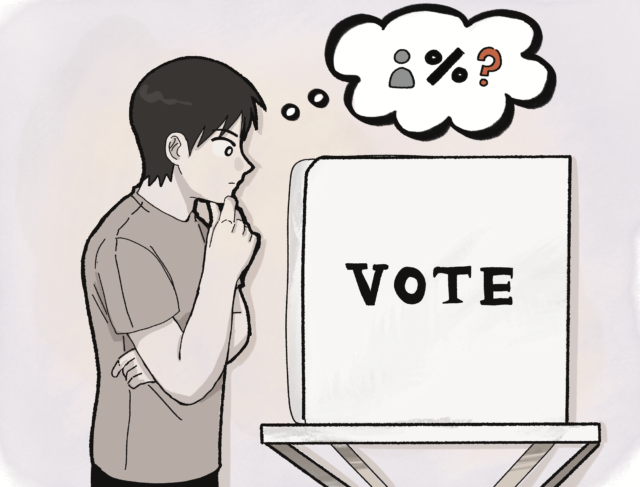
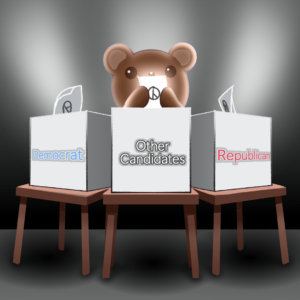
Understanding the electoral system may encourage voters to consider casting their vote strategically.
Isaiah Garcia, a rising third-year microbiology, immunology and molecular genetics and neuroscience student, said he would support a more electable candidate if multiple contenders held similar views, prioritizing the likelihood of success.
In these situations, it’s vital that voters with similar political views rally behind a candidate who may be more likely to advance.
Lynn Vavreck, a professor of American politics and public policy, said in an emailed statement that strategic voting depends on voters organizing around a candidate and casting their ballots with the election’s overall outcome in mind.
But coordination is difficult when voters do not understand its importance. That’s why learning how the electoral system works is so essential.
Strategic voting, to be sure, can place limits on political diversity and reinforce political division because fewer viewpoints are being represented. But understanding the realities of the electoral system – no matter how messy – is necessary for voters to boost their political influence.
Becerra’s success may have been aided by coordination and strategic voting.
Just a few months ago, Becerra was polling at 3%, according to the Guardian. As fear grew over the possibility of two Republicans advancing, many Democrats ultimately united behind Becerra to minimize the chance of two Republicans moving forward. He went on to win about 28% of the vote, according to NPR.
As the 2026 midterms quickly approach, UCLA students should consider strategic voting to increase the likelihood that candidates who align with their values advance to the general election.
It is essential for effective – and informed – civic participation.

Comments are closed.