This post was updated Sept. 4 at 3:01 p.m.
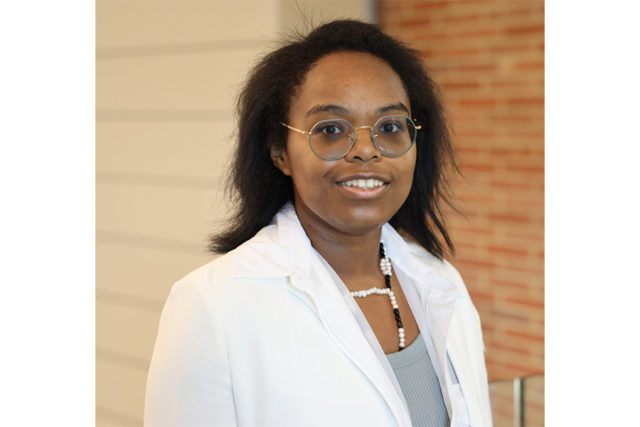
A UCLA researcher received a new Amazon computing grant to make multilingual artificial intelligence more accessible.
Saadia Gabriel, an assistant professor of computer science, was awarded $250,000 of compute credits – which provide processing time, memory and storage on online computer hardware – through Amazon’s Build on Trainium grant. The grant program, which invests $110 million in new research developed on Trainium AI chips, aims to support university faculty and students researching AI.
The credits will go toward Gabriel’s research on multimodal large language models, which are AI systems that interpret and respond to questions from languages across audio, text, image and video. Computing power allows people to train generative AI models at massive scales.
“We’re very resource constrained in academia,” Gabriel said. “But it definitely just empowers us to be able to do more when we have these collaborations.”
The program represents a growing investment in academia as researchers face federal grant disbursement delays, Gabriel said.
“I’m all industry funded at the moment, and I think that’s becoming increasingly typical in computer science,” she said. “There have been a lot of restrictions placed on federal funding.”
The Trump administration froze $584 million in UCLA’s research grants in July 2025, alleging that UCLA allowed affirmative action, antisemitism and “men to participate in women’s sports.” Chancellor Julio Frenk denied the federal government’s allegations in a January interview with the Daily Bruin.
A federal judge restored most of the grants in August and September 2025, and the same judge ruled separately in November that the federal government could not freeze or threaten to freeze the university’s grants.
[Related: Federal government suspends research funding to UCLA]
Gabriel said her research project – titled MANSA: Democratizing Voice AI with Efficient Multimodal Foundation Models – aims to improve AI tools for millions of users in Africa. She added that her lab previously developed a mobile app to collect speech and text data from native speakers of 40 African languages to train AI models.
The computing power offered by Amazon exceeded prior grant amounts she has received, Gabriel said.
Amazon is hoping to expand access to Trainium computing servers – a collection of AI chips that grant recipients use to train models – by making the source code behind the platform publicly available online for others to use and improve, said Kamran Khan, head of business development at Amazon’s semiconductor division.
Trainium has the capacity to support some workloads that university-run servers often struggle with, said Miryung Kim, a professor of computer science and an Amazon Web Services AI Scholar.
Yida Wang, a principal scientist at Amazon AWS AI, said he hopes the Build on Trainium program encourages more collaboration between corporations and researchers.
Gabriel’s experiment-based research methods make her especially fit for the fast-paced nature of modern AI research, said Genglin Liu, a doctoral student in computer science who works under Gabriel.
“For people that work in AI, the publication cycle (has gotten) quicker and quicker,” Liu said. “But then that leaves gaps in your research rigor.”
Liu said Gabriel’s focus on data collected through observation and experimentation inspired him to challenge his own assumptions and broaden the scope of his research.
Gabriel said she hopes her research will allow AI models to better understand cultural values and nuances among communities that are currently less visible in online databases. Her work will also include audio recordings from people in areas with higher illiteracy rates so their languages can be used to train future models, she added.
“There’s a lot of information about the region and about people’s lives and behaviors that are not going to be captured if you’re just looking at web data that’s giving you this very narrow view of the world and excluding these populations,” Gabriel said.


Comments are closed.