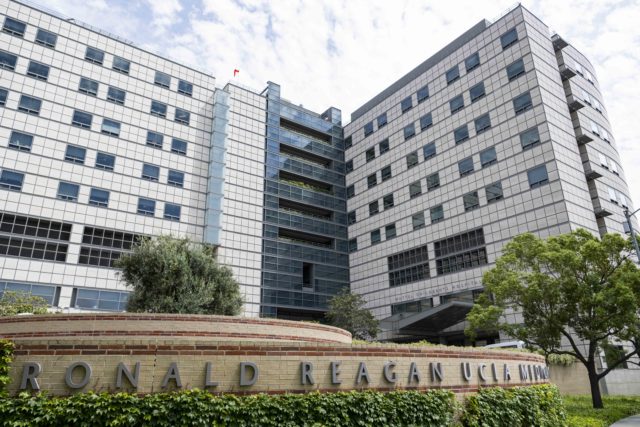
Nearly 10,000 UC doctors – including UCLA Health employees – have started the largest unionization campaign of attending doctors in United States history.
UC Doctors United – backed by the Service Employees International Union, a labor union representing around 2 million public sector workers – announced the campaign in July outside the Zuckerberg San Francisco General Hospital. Physicians in the campaign said they organized because of alleged increases in labor burden, patient boarding crisis and hospital leadership who won’t address ongoing issues.
“Across all the attending physicians at UCLA and across all the departments, our working conditions have just degraded to a point where something has to be done,” said Dr. Jacob Lentz, an attending physician in UCLA Health’s emergency medicine department. “To rescue medicine and healthcare for our patients, physicians need to organize themselves in order to negotiate better care.”
Lentz declined to comment on the exact number of supporting UCLA physicians.
A UC Office of the President spokesperson said in an emailed statement that the University takes physicians’ concerns about workload, understaffing and workplace safety seriously. UC leaders regularly evaluate staffing, hiring, security, workplace needs and compensation, the spokesperson added.
The spokesperson also noted that the doctors have not yet formed a union. Employees are required to garner majority support and file a petition with the California Public Employment Relations Board to form a legally recognized union.
“Neither organizing activity nor the announcement of a campaign means the affected physicians and clinical faculty are represented by a union,” the spokesperson said. “Any representation proceedings would occur through the applicable legal and Public Employment Relations Board processes.”
The UC reached an agreement with the Committee of Interns and Residents/SEIU – which represents more than 6,400 University interns, residents, and fellows – in July after nearly one year of contract negotiations. Lentz said the agreement inspired UC Doctors United.
[Related: UC reaches tentative agreement with CIR-SEIU after almost a year of negotiations]
“Being part of a resident union, I felt the exact opposite of that (feeling powerless),” said Dr. Reza Hessabi, an attending physician and health sciences assistant clinical professor in UCLA’s emergency department. “I had the ability to issue a grievance. I had the ability to change my working conditions materially.”
Lentz, who has worked at UCLA Health for more than a decade, said a union would give physicians formal input into hospital operations that existing leadership structures have not provided.
“A union would force – legally – UCLA to negotiate not just pay but, more importantly, the way in which the hospital operates,” he said. “A union is much more boots on the ground – the people who actually do the work, being involved in shaping how policy is made and how business is done.”
When patients are admitted to the hospital, they wait in the emergency department if no inpatient beds are available, Hessabi said. Boarding – or severe backup of patients – is one of the issues driving the campaign, Lentz added.
“I have to suffer the moral injury of talking to them about their cancer diagnosis in the middle of a hallway,” Hessabi said. “I don’t have rooms to see people in.”
Hessabi alleged that physicians’ workloads have increased over recent years without a corresponding rise in pay or support from hospital leadership. The healthcare industry has failed to treat physicians as clinical-decision makers who deserve a voice in hospital operations, he added.
“As corporate entities swallow up medicine, as more and more hospitals merge with each other, physicians are not considered part of management,” Hessabi said. “They are considered labor, and our labor is frequently being abused. Our labor is frequently being taken advantage of and taken for granted.”
The campaign reflects a broader national shift in how physicians are responding to changes in the healthcare industry, Hessabi said. It aims to demonstrate to other doctors in the country that collective action is achievable, he added.
The unionization effort is centered on patient care rather than compensation, Lentz said.
“All the people involved in organizing this union, we don’t talk about money,” Lentz said. “The only thing that people keep coming back to is patient care. We are doing this on behalf of our patients in order to provide better care for our patients.”

Comments are closed.