Wildfires are known for their unpredictable, destructive nature.
But in the ashes of a wildfire exists the potential for rebirth and growth.
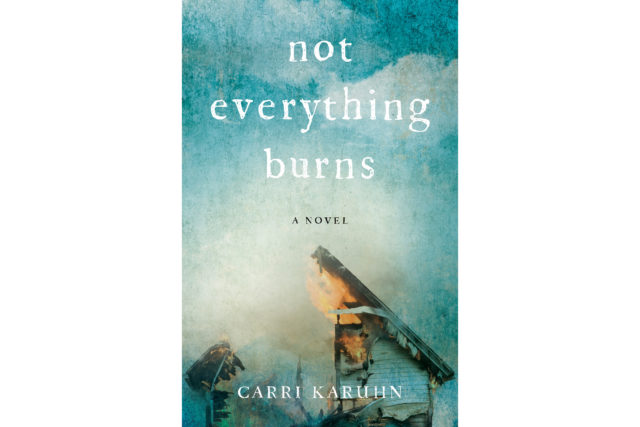
Author Carri Karuhn explores that tension in her upcoming Nov. 10 novel, “Not Everything Burns,” which follows journalist Amber Mettle as she faces a devastating wildfire in Los Angeles. Karuhn, a UCLA alumnus and longtime journalist, wrote the novel with inspiration from her own experiences surviving the 2007 Corral fire in Malibu.
In “Not Everything Burns,” Karuhn explores the theme of grief in the face of catastrophe. Karuhn spoke with the Daily Bruin’s Vishnu Potharaju about how she approached writing a fictional narrative based on her life.
This interview has been edited for length and clarity.
Daily Bruin: Could you describe what “Not Everything Burns” is about and how you got the idea to write the novel?
Carri Karuhn: It’s about a woman whose life burns down twice: first, when her marriage falls apart, and then literally, when a wildfire destroys her home and takes the animals that she loves so much. It’s loosely based on my own experience, and at its heart, it’s a love story about loss and resilience and accountability – and ultimately about deciding whether the things that happen to us are going to define the rest of our lives.
DB: What is Amber like? What inspiration did you use to draw on her qualities?
CK: I’m a survivor of the 2007 Corral Canyon fire that swept through Malibu. That fire pretty much wiped out my neighborhood, and it was caused by three men who set an illegal campfire during 90-mile-per-hour winds on a ridgeline and fled, and it wiped out everything. I was out of the country at the time, and what happened was that it destroyed my house and took my animals as well. What inspired me was, during that time in my life – I was distraught by the loss of my animals – it was very important for me to hold the men who started this fire accountable.
[Related: Q&A: Faouzia talks ‘FILM NOIR’ era, onstage world-building]
DB: What was the emotional journey like of pulling from your own memories and writing a narrative about these tragedies? How did you draw the line between what was your story and what became Amber’s story in the book?
CK: It was many levels on the emotional journey because I was out of the country at the time, … so the emotional level is coming to terms with betrayal and the grief of my animals and ultimately the anger that got me through to fight and make people held accountable for their actions. This fire happened almost 20 years ago. My story started out as a memoir, but ultimately I wasn’t trusting my memory from 20 years ago to get everything absolutely correct. I was struggling with my memoir a little bit, but when I was living in California, I had interned with the legendary producer Fred Roos, and shortly before he passed away, he called me to ask what I was working on. I told him, and he said, “Can I give you some advice?” And I said, “Absolutely,” and he said, “Fictionalize your story to make the story work,” and so that’s what I did.
DB: What messages or themes were you aiming to explore with this novel?
CK: Resilience and accountability – those are the two main themes of my story. There was a moment where I felt like the entire world, the universe, was against me, and I had this metaphysical experience after looters stole my dog’s headstones. I had this experience, and I realized that even though everyone seems to be wanting a piece of me, I still had a choice. I could curl up into a ball and let everyone take advantage of me, or I could come out fighting.
DB: Your novel’s press release mentions “insurers, mortgage lenders, and opportunist grifters circling for profit” after the tragedy. What sort of commentary were you hoping to make on these real-world industries and how they deal with wildfires through your story?
CK: In the aftermath, I expected some sympathy or understanding or something, and then when that didn’t happen, I was like, “Oh my, they don’t care about me or us. They don’t care.” The mortgage company still wants its monthly payments. They still want to be paid. There’s very little grace. There’s no grace in their mind for that. The insurance company didn’t want to pay. They didn’t care. Naively, that was a wake-up call. I was slapped in the face, like “Why did I think they would care? This is corporate America, and it’s really about the bottom line.”
I was absolutely appalled by the grifters. One example, I was up at the property. I was by myself. My house was leveled. There was nothing. The fireplace wasn’t even standing anymore. I was sifting through the debris in hopes that I might find something that might have survived. This pickup truck drove by and saw me there and stopped, and the man got out and said, “Hey, can I give you an estimate to clear your property?” Because the county requires people to clear the debris from the property after a certain amount of time. And I was like, “Sure, you can give me an estimate.” And so he came back and gave me an estimate to clear my property for $50,000, and I had gotten other estimates prior to that of $5,000, so I knew he was trying to scam me.
[Related: Book Review: Mariam Rahmani’s ‘Liquid’ lacks fluidity in its traversal through storylines]
DB: You have a very extensive journalism background. You’ve reported for the Chicago Tribune and the Associated Press, and you’ve been a freelance writer for the LA Times. How did your experience as a journalist influence your writing style on a fictional narrative like “Not Everything Burns”?
CK: From my journalism background, it came from storytelling. But from the fictionalized side, I graduated from UCLA in screenwriting, and so I merged the two, using what I learned in the MFA program with screenwriting about how to tell a story, fictionalizing it with a beginning, middle and end – and a character’s arc.
I blended, in my story, humor with trauma and tragedy. For me, that was very intentional, and the humor actually does come from my life. I have some very eccentric family members, and they’re part of my narrative, and I couldn’t tell the story without them being a part of it. So this is not a treatise of loss – I hope not a totally depressing book. It’s not meant to be a depressing book. I wanted to inject comedic relief in there because that’s really important. Rather than someone walking away going, “Oh my God, I’m devastated,” I wanted them to be able to laugh with some of my characters.
DB: What would your message be to readers who are reading the story and have been through a similar event or tragedy like you have? What were you hoping to impart onto them by telling your story?
CK: There’s light at the end of the tunnel. When you’re going through something like this, when you’re going through hell, when you’re in hell, don’t stop. You got to keep walking through that bad time, so you can get to the other side. Because if you stop, then you’re stuck there. So you just need to keep moving through it and surround yourself with good people and supportive people. I know you’re maybe going through this really hard time, but you will get through it. There’s light at the end of the tunnel.



Comments are closed.