Coffee is a staple drink for many college students looking to stay awake throughout the day and during late nights of studying.
But is the drink actually good for you beyond the caffeine boost? It can be – but only in moderation, according to experts.
A study conducted by Harvard University researchers found that drinking about five eight-ounce coffee cups daily can promote cardiovascular health.
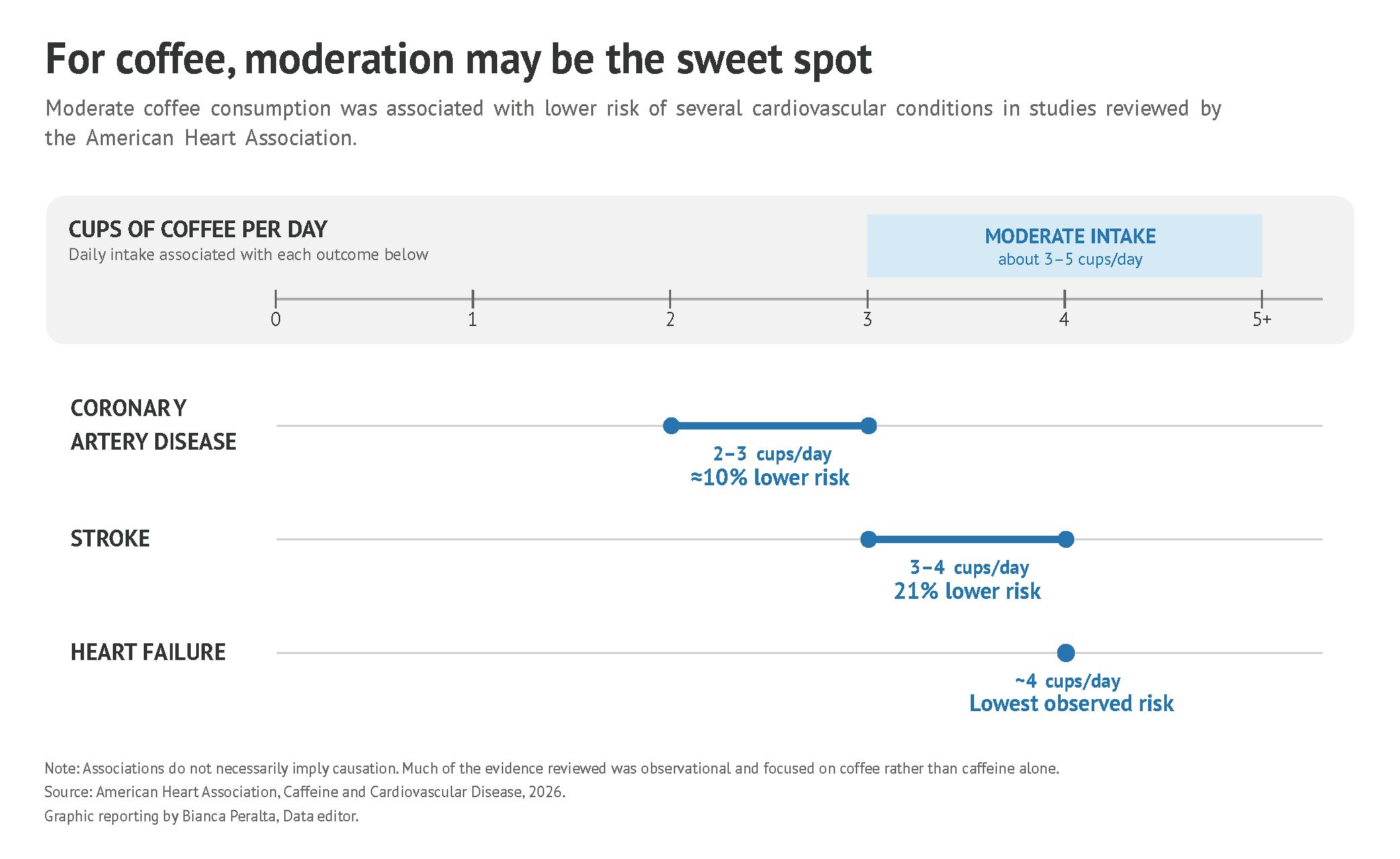
Drinking the recommended serving of three to four cups of coffee per day has been linked, in some studies, to faster metabolisms, increased brain function and decreased cancer and Type 2 diabetes risks in consumers, said Patrick Allard, a professor in the Institute of Society and Genetics at UCLA.
However, those effects don’t apply if drinkers overdo it, Allard said. Negative side effects of excess coffee consumption can include cardiovascular issues and sleep interruption, he added.
“In toxicology, dose makes the poison,” Allard said. “We see a lower dose, a positive effect, and then as you get higher and higher, to start to get into the more poisonous toxic effect. More of a good thing is not a better thing.”
To understand how consumables like coffee impact aging, researchers – like those who authored the Harvard study – can look at modifications in a person’s DNA sequence, said Matteo Pellegrini, a professor of molecular, cell and developmental biology, medicine, and human genetics.
Pellegrini added that although a person’s DNA sequence does not change with age, observing patterns in DNA methylation – a specific type of modification – has served as a more accurate molecular representation of aging.
“Aging is complicated,” he said. “The ultimate goal is to come up with some kind of molecular test that allows you to gauge how rapidly an individual or tissue is aging, and then that allows you then to introduce either lifestyle or pharmaceutical or other kinds of interventions that would presumably slow down aging and make people live longer, healthier lives.”
Charlie Haines, a fourth-year psychobiology student, said he consumes caffeine, such as black coffee and cortados, for both academic and social reasons.
“Coffee is also great socially,” said Callie Ackerman, a fourth-year political science student. “Say you run into somebody, you’re like, ‘Oh, let’s go grab a coffee tomorrow.’ It also contributes to the environment as well – you go and sit in a coffee shop and chat for a little bit.”
Alyssa Adina James, an assistant professor in the department of anthropology at McGill University, said coffee can create unity by bringing people together in a shared environment like a coffee shop.
“Coffee became a lifestyle because it stopped being treated as a generic commodity and started being treated as a story, as something that represents our identity. It’s about who we are,” she said. “Coffee itself is something that is about geography. It’s about craft, and it’s also about history.”




Comments are closed.