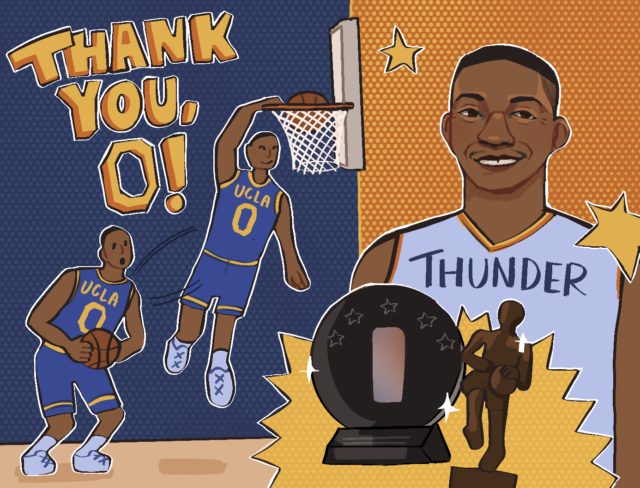
Russell Westbrook was an anomaly.
The 6-foot-4, 200-pound point guard spent 18 years in the NBA scowling at and dunking over opponents.
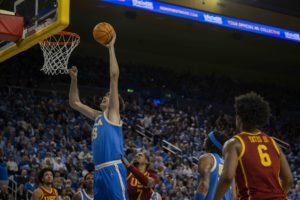
And the two seasons prior, “Russ” inflicted punishment on college rims while donning UCLA’s blue and gold.
Westbrook retired from the NBA on Aug. 12 after authoring a career that included a league MVP recognition, two All-Star MVPs and nine All-Star selections across seven teams. He is a shoo-in for the Naismith Basketball Hall of Fame and will certainly be serenaded with a jersey retirement and a statue in Oklahoma City, where he achieved the bulk of his success.
Despite the accolades, pundits and fans alike criticized Westbrook for his ball-dominant play and inability to win an NBA title, branding him a polarizing player.
But when Russ retired, I didn’t think of his accomplishments or his lack of a Larry O’Brien trophy.
I didn’t think of his league MVP title or his 209 career triple-doubles – the most in NBA history.
I thought about his passion, drive and ferocity.
I thought about my love for basketball, which he helped inspire.
And I thought about what Russ meant to UCLA – how he epitomized being a Bruin.
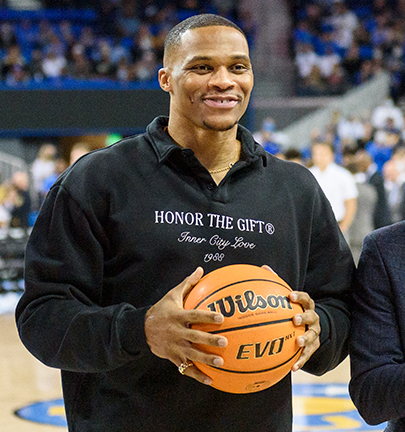
Westbrook’s career began at Leuzinger High School in Lawndale, California, where he and Khelcey Barrs, his close friend and teammate, dominated on the court and had dreams of suiting up at Pauley Pavilion and subsequently in the NBA together.
But when Barrs died from the complications of an enlarged heart in 2004, that dream came to a sudden halt. It was a moment that sculpted Westbrook’s relentless determination and work ethic. To honor his late friend, Westbrook wore Barrs’ name on his shoes and on a wristband every game during his career.
“The player he was and the person he was, he would have been one of the best players at the time in high school and moving to college and definitely going pro,” Westbrook said in a 2015 interview with Graham Bensinger. “I’ve got to come out every day, every game, every time I could to work as hard as I can to put myself in position to be the best player I can be.”
After experiencing a late growth spurt, Westbrook took the pair’s dreams to UCLA, where he became a contributor to consecutive Final Four trips during his two seasons. He showcased his explosiveness and endurance as a defender, hounding opposing guards and collecting steals and blocks. He also flashed offensive upside and an ability to improve rapidly, increasing his scoring average from 3.4 points per game as a freshman to 12.7 points per game in his second and final collegiate season.
From there, Russ was drafted fourth overall in the 2008 NBA Draft and began a career of historical achievements on the hardwood.
I first saw Westbrook play in the 2016 Western Conference Finals against the Golden State Warriors, and I was mesmerized by his intensity and inability to give in to fatigue.
Tomahawk dunks, high-stepping into pull-up jump shots and splitting double teams to take off toward the rim were some of the many moves Westbrook pulled off on a nightly basis. And despite his acrobatics and highlights, Westbrook never showed the slightest hint of a smile.
Put simply, the point guard appeared to be a battery without a battery life.
After the departure of teammate Kevin Durant for the Golden State Warriors in the 2016 offseason, Westbrook put the world on notice with the motto “Why not” and averaged 31.6 points, 10.7 rebounds and 10.4 assists per game en route to MVP honors.
Westbrook routinely authored 30-, 40- and 50-point games with an unprecedented 41.65% use that season, still the highest percentage in league history.
And he never seemed tired.
I was hooked.
I wanted to jump like Russ, move like Russ, feel like Russ on the basketball court.
I recall sporting Legarza wristbands on the basketball court to mimic Russ. The summer before my seventh-grade year, I ran hills daily in an attempt to mirror his explosiveness.
After hours on the basketball court, I spent summer evenings watching Westbrook’s pickup highlights at the Rico Hines runs at UCLA’s Student Activities Center.
Westbrook taught me what it meant to display hunger for a craft.
It meant making choices conducive to success even when the circumstances may indicate otherwise. Russ played 81 games in 2017 despite carrying – quite literally – the highest burden of any player in the history of the league.
As I transitioned from professional basketball aspirations as a middle schooler to dreams of becoming a physician, I frequently thought about Westbrook’s unfazed attitude to challenges and how they applied to my next pursuit.
“I say ‘Why not’ to everything,” the point guard said.
In an era where we often compare ourselves to others and seek external validation, Westbrook’s attitude stands out. As a 6-foot-4 point guard with limited shooting ability in the 3-point era, the odds were stacked against him.
But he etched his name on the game in his own way.
Instead of comparing ourselves to others, we can chase challenges and push our own envelopes.
Russ made his mark at UCLA in his own way. He began as a defensive weapon and grew into an offensive threat. He returned during summers to hone his craft. And he continued paying it forward, making historic financial contributions to the school that helped launch his career.
Westbrook represents loyalty and persistence over everything – an unwillingness to compromise on one’s deepest goals.
And that attitude is something I aim to carry every day as a Bruin.
Because, why not?

Comments are closed.